Follow Up Status: How to Decode “In Process,” “Under Review,” and “Not Retained” After You Apply
Stuck on follow up status after you apply? This guide explains common job portal statuses and exactly what to do next—plus a review-first way to track each application step.
Free Chrome extension
Track all your applications in one place
JobWizard auto-tracks status changes across Workday, Greenhouse, and every major job site — free.
You applied on Monday and the portal updated overnight—but follow up status now shows a vague label like “In Process” or “Under Review.” You want to know whether you should email today, wait longer, or pivot your applications.
This guide translates the most common job application statuses into plain-English actions, then shows you a track-and-follow-up workflow you can reuse so your next message is timely and specific.
What does “In Process” mean for my job application?
In Process usually means your application is actively moving through the hiring pipeline—screening completed or underway. It’s a better sign than “Pending” but it’s not the same as “interview scheduled.”
Because “In Process” can mean different internal stages, your goal is to treat it as “in motion” and manage follow-up timing. Don’t send multiple messages quickly—use a single follow-up at an interval that matches how long you’d expect that pipeline step to take.
Key takeaway: “In Process” = movement, not a guarantee. Follow up once, then focus on other aligned roles until you get a clear signal.
- Do: note the date the status changed and set a follow-up reminder.
- Don’t: assume interview approval—keep your message low-pressure.
- Use this cue: if the posting is still open, it’s normal for the process to take time.
What does “In Progress” mean in Workday or other applicant systems?
In Progress generally indicates the application has been accepted for review and is part of the active workflow. In Workday-like systems, that wording often maps to the company’s internal process steps.
The practical takeaway is the same: you don’t need to chase instantly. Instead, decide whether your next message should be a status check-in (light) or a value-added note (slightly more specific), based on whether you’ve already contacted anyone.
Key takeaway: Treat “In Progress” as “active review.” One follow-up and smart tracking beat frequent checking.
- Label the stage: screening/review vs decision.
- Choose one action: wait, or send one concise email.
- Track the outcome: update your tracker with the date and wording.
What does “Under Review” mean and what should I do?
Under Review typically means someone is looking at your resume and answers. This is when a well-timed, relevant follow-up can help—especially if you add one concrete detail.
If you have a portfolio link, a project outcome, or a short accomplishment that matches the job description, you can reference it without rewriting your entire history. Keep the message short: role, brief reminder, one value point, and a question about next steps.
Key takeaway: “Under Review” is your window for a polite, value-added check-in.
Copy-paste follow-up email (status unchanged after review starts)
Subject: Follow up on [Job Title] — Application submitted [Date]
Hello [Hiring Team Name/Recruiter Name],
I’m following up on my application for the [Job Title] role submitted on [Date]. My background in [1 relevant skill/area] closely matches what you’re looking for, especially [one specific example tied to the posting].
If it’s helpful, I’m happy to share additional context or work samples. Is there an updated timeline for next steps?
Thank you for your time,
[Your Name]
[Phone] | [LinkedIn/Portfolio]
- Do: add one relevant detail that’s easy to skim.
- Don’t: send a long attachment list or multiple follow-ups in a day.
What does “Pending Approval” mean after I apply?
Pending Approval usually suggests your application hasn’t fully entered the hiring workflow yet—often due to internal checks or approvals within the system.
This status is common when an application needs to be processed, confirmed, or categorized. Your best approach is patience plus preparation: make sure your contact information is correct, your resume is final, and your follow-up timing isn’t too aggressive.
Key takeaway: “Pending Approval” often means “not yet active.” Wait and confirm your details rather than escalating.
- Do: verify the email/phone you provided.
- Wait: use your tracker to time a single follow-up after the next reasonable window.
What does “Application Viewed” mean, and does it mean I’m shortlisted?
Application Viewed typically means a recruiter or hiring manager opened your application. That’s a positive signal, but it still doesn’t confirm an interview.
Think of this as: “someone saw it.” Your follow-up can be a helpful nudge that makes the next step easy. Ask a simple question about next steps or whether they need anything else (without demanding a response).
Key takeaway: “Application Viewed” = interest signal. Follow up once, keep it brief, and be actionable.
- Wait for a sensible interval: don’t message immediately.
- Be specific: reference the role and one fit point.
- Offer next step: “happy to discuss” or “share samples.”
What does “Not Retained” mean on a job portal?
Not Retained generally indicates your application was not moved forward at that time. It’s a disappointment, but it’s also useful feedback.
When you see this, don’t keep emailing the same recruiter to reopen the process. Instead, treat it as data: did your resume emphasize the right responsibilities, skills, and outcomes? If the posting is still active, consider applying again only if you have a genuinely improved, targeted version.
Key takeaway: “Not Retained” is usually a close-out. Use it to sharpen your next application.
- Do: update your resume keyword alignment and adjust your cover letter angle (if you use one).
- Don’t: assume a glitch—move forward with new targets.
What does “Dispositioned” mean, and should I assume the outcome?
Dispositioned is a status you’ll often see in systems that explicitly record an application’s end-of-cycle decision. It can mean “not moving forward,” “closed,” or another final label depending on the portal.
If “Dispositioned” appears, your best action is to interpret it as a decision stage and stop repetitive follow-ups. If you want closure, send one polite email asking whether there’s anything else you can provide—otherwise, redirect to new applications.
Key takeaway: “Dispositioned” implies a decision. Keep your final message polite—or move on.
- Do: interpret it as closure unless the portal provides an alternate next step.
- Don’t: keep checking for changes that may never come.
What does “Under Consideration” mean vs “Under Review”?
Under Consideration often sounds like a broader evaluation phase, while “Under Review” can imply the resume/material review step specifically. Both can be positive; the wording difference doesn’t always map cleanly across companies.
To avoid overthinking, anchor on the action: you’re waiting for a decision stage. Use your tracker to keep the follow-up window consistent, and only adjust if the portal moves to a clearer next step (like interview scheduling or a final disposition).
Key takeaway: Don’t over-interpret wording—use stage labels to time one high-quality follow-up.
| Follow up status wording | Plain meaning (most common) | What to do next |
|---|---|---|
| In Process / In Progress | Application is actively moving through pipeline | Track the date; plan one follow-up at a reasonable interval |
| Under Review | Recruiter/hiring team is examining your application | Send a short, value-added follow-up after a suitable wait |
| Application Viewed | Someone opened your application | Polite check-in if enough time has passed; keep it brief |
| Pending Approval | Not fully entered into active workflow yet | Be patient; verify contact details and set a later reminder |
| Not Retained | Not advanced at this time | Stop repeated follow-ups; improve targeting and apply elsewhere |
| Dispositioned | Application reached a decision/closure state | Consider a final polite note or move on |
| Under Consideration | General evaluation phase | Use one timed follow-up; continue applying in parallel |
Key takeaway: Treat the status as a stage, not a prophecy. Your action is the same: track, wait appropriately, and send one clear, helpful message.
How do you track follow up status without losing context across multiple applications?
Tracking follow up status works best when you connect each role to its date, its wording, and your next planned action. Without that, you’ll either follow up too early or miss the perfect moment.
Start with a simple structure: one row per application, and one note field for what you said last time. That prevents duplicate emails and helps you tailor future messages when the portal finally updates.
Key takeaway: A tracker is only useful if it stores “what happened” and “what you’ll do next.”
- Create columns: company, role, portal status wording, last updated date, next follow-up date, last contact message.
- Use a single source of truth: whichever tool you choose, keep updating it consistently.
- Link the stage to your action: e.g., “Under Review” → value-added check-in; “Not Retained” → stop messaging.
For a full system you can copy, see How to Track Job Applications: A Practical System (JobWizard + Beyond) and the lighter-weight setup in Job Application Tracker Google Sheets: Build a Status + Follow-Up System You’ll Actually Use.
Can JobWizard help you manage follow up status with a review-first workflow?
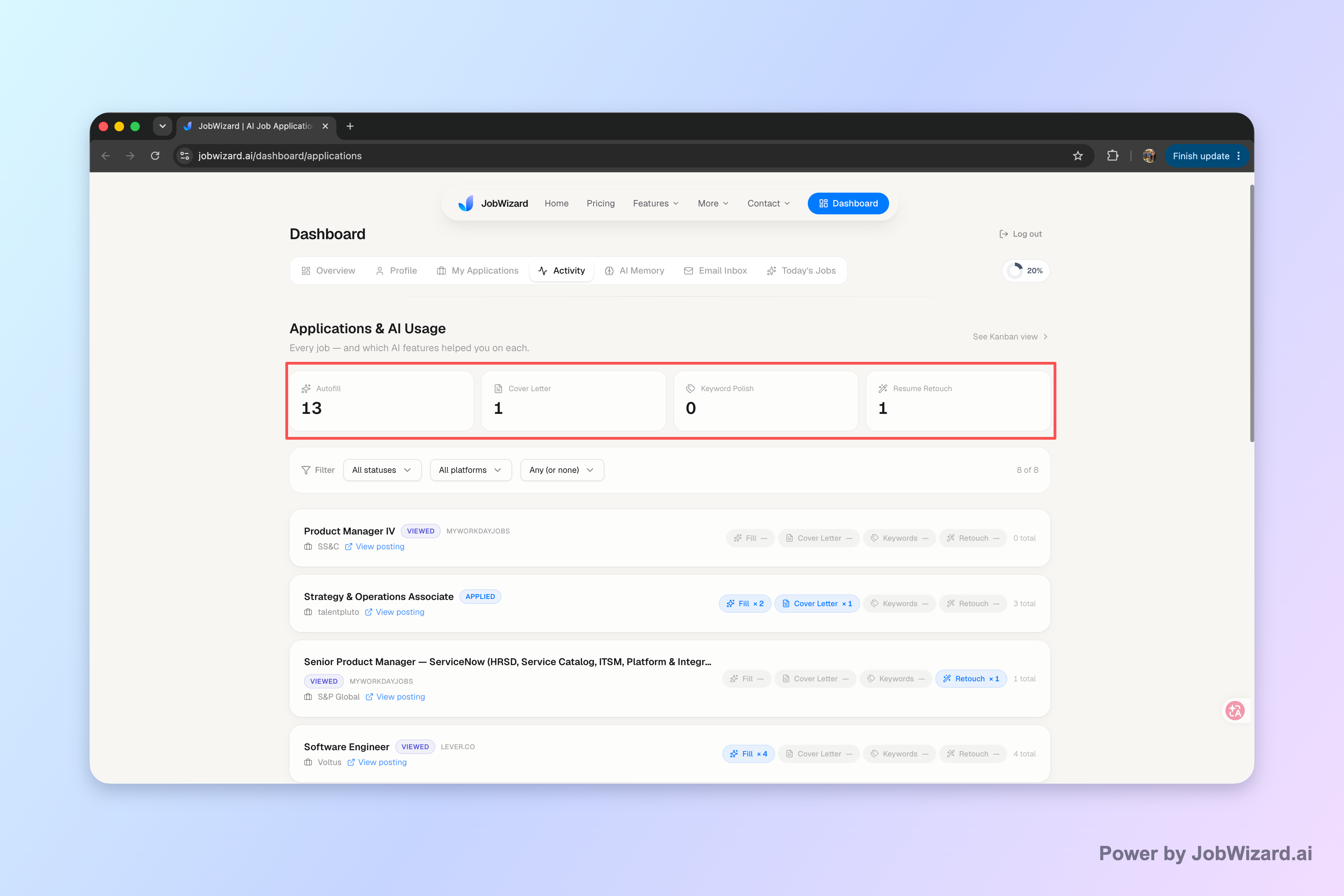
JobWizard helps you keep the rest of your job search organized by centralizing application activity and the tools you used along the way, so you can review and act with clarity.
The Activity view shows application status and which JobWizard tools were used for each role. That’s useful when you’re juggling multiple applications and trying to decide whether your next message should be a status check-in or a pivot to new targets.
Key takeaway: The goal isn’t blind automation—it’s “autofill + review-before-submit,” then keep each role’s next step visible in one place.
If you want to understand how this maps to speed without losing control: JobWizard usage shows 720,000+ applications submitted and 600,000+ autofill sessions run through JobWizard, with autofill filling an average of about ~18 repetitive fields per application (typically 11–23). Across those submissions, about ~65% are on Workday, ~19% on Greenhouse, ~12% on Ashby, and ~4% on Lever—Workday tends to be where it saves the most time. In all cases, users still review before submitting, especially for sponsorship/salary/EEO/custom questions.
- How this helps follow-up decisions: you can see where the application stands and what happened when, without guessing.
- How it fits your process: track status → draft next action → review before sending.
If you prefer a simpler checklist-first approach, you can also use Job Tracker App Free: A No-Fluff System to Track Application Status and Follow Up alongside your follow-up email templates.
Do this automatically with JobWizard
Skip the manual work — JobWizard's Application Tracker handles this for you.
FAQ: Follow up status questions job seekers ask most
What does “In Process” mean for my job application?
“In Process” usually means your application is moving through the company’s internal pipeline—often screened and ready for the next step. Use it as a cue to keep tracking your follow up date, but don’t pester until you’ve waited long enough for that stage to progress.
What does “Under Review” mean and what should I do?
“Under Review” generally indicates a recruiter or hiring team is looking at your materials. Your best next action is to prepare a concise follow-up that references the role and adds a small value point (e.g., a relevant project), then send it after a reasonable interval.
What does “Not Retained” mean on a job portal?
“Not Retained” typically means your application was not advanced at this time. If the portal doesn’t offer next steps, shift your effort to other roles and use the status as data for improving your resume match.
If my status says “Application Viewed,” should I follow up?
“Application Viewed” often means someone looked at your application, but it doesn’t guarantee an interview. You can follow up—politely and briefly—if enough time has passed, and your message should make it easy for them to say “next step” (screening call, portfolio review, etc.).
How often should I check my follow up status without hurting my chances?
Check only on a predictable cadence (for example, once or twice per week) and avoid repeated messages that don’t add new information. If you’re not seeing updates, your time is usually better spent tailoring and applying to roles with stronger alignment.
Can a tool automatically track follow up status for me?
A tracker can centralize your roles, statuses, and next follow-up dates—but you should still review what’s happening in each application and submit anything that requires your judgment. A review-first workflow helps you fill repetitive parts quickly while keeping sponsorship/salary/EEO/custom questions under your control.
What should I write in a follow-up email when the status hasn’t changed?
When nothing has changed, focus on professionalism and relevance: remind them which role you applied for, note a specific strength that connects to the job, and ask whether there’s an updated timeline for next steps. Keep it short, and avoid sounding angry or desperate.
Should I follow up differently for Workday, Greenhouse, Lever, or Ashby statuses?
The names differ by system, but the best approach is consistent: interpret the stage as “screening,” “review,” or “decision,” then follow the same principles—wait for a reasonable interval, be concise, and add value. Use the portal’s wording to decide whether your message should be a light check-in or a polite close-out.
Ready to turn follow up status into a repeatable action plan?
Follow up status gets easier when every application has one next step and a single place to record it.
Use JobWizard to centralize application activity so you can see where each role stands and what happened along the way—then send one review-ready follow-up when the timing is right.
Start by organizing your roles: track your statuses, pick your next follow-up date, and tailor your message. If you want more copy you can reuse, grab templates from Sample Follow-Up Letter for Job Application Status: 7 Templates + What to Say Next.
JobWizard CTA: Sign up and keep every application’s status and next action in one place using a review-first workflow you can trust.
Frequently Asked Questions
Track all your applications in one place
JobWizard auto-tracks status changes across Workday, Greenhouse, and every major job site — free.