How to Follow Up Your Application Status When You Don’t Hear Back (Step-by-Step)
Learn how to follow up your application status without guessing—use a repeatable timeline, status meanings, and review-before-submit follow-up emails. With JobWizard’s application tracker, you can keep every role and next step in one activity view.
Free Chrome extension
Track all your applications in one place
JobWizard auto-tracks status changes across Workday, Greenhouse, and every major job site — free.
Why is it so hard to follow up your application status after you apply?
You follow up because silence feels like a decision you can’t see—but most job seekers don’t know what each status actually means or when it’s appropriate to reach out. If you’ve applied and the portal hasn’t updated, you still need a clear next step that protects your time (and your tone).
In this guide, you’ll learn how to follow up your application status using a simple timeline, status meanings, and copy-paste email templates you can send confidently. You’ll also see how JobWizard’s application activity view can help you keep roles and follow-ups together.
What does “Application Status” actually mean (and why it varies by employer)?
Application status is the employer’s signal—shown through their own system, not a universal label. Some companies update every stage, while others only change a status at key decision points (or not often at all).
That’s why the safest approach to how to follow up your application status is not “interpret silence as rejection.” Instead, use the portal’s status labels (when available), your application date, and a calm, scheduled follow-up cadence.
Key takeaway: Treat status labels as hints, not proof—your follow-up should be brief, relevant, and based on timing.
How long should I wait before following up on my application status?
Wait long enough to respect the review window—then follow up once. If the job post includes a hiring timeline, use that as your baseline. If it doesn’t, a common approach is to follow up after about 7–14 days, then avoid sending multiple messages back-to-back.
When you follow up, keep it anchored to what the employer already knows: the role title and the date you submitted. This reduces friction for recruiters and hiring coordinators who may be scanning messages fast.
- First check: Follow up after you’ve given the team reasonable time to review.
- No pressure messages: Ask for updates on next steps, not for guarantees.
- One follow-up at a time: If you don’t hear back, wait before sending another.
Key takeaway: The goal isn’t to “catch” an update—it’s to remain visible without becoming a distraction.
What do “Viewed,” “Under Consideration,” and “Not Retained” mean in common hiring systems?
Status wording like “Viewed,” “Under Consideration,” and “Not Retained” can indicate stage changes, but you should map them to actions—not assumptions. For example, some systems treat “Viewed” as an internal visibility step, while “Not Retained” often indicates the application won’t move forward.
If you’re seeing these labels, use this practical mapping to decide whether your next move is follow-up, pivot, or both.
| Portal status you see | What it usually means | Recommended action (what to do next) |
|---|---|---|
| Viewed | Someone has seen your application in the system (not necessarily a decision). | Send a polite follow-up asking about next steps and timeline if it’s been ~7–14 days. |
| Under Consideration | Your application is in the active review pool. | Follow up once, then wait. Continue applying elsewhere in parallel. |
| Not Retained | Not selected to continue in the hiring process. | Consider focusing on new applications. If appropriate, you can send a short “future opportunities” note. |
| Under Review | Review is in progress; decision may come later. | Confirm you applied correctly, then follow up after the review window you’ve chosen. |
| In Progress | Process is moving in the employer’s workflow. | Be patient, but don’t stop tracking. Send one follow-up for next steps. |
| Pending Approval | A step requires an internal approval or workflow action. | Follow up after a reasonable interval; ask whether the approval has progressed. |
| No status change | System updates may be infrequent even if progress is happening. | Use timing-based follow-up (one message), then continue your job search. |
Key takeaway: Match your follow-up action to the label—don’t treat every status as a final outcome.
What does “Under Review” mean, and how should you follow up?
“Under Review” usually means your application is being evaluated, not that you’re automatically rejected or approved. This is where your best follow-up is short and status-aware.
When you follow up for an “Under Review” application, avoid repeating your entire resume. Instead, reference the role and ask if the team can share the next step or timeline.
- Reference the role: Include the exact job title from the posting.
- Keep it brief: 2–4 sentences is usually enough.
- Ask for next steps: “If there’s any update on timelines, I’d appreciate it.”
Key takeaway: “Under Review” is an invitation to ask—gently—about what happens next.
What does “In Progress” or “In Process” mean in Workday-style workflows?
“In Progress” typically signals the employer workflow is actively moving. It doesn’t tell you whether you’re shortlisted, but it’s a sign that your application is not stuck forever.
If you’re trying to figure out how to follow up your application status in this case, use your chosen interval (again, often 7–14 days) and send one follow-up that asks about next steps. Then let the process run.
For deeper status-language breakdowns across systems, see Application Under Review: What It Usually Means, How Long It Takes, and the Follow-Up Email That Fits.
Key takeaway: “In Progress” is progress—your follow-up should be a timeline request, not a pressure email.
What if your application status says “Not Retained”—should you still follow up?
“Not Retained” usually means the employer didn’t move your application forward. That doesn’t mean you did everything wrong; it often reflects fit, timing, or internal priorities.
If you want to follow up, keep it to one message that asks about future opportunities (and then move on). Use a “maintain professional visibility” tone rather than re-litigating your candidacy.
If you’re dealing with this type of label, also review Jobvite Application Status: How to Track “Viewed,” “Under Consideration,” and “Not Retained” with a Clear Follow-Up Plan for a system-specific view of those terms.
Key takeaway: After “Not Retained,” it’s okay to follow up—but prioritize new applications.
What should you do if your status hasn’t changed at all?
No change can mean nothing is wrong—it can mean updates are infrequent. Some systems only refresh at decision points, and some teams review in batches.
So, how do you follow up your application status when the portal is quiet? Use a timing-based message that’s easy to respond to: role title, application date, and a short “any update on next steps?” question.
- Confirm details: Make sure you applied to the exact role and used the correct information.
- Send one follow-up: Keep it concise and polite.
- Track the outcome: Record the date you followed up so you don’t duplicate efforts.
- Continue applying: Silence isn’t a reason to stop your search.
Key takeaway: Follow up to reduce uncertainty—not to replace your ongoing job search.
How do you write a follow-up email that recruiters actually read?
The best follow-ups are short, specific, and easy to answer. Recruiters may have dozens of messages—your job is to make it effortless to understand what you want.
Here’s a copy-paste template you can use right away after you apply.
Subject: Follow-up on my application for [Role Title]
Hello [Hiring Manager/Recruiter Name],
I’m following up on my application for the [Role Title] position submitted on [Application Date]. I remain very interested in the opportunity and would appreciate any update on the hiring timeline or next steps.
Thank you for your time,
[Your Name]
[Phone number] | [LinkedIn URL]
For more templates and status-aware messaging, pair this with Application Under Review: What It Usually Means, How Long It Takes, and the Follow-Up Email That Fits so your email matches the label you’re seeing.
Key takeaway: Write for speed and clarity—your follow-up should be answerable in seconds.
How can an application tracker help you follow up your application status without losing track?
An application tracker prevents duplicate follow-ups and missing the right moment. Instead of relying on memory, you log the role, the status you saw, and the follow-up date(s).
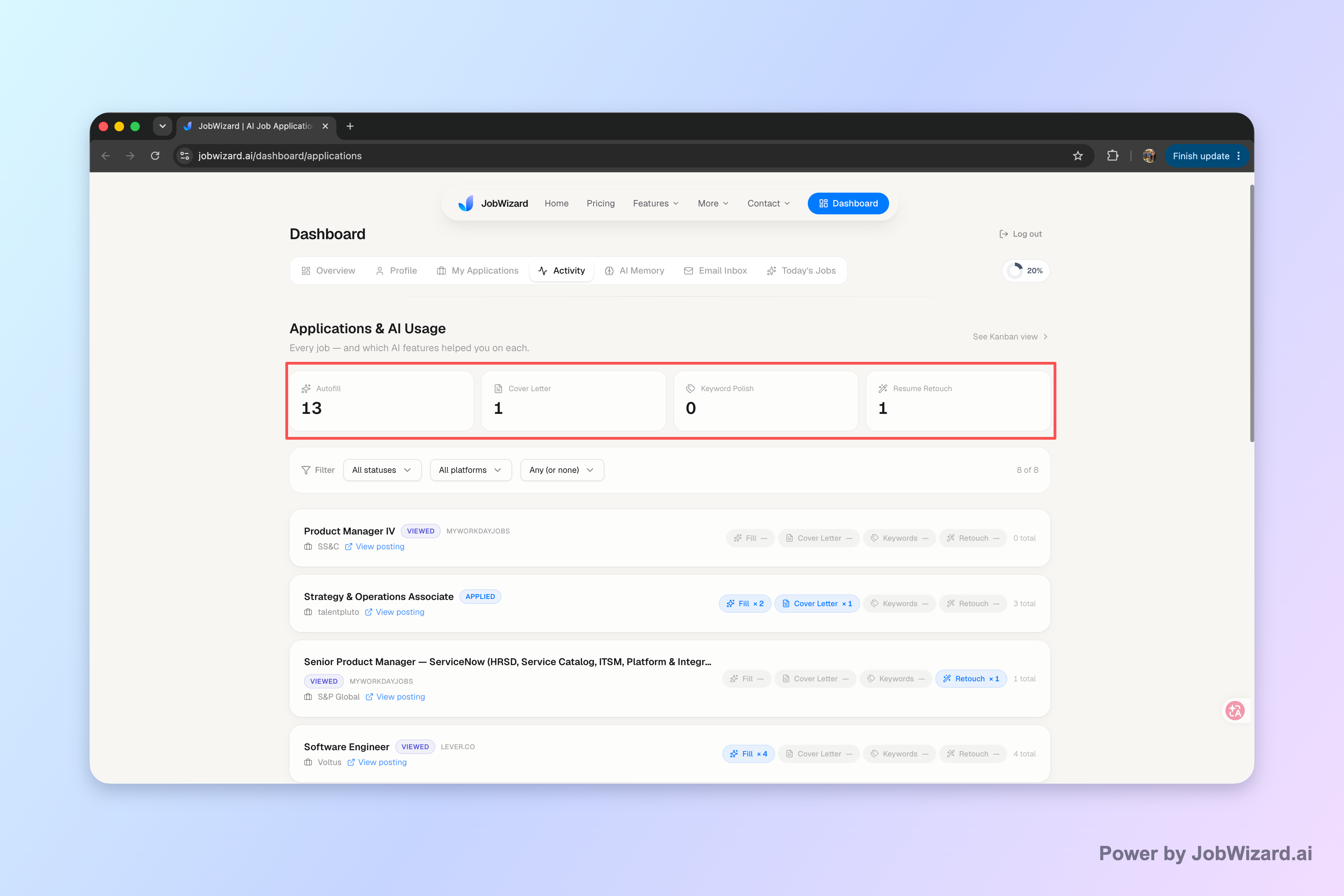
JobWizard’s application activity view is built for this exact workflow: it shows application status and which JobWizard tools were used for each role, so you can stay organized while you decide what to do next.
You’ve likely heard advice like “just check the portal,” but tracking does more than remind you—it helps you connect status updates to your follow-up history.
- One activity view: Keep each application and next step together.
- Fewer surprises: Know when you already reached out.
- Review before submit: Ensure sponsorship, salary, EEO, and custom questions are reviewed by you before you submit.
Key takeaway: When you track, you can follow up intentionally instead of repeatedly by accident.
How do I track application status consistently across multiple job boards and systems?
Consistency is the advantage—use the same tracking rules everywhere. Even if you apply through different portals, your system can stay the same: record the role, status, and follow-up dates.
To compare trackers and workflows, start with How to Track Job Applications: A Practical System (JobWizard + Beyond). If spreadsheets work better for you, also use Google Sheet Job Application Tracker That Actually Keeps Your Follow-Ups Straight (Template + System) for a structured option.
And if you’re specifically working with Workday-style or Jobvite-style status labels, keep those mappings handy by revisiting Jobvite Application Status: How to Track “Viewed,” “Under Consideration,” and “Not Retained” with a Clear Follow-Up Plan and Application Under Review: What It Usually Means, How Long It Takes, and the Follow-Up Email That Fits.
Key takeaway: Tracking is a process—make it repeatable across every portal you use.
Do this automatically with JobWizard
Skip the manual work — JobWizard's Application Tracker handles this for you.
FAQ about following up your application status
How long should I wait before following up on my application status?
Wait long enough that the employer has had time to review the application, then follow up once using a brief, polite message. If the posting lists a timeline, use that as your baseline; otherwise, pick a reasonable interval (commonly about 7–14 days) and then check again only after you’ve sent your follow-up.
What should I do if my application status says “Under Review” or “In Progress”?
If it’s marked “Under Review” or “In Progress,” the best move is to confirm you’ve tracked the role, verify the job details you applied with, and prepare one follow-up message that asks for an update without sounding impatient.
What does “Not Retained” mean, and should I follow up?
“Not Retained” usually means the employer didn’t move your application forward for consideration. You can still follow up politely for future opportunities, but treat it as a sign to focus on new applications and keep your tracker updated.
How do I follow up if the status hasn’t changed at all?
If nothing changes, don’t assume it’s bad—some systems update infrequently. Send a short follow-up referencing the role and date you applied, and then keep the cadence consistent (one follow-up at a time) while you continue applying to other roles.
What’s a good follow-up email template after I apply?
Use a concise subject line, restate the role and approximate application date, and ask if they can share any update on next steps. Keep it under a few short sentences and make it easy to respond, like: “Hello [Name], I’m following up on my application for [Role] submitted on [Date]. I remain very interested—could you share whether there are any updates on the hiring timeline or next steps?”
How can JobWizard help me keep track of application status during follow-ups?
JobWizard includes an activity view that shows application status and which JobWizard tools were used for each role. That helps you keep your follow-ups organized and review-before-submit your answers, rather than guessing what you already submitted or whether you need to follow up again.
Do I need to follow up if I already sent a message?
Not immediately—stick to a single follow-up first, then wait before sending another. If the portal provides a status update after your follow-up, you may not need another note until a new stage appears or the timeline passes.
Will tracking guarantee I hear back?
No. Tracking helps you follow up correctly and stay organized, but it can’t control employer decisions. Focus on sending a professional follow-up at the right time while continuing to apply and refine your materials.
Ready to follow up with confidence? Keep every role in one activity view
Use JobWizard to track application status and your next move in one place—so you know what you already submitted, when you followed up, and what to do next for each role.
Start with your existing workflow, then keep each application and its next step in a single activity view—so your follow-ups are intentional, not guesswork.
Frequently Asked Questions
Track all your applications in one place
JobWizard auto-tracks status changes across Workday, Greenhouse, and every major job site — free.