Application Under Review: What It Usually Means, How Long It Takes, and the Follow-Up Email That Fits
If you’re seeing “application under review,” you’re not alone. This guide explains the most common ATS meanings, what to do next, and how to follow up without guessing.
Free Chrome extension
Track all your applications in one place
JobWizard auto-tracks status changes across Workday, Greenhouse, and every major job site — free.
You refreshed the job page after dinner and saw the same message again: “application under review.” You’re excited—but also stuck wondering whether you should wait, follow up, or adjust your strategy.
Use this guide to interpret application under review in a way that’s practical, not panic-driven: what it usually signals, what to do next, and a follow-up email you can copy/paste based on what your ATS shows.
How to Track Job Applications: A Practical System (JobWizard + Beyond)
What does “application under review” mean in ATS terms?
“Application under review” typically means the employer (or the ATS workflow for the employer) has started evaluating your application after you submitted it.
It’s a progress marker—not a rejection, and not a guarantee. In many systems, it simply means your application is in a queue where recruiters or hiring teams may screen, score, or route it for the next step.
Key takeaway: “Under review” is an evaluation-stage status, so your next move is usually “wait thoughtfully + track + follow up once” rather than repeatedly checking or emailing immediately.
What if my application status says “application under review” for days?
When “application under review” stays unchanged for several days, it usually indicates the employer hasn’t pushed a new status update yet—not that your candidacy is automatically dead.
Many ATS platforms update status in batches. That means you may experience long stretches where nothing appears to change, even when internal reviewers are reading.
Here’s the approach that keeps you both proactive and realistic:
- Track the date you applied so your follow-up timing is based on your timeline, not anxiety.
- Watch for any status change (even small wording shifts) and treat that as your cue to update your plan.
- Send one concise follow-up after a reasonable wait window, especially if the posting doesn’t mention a “no contact” policy.
Key takeaway: No status change isn’t automatically bad; use time-based follow-up and keep your applications moving.
How long should I wait after my application says “under review”?
A good rule of thumb is to wait a reasonable window before following up—often about 7–10 business days—unless the job post lists a specific hiring timeline.
If you see another status (like “in process” or “pending approval”), update your expectations accordingly. When you can’t confirm exact timing, you’ll get the best results from consistency: one follow-up, well-written, and relevant.
Key takeaway: Don’t follow up at day 1; don’t assume silence forever. Pick one timing window, then follow up once.
What’s the difference between “under review” and “under consideration”?
“Under consideration” generally reads like the recruiter has your application in a candidate review workflow and is actively considering you.
Depending on the ATS, “under review” and “under consideration” may be close in meaning. Practically, the difference is usually about tone, not action: both point to evaluation rather than “finished” outcomes.
Recommended action:
- If it’s still under review/consideration: wait, track, and follow up once after enough time has passed.
- If it moves to next-stage wording: adjust your follow-up to match the new stage and, if relevant, prepare for potential interview steps.
Key takeaway: Treat both as “still in the evaluation funnel” unless the ATS moves to a different stage.
What does “application viewed” mean?
“Application viewed” usually means someone inside the hiring process has opened or accessed your submission.
This is a positive signal because it suggests the file reached a human reader (or at least that the system recorded an access event). However, it still doesn’t guarantee an interview.
Recommended action:
- Wait for the next status change if the employer tends to update frequently.
- Follow up once if enough time has passed and you haven’t heard back, keeping your note short and specific.
Key takeaway: “Viewed” can be good news—still, your safest move is one targeted follow-up, not a flood of messages.
Does “in process” mean I’m closer than “under review”?
“In process” typically indicates the application has progressed into a workflow stage beyond initial screening—often closer to active evaluation or internal routing.
The exact meaning varies by ATS. That’s why it helps to treat status wording as a “directional signal,” not a perfect timer.
If you want a deeper breakdown of the exact status language that can appear after applying, start here:
Follow Up Status: How to Decode “In Process,” “Under Review,” and “Not Retained” After You Apply
Key takeaway: “In process” generally means progress—use it to justify a follow-up timeline, not to jump to assumptions.
What does “not retained” mean after I applied?
“Not retained” typically means the employer did not keep your application for further consideration.
When that happens, the best move is usually not another follow-up email to the same role—it’s to learn from the situation and redeploy your effort to roles where you’re more likely to move forward.
Recommended action:
- Check whether the job posting has alternative roles that match your background better.
- Update your resume and answers if you notice recurring gaps (skills, scope, seniority alignment).
- Keep applying so one “not retained” doesn’t stall your momentum.
Key takeaway: “Not retained” is a signal to pivot—not to keep negotiating your candidacy via repeated follow-ups.
Can “application under review” be a good sign?
Yes—“under review” can be a good sign because it implies your application has passed a minimal submission step and is in evaluation.
But the real question is what you do with that signal. A status alone can’t tell you how competitive you are; it can only tell you where you are in the process.
Is Application Under Review a Good Sign? What Each ATS Status Really Means (and When to Follow Up)
Key takeaway: Use “good sign” energy for actions: track, wait appropriately, and follow up once with a strong, relevant message.
What should I do next after my application status becomes “application under review”?
After you see “application under review,” your next steps should be lightweight but disciplined: track, prepare, and schedule one well-timed follow-up.
Think of this as a two-track plan: one for progress (statuses and timing) and one for readiness (your materials and outreach).
- Confirm the submission details (role title, date, and any custom answers you provided).
- Track the status and last outreach so you don’t double-message the recruiter or email too early.
- Prepare a short follow-up note that references your interest and highlights 1–2 relevant strengths.
- Keep applying so you’re not waiting on one outcome while hiring teams move.
Key takeaway: “Under review” is a waiting stage—your advantage is structure: timing + tracking + readiness.
How do I interpret “application under review” vs “application submitted” in the same portal?
“Submitted” usually means the ATS received your application. “Under review” generally means it has moved into evaluation.
When portals show multiple stages, you’ll often see a progression: submitted → under review → in process/under consideration → interview/hired/closed outcomes. Your job is to treat each step as new information.
| ATS wording | What it often means | Recommended action |
|---|---|---|
| Application submitted | The system received your application. | Start your tracking timeline; don’t follow up immediately. |
| Application under review | Your application is in evaluation/screening workflow. | Wait a reasonable window; follow up once if no updates. |
| Application viewed | Someone opened or accessed your application. | Be patient; follow up once if enough time has passed. |
| In process / In progress | Your application has progressed into deeper workflow stages. | Update your plan; prepare for potential next steps. |
| Under consideration | Recruiters/hiring team is considering you for roles. | Track and follow up once; keep applications active. |
| Not retained | Your application wasn’t kept for further consideration. | Pivot and apply to better-matching roles; avoid repeated follow-ups. |
Key takeaway: Map each status to an action level: track, wait, follow up once, or pivot.
How do I track my application status without losing where I am?
Tracking is how you stop guessing—and it’s the difference between a well-timed follow-up and an accidental “wrong moment” message.
JobWizard supports an application tracker approach through an Activity view that shows application status and which JobWizard tools were used for each role. This keeps your next step attached to the correct job, so you don’t follow up from memory.
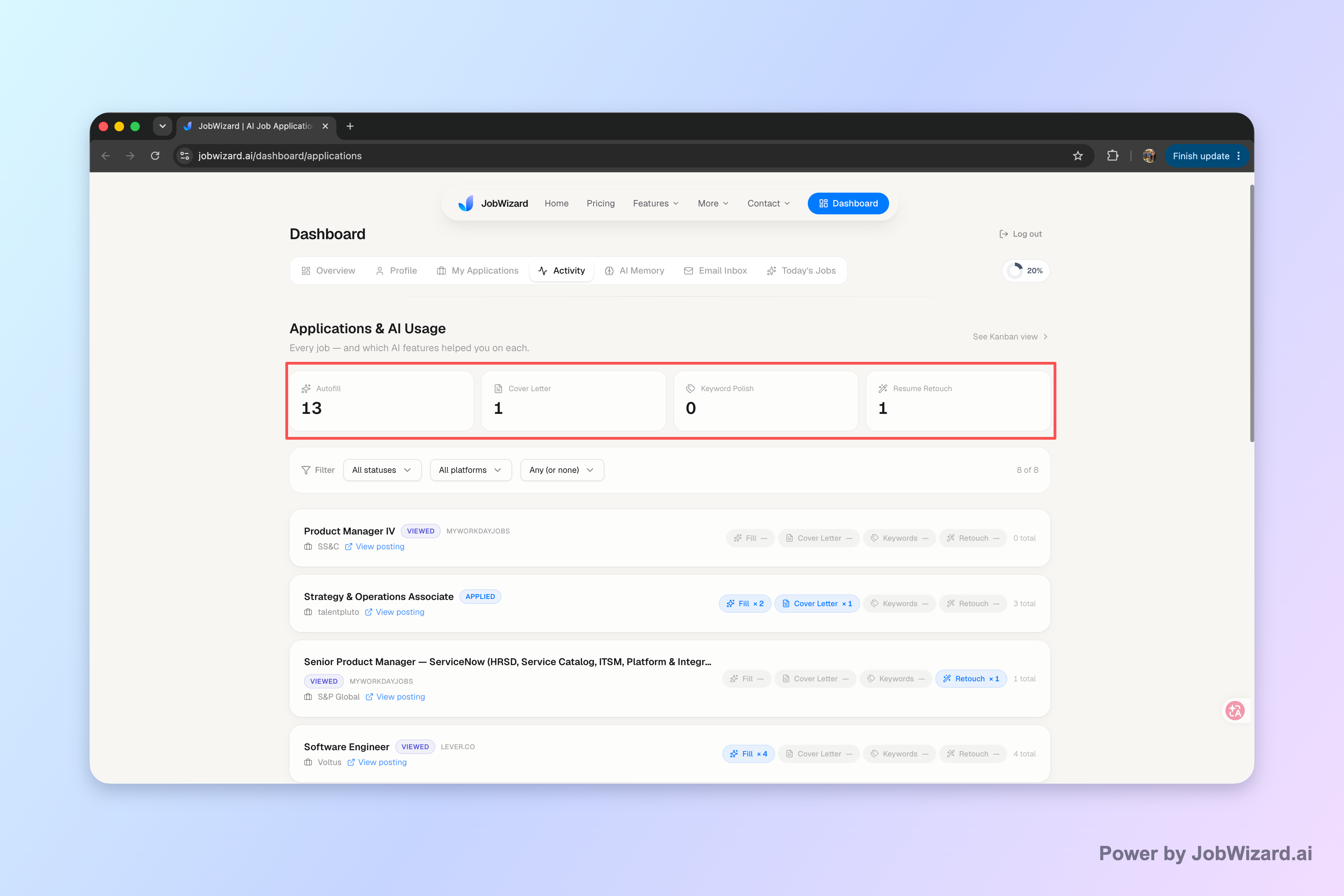
Activity view = clarity. You can use it to confirm your latest status, review your workflow, and decide whether it’s time to follow up—without mixing up dates across roles.
- Track by role, not by “how it feels.”
- Record the last outreach so your follow-ups are spaced and purposeful.
- Match follow-up to status (“under review” gets a different tone than “not retained”).
Key takeaway: When you track applications well, your follow-up becomes a decision—not a reaction.
When should I send my follow-up email if my application is under review?
Follow up when it’s been long enough for evaluation to plausibly happen and you haven’t received updates—often after about 7–10 business days.
Then send a short message that adds value: reaffirm your interest, connect your background to the role, and ask whether there’s anything else they need. Keep it professional, not persistent.
If you want a status-first interpretation, also read:
“Application Under Review Meaning”: What It Really Signals (and What to Do Next)
Key takeaway: One follow-up email, written specifically, at the right time—then stop and wait.
Copy-paste follow-up email for “application under review” (short + effective)
Use this template when your status is still “application under review” and you’re following up after a reasonable wait.
Subject: Follow-up on [Job Title] application (Submitted [Date])
Hi [Hiring Manager/Recruiter Name],
I hope you’re doing well. I’m following up on my application for the [Job Title] role submitted on [Date]. I’m very interested in the opportunity and believe my experience in [1–2 relevant skills/areas] aligns well with what you’re looking for.
If there’s any additional information I can provide to support my candidacy, I’d be happy to share. Thank you for your time and consideration.
Best regards,[Your Name][Phone Number][LinkedIn or Portfolio]
Quick customization tips:
- Replace bracketed parts with role-specific details you already have.
- Keep it to 5–7 sentences; recruiters skim.
- Don’t re-attach your resume unless the posting asked for it again.
Key takeaway: Your email should confirm interest, show alignment, and make it easy to respond—without sounding like you’re demanding an update.
How should my follow-up change if the status shifts to “in process” or “not retained”?
Your follow-up should match the stage, because the message you send signals how you interpret the hiring workflow.
If it changes to “in process”
Keep it short and slightly more “supportive” than “checking.” You can mention you’re excited and ask if there’s a next step you can prepare for.
If it changes to “not retained”
Don’t push for reconsideration via multiple emails. If you choose to respond, do it once with professionalism and an ask for guidance only if the employer explicitly invites replies. Otherwise, pivot to new targets.
Key takeaway: “In process” = follow-up as a nudge; “not retained” = pivot your strategy.
Can JobWizard help while you’re waiting for “application under review”?
Yes—JobWizard can help you stay organized while you wait, so you can follow up at the right time and keep your pipeline moving.
JobWizard autofills repetitive fields per application, but you review the content before submitting, including role-specific details like sponsorship/salary/EEO/custom questions. That “autofill + review-before-submit” workflow can reduce the tedium of applying repeatedly, while keeping you in control of what gets sent.
Verified usage context: JobWizard has supported 720,000+ applications submitted and 600,000+ autofill sessions. On average it autofills about ~18 repetitive fields per application (typically 11–23). For platforms, about ~65% of applications are on Workday, ~19% on Greenhouse, ~12% on Ashby, and ~4% on Lever.
Key takeaway: Use automation to reduce repetitive work, and use your tracker to decide when to follow up—especially when you see “application under review.”
Do this automatically with JobWizard
Skip the manual work — JobWizard's Application Tracker handles this for you.
FAQ about “application under review”
How long should I wait after my application says “under review”?
Generally, treat “application under review” as an early stage of evaluation: wait a reasonable window (often about 7–10 business days) before following up, unless the job post gives a different timeline or you see another clearer status change.
Does “application under review” mean I will get an interview?
Not necessarily. It usually means the employer has started evaluating your application, but it doesn’t guarantee an interview—your next best signal is whether the status moves forward (e.g., “in process”) or you receive a direct response.
What if my status changes from “under review” to “not retained”?
“Not retained” typically means your application wasn’t kept for further consideration. The best move is to save any feedback you have (if provided), adjust your resume/answers if you reapply elsewhere, and keep submitting to fresh roles rather than re-following up on the same opening.
Should I follow up if my application status never changes?
Yes, but do it strategically. If the role is still open and your application is “under review” with no updates, send one concise follow-up after a reasonable wait; avoid repeated emails that don’t add new value.
How do I track my applications so I don’t follow up at the wrong time?
Use an application tracker to tie each role to its latest status and your last outreach. In JobWizard’s Activity view, you can see application status and which JobWizard tools were used for each role—then you review-before-submit any changes before reaching out again.
Can I use “autofill” to submit applications while I’m waiting for “under review”?
Yes—if you use autofill to complete repetitive fields, but always review the sponsorship/role-specific details (like custom questions) before submitting. JobWizard autofills repetitive fields quickly while you review before you hit submit.
What’s the difference between “under review,” “in progress,” and “in process”?
They’re often similar early evaluation stages, but the exact meaning can vary by ATS/vendor. If you see “in process” or “in progress,” treat it as a sign your application is moving through internal workflows; the safest next step is to follow your tracker’s timeline and send a single follow-up if enough time has passed.
Next step: Keep your pipeline from turning into guesswork. Start using JobWizard to organize each role’s status and next action in one place—then you’ll know exactly when your next follow-up belongs after your application is under review.
Frequently Asked Questions
Track all your applications in one place
JobWizard auto-tracks status changes across Workday, Greenhouse, and every major job site — free.