“Application Status Under Review” — What It Means and How to Track Every Next Step
“Application status under review” usually means your application is in the employer’s evaluation queue. Learn what it can mean across ATSs and how to track updates, using JobWizard’s activity view.
Free Chrome extension
Track all your applications in one place
JobWizard auto-tracks status changes across Workday, Greenhouse, and every major job site — free.
You applied for a role you really want, then you watch the portal like it’s a sports scoreboard. The moment you see application status under review, you’re left wondering: is this progress—or just a long wait?
This guide breaks down what “application status under review” usually means across common ATS workflows, what to do next, and how to track everything in a simple system so you’re not guessing when to follow up.
How to Track Job Applications: A Practical System (JobWizard + Beyond) is a great place to start if you want a full tracking workflow beyond status meanings.
What does “application status under review” actually mean?
“Application status under review” generally means your application is in the employer’s evaluation stage. Most of the time, it’s not an instant “yes” or “no”—it’s a signal that the ATS and hiring team have the application and are working through it.
Because each company configures its ATS differently, the same wording can represent different internal steps. Your best next move is to treat the status as “active processing” and keep your next action tied to timing and changes you can verify.
Key takeaway: Under review usually means “being evaluated,” not “decision made.” Your job now is to track reliably and follow up thoughtfully when appropriate.
What does “under consideration” mean compared with “under review”?
“Under consideration” usually indicates your application remains in the active evaluation pool. In many workflows, it’s functionally close to “under review,” but it can imply a broader stage (review plus internal screening) rather than a single step.
If you see both statuses across different companies, focus less on the exact phrase and more on what changes after it—interview invitations, requested materials, or a disposition status like “not retained.”
Key takeaway: Under consideration is often “still in the mix.” Track for movement, not for panic.
What does “in progress” or “in process” mean in an application tracker?
“In progress” / “in process” typically means your application is actively moving through the workflow. Depending on the ATS, it may correspond to review, recruiter assignment, or eligibility checks.
Use “in progress” as a prompt to confirm your baseline details (resume, contact info, and any work authorization or location fields) are correct—then return to waiting for a status change.
| ATS status or portal phrase | What it typically means | Recommended action |
|---|---|---|
| Application status under review | Your application is being evaluated by the employer. | Wait and track; prepare a short follow-up if the timeline is past due. |
| Under consideration | Your application remains in the active evaluation pool. | Continue tracking; follow up only if it’s been long enough to be reasonable. |
| In progress / In process | The application is actively moving through workflow stages. | Confirm details are correct; do not spam follow-ups. |
| Application viewed | Someone (often a recruiter or hiring manager) has opened/checked your application. | Be ready to respond quickly if they reach out; consider a polite follow-up if it stalls. |
| Pending approval | Your application is waiting for a workflow approval step. | Track the next update; avoid aggressive follow-ups until the workflow clears. |
| Not retained / Not selected | The employer decided not to move forward for this role. | Stop investing time in that role; apply elsewhere and reuse your strengths. |
Key takeaway: Treat these as workflow stages. Your action should depend on verified movement, not guessing.
What does “pending approval” mean on an ATS?
“Pending approval” usually means the application is waiting for a workflow step to be cleared. That could be internal assignment, a recruiter’s approval to advance candidates, or compliance/eligibility checks before review begins.
For this status, the most useful approach is patience plus documentation: log the date you saw “pending approval,” and plan your next check or follow-up based on when you applied or when the role likely started reviewing.
Key takeaway: Pending approval is often a delay in process, not a negative verdict.
What does “application viewed” mean after I applied?
“Application viewed” means your profile was opened/checked in the ATS. That’s a meaningful signal that a human may have seen it, even if it doesn’t lead immediately to an interview.
The next step is to keep your materials ready: make sure your phone and email are reliable, and be prepared to answer follow-up questions quickly.
Key takeaway: Viewed is progress. It’s also not the end of the process—follow up gently if time passes.
What does “not retained” mean after I see under review?
“Not retained” typically means the employer didn’t move your application forward for that role. This can happen for reasons that aren’t about your ability—sometimes it’s role fit, keyword matching, ordering of priorities, or volume.
If you saw “under review” and then “not retained,” use it as feedback for your strategy: compare your resume and application answers to the job description language, and apply that learning to your next set.
Key takeaway: Not retained is a clear boundary for that role—shift your energy to new applications.
How can I track my application status in one place without missing updates?
A good tracker lets you see where every application stands and when it was last updated. That’s exactly what “application activity” is for: consolidating status changes, dates, and your next action so you don’t rely on memory or scattered email threads.
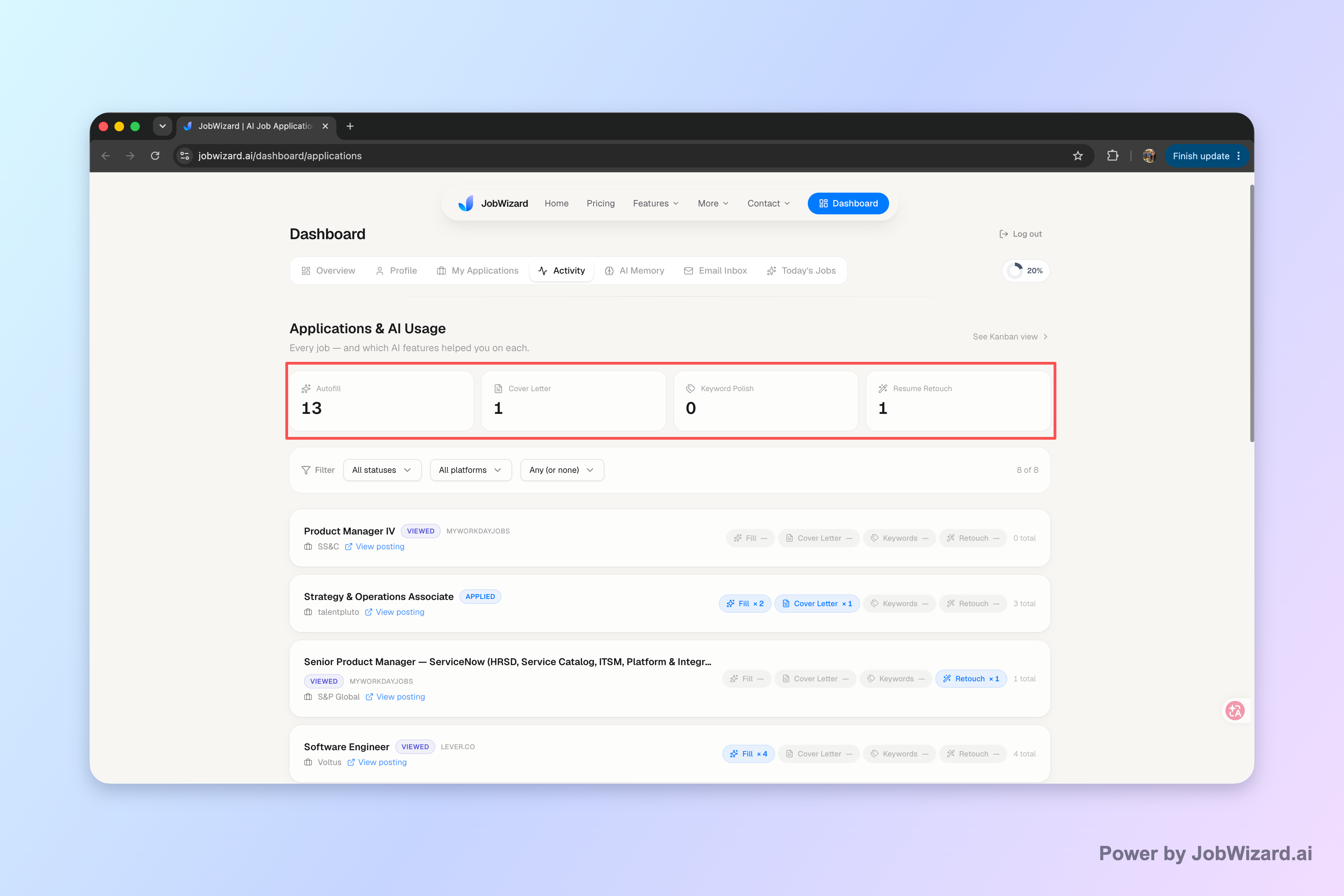
JobWizard’s Activity view shows application status and which JobWizard tools were used for each role, so you can keep your tracking organized while you manage multiple applications at once. The Activity approach is also designed to support autofill + review-before-submit—you still review and submit applications yourself, including sponsorship/salary/EEO/custom questions where applicable.
For an end-to-end system, use excel job application tracker: Build an Activity-First System for “Under Review” and Next Steps to structure dates, follow-ups, and notes so you always know what to do next.
Key takeaway: Track in one view, then act only when something changes or your follow-up window arrives.
What should I do next if my application status keeps changing?
Status changes are information—use them to update your next-step plan. When you see movement (under review → viewed; viewed → under consideration; under consideration → not retained), update your tracker immediately.
Then decide your next action using a simple rule: follow up only if (1) enough time has passed since you applied and (2) the status hasn’t changed recently.
- Update your tracker date: record the day you saw the newest status phrase.
- Recheck contact details: confirm your email/phone are correct in the application profile.
- Prepare a one-paragraph follow-up: if it’s time, ask whether they need anything else—don’t rewrite your whole story.
- Move on when rejected: if you see “not retained,” redirect effort to fresh applications.
Key takeaway: Treat each status as a checkpoint. Your tracker turns uncertainty into decisions.
How long should I wait before following up on “application status under review”?
There isn’t one universal timeline, but a reasonable waiting period helps you avoid sounding impatient. For many roles, waiting about a week or two after you see the status is a common approach—especially when the employer’s process is slower.
The key is consistency: use your tracker to know when you applied and when you saw “under review.” If you already received “application viewed,” that may justify a slightly different cadence.
Key takeaway: Follow-up timing should be based on your dates, not your anxiety.
When should I follow up if my status is “under review” vs “under consideration”?
Follow up when you’ve waited long enough for review, regardless of the exact phrase. “Under review” and “under consideration” are often both “still active” signals—your message should reflect that you’re checking in, not demanding an answer.
If you want a role-specific perspective, read Is Application Under Review a Good Sign? What Each ATS Status Really Means (and When to Follow Up) so you can align follow-up frequency with what the status usually indicates.
Key takeaway: Use the status to choose a tone: curious, concise, and respectful—not aggressive.
What follow-up email should I send after “application status under review”?
A strong follow-up is brief, role-specific, and easy to respond to. Below is a copy-paste template that works when your portal shows “application status under review.”
Follow-up email template (copy/paste) Subject: Follow-up on [Role Title] application Hi [Hiring Manager/Recruiter Name], I hope you’re doing well. I’m following up on my application for the [Role Title] role submitted on [Date]. My application status shows “under review,” and I wanted to see if there’s any additional information I can provide. If helpful, I can also share [a portfolio link / a brief work sample / confirmation of availability] for the role. Thank you for your time and consideration. Best regards, [Your Name] [Phone] | [Email] | [LinkedIn/Portfolio]
If you’re tracking across Jobvite specifically, you may also find it useful to compare phrases like “viewed” and “under consideration” with a pre-planned approach in Jobvite Application Status: How to Track “Viewed,” “Under Consideration,” and “Not Retained” with a Clear Follow-Up Plan.
- Keep it to one paragraph + one question: make it easy to reply.
- Reference the role title and application date: reduces back-and-forth.
- Offer one additional resource: a link or confirmation is often enough.
Key takeaway: Make your follow-up response-friendly. The goal is clarity, not pressure.
Do this automatically with JobWizard
Skip the manual work — JobWizard's Application Tracker handles this for you.
FAQ: Application status under review
What does “application status under review” actually mean?
It typically means the employer has received your application and is evaluating it. In many ATS workflows, you’re waiting for a decision stage (review, disposition, or next-round screening), not an instant reply.
Should I follow up if my application status is under review?
Follow up only when you have enough time for the employer’s review cycle (for many roles, that’s after about a week or two). Keep the message brief, reference the role, and ask whether they need anything else—don’t pressure for an immediate decision.
What does “under consideration” mean compared with “under review”?
“Under consideration” usually signals your application remains in the active evaluation process (often alongside others). It can be a close cousin of “under review,” but the employer may still be screening internally before any interview requests.
What does “not retained” mean after I see under review?
“Not retained” typically means the employer chose not to move forward with your application for that role. It doesn’t always mean you’re not qualified—sometimes it’s volume, matching, or timing—but it’s generally a signal to refocus on other applications.
How can I track my application status in one place without missing updates?
Use a job tracker that records each role, the exact ATS status you see, the date you applied, and any follow-up you sent. JobWizard’s Activity view is designed to show where each application stands and which JobWizard tools were used, so your tracking stays organized.
Does “in progress” or “in process” mean the same thing as under review?
Often, yes: “in progress” / “in process” generally indicates the application is moving through a workflow stage. The exact meaning depends on the ATS and the employer’s setup, so treat it as “still being processed” and track for the next status change.
How do I build an activity-first system to handle follow-ups for multiple applications?
Create an activity-first tracker: one row per role with columns for status, last update date, next follow-up date, and notes (like recruiter name or custom questions). Review the list weekly, send one follow-up per role when it’s due, and update the status/date after any response.
Ready to stop guessing and track every next step?
JobWizard helps you keep “application status under review” from turning into uncertainty by organizing your application activity in one place. Build your workflow around an activity-first job tracker, review your messages before you send, and let real status changes guide your next move.
Start with a practical tracking system, then use JobWizard’s Activity view to keep each role’s status and your next step connected.
Frequently Asked Questions
Track all your applications in one place
JobWizard auto-tracks status changes across Workday, Greenhouse, and every major job site — free.