How Follow Up Job Application Work Gets Easier: Use Application Activity to Track Next Steps
Learn how follow up job application updates with a practical job tracker system. See where each role stands and what to do next—before you send your next message.
Free Chrome extension
Track all your applications in one place
JobWizard auto-tracks status changes across Workday, Greenhouse, and every major job site — free.
How follow up job application works: start with one source of truth for status
If you’re asking “how follow up job application” because you don’t want to spam recruiters or waste time guessing, your best first move is to track the status you’re seeing and pair it with a follow-up date. The goal isn’t to “check every day”—it’s to send the right message at the right moment based on what’s actually happening.
Many job seekers lose track because applications go into different portals (and different statuses) across Workday, Greenhouse, Ashby, Lever, and company career sites. A simple job tracker helps you replace uncertainty with a plan: where each role stands, what you already asked, and what you’ll do next.
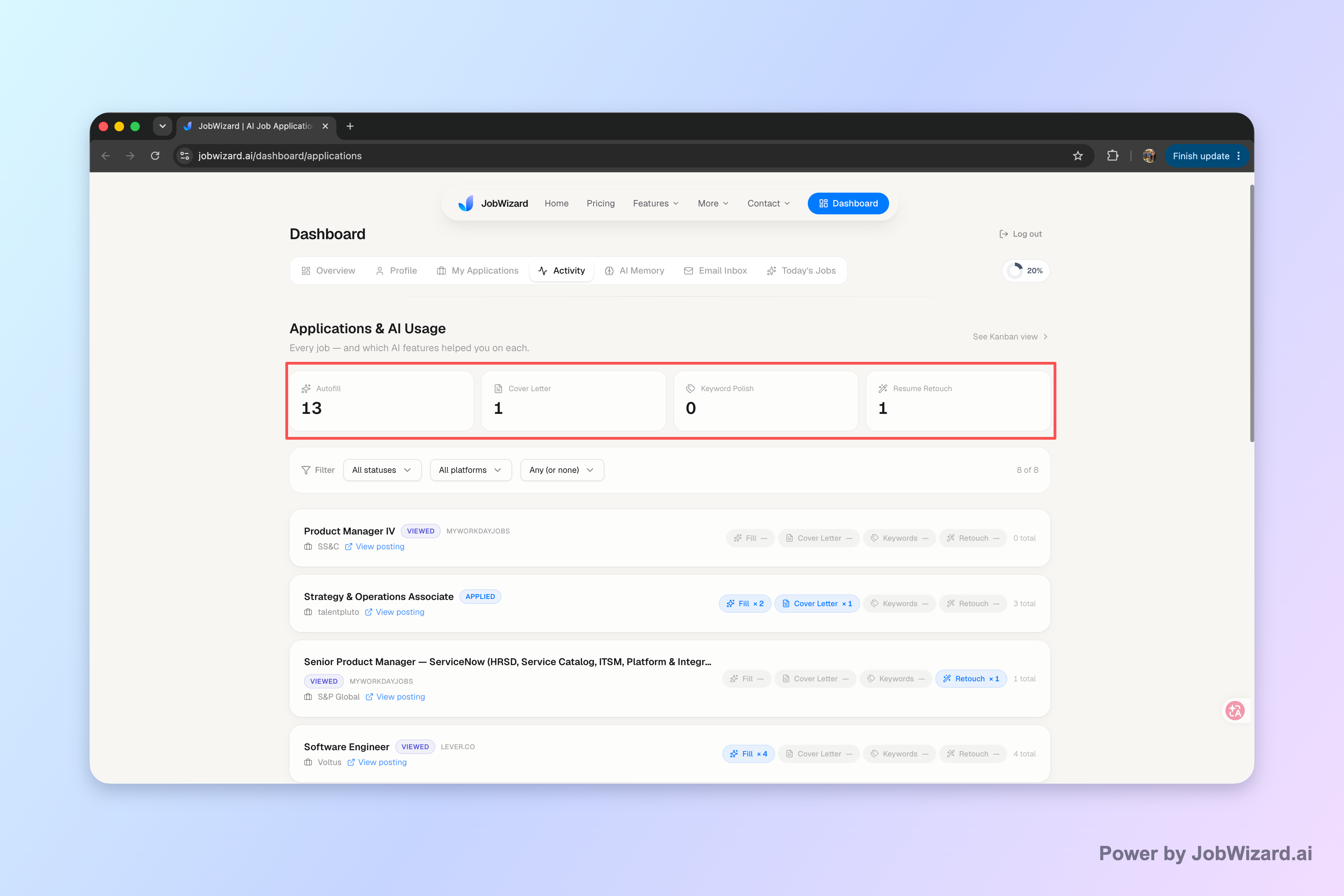
In JobWizard, the Activity view shows application status and which JobWizard tools were used for each role—so you can decide your next step without guessing.
Build a follow-up timeline that recruiters can actually follow
A strong follow-up plan balances persistence with professionalism. If you follow too soon, you look impatient; if you follow too late, you miss the window when a hiring team is actively moving applicants forward.
Use this timeline approach for most online applications:
- Submit + record right after you apply (company, role title, date, and the status you see in the portal).
- Wait 5–7 business days before your first follow-up if there’s no posted deadline or timeline.
- Send one focused message asking about next steps, not demanding an update.
- Wait again before a second check-in (only if the posting is still active or your first message didn’t produce anything).
- Switch channels thoughtfully if you have a referral, recruiter contact, or a new relevant update.
This is also where tracking stops you from over-emailing. When you can see what you already sent, you can wait instead of firing off another message “just in case.”
Match your follow-up message to the status you’re seeing
Your follow-up should sound like it belongs to the stage you’re in. When you align your note to the most recent application status you can confirm, you come across as organized and genuinely interested.
Below are practical message intents by common status themes (use the one that best matches your portal view):
| What the portal suggests | What to ask | Keep it specific like… |
|---|---|---|
| Application received / viewed | Whether they’ve started reviewing and what comes next | “Have you begun reviewing applications for the [Role Title] position?” |
| Under consideration / in progress | Expected next steps or timeline | “Is there an estimated timeline for next steps in the process?” |
| Pending approval / in review | Whether anything is needed from you | “If you need any additional information from me to support my application, I’m happy to provide it.” |
| Not retained / not selected | Polite closure + ask about future fits | “Thank you for the update. If there’s another role where my background could be a stronger match, I’d welcome a referral.” |
Example follow-up email (simple, reply-friendly)
Subject: Follow up — [Role Title] (Applied [Date])
Hi [Hiring Manager/Recruiter Name], I hope you’re doing well. I’m following up on my application for the [Role Title] position submitted on [Date]. Have you started reviewing applications, and is there an estimated timeline for next steps? Thank you for your time and consideration. Best regards, [Your Name] [Phone] | [LinkedIn or Portfolio]
What not to do (so your follow-up doesn’t backfire)
- Don’t over-ask (avoid a long paragraph of questions—pick one clear ask).
- Don’t “check daily” after applying unless the job posting explicitly tells you to.
- Don’t threaten or sound frustrated—keep it calm and concise.
- Don’t assume you know the hiring stage—ask about next steps rather than declaring your own interpretation.
Use an activity-based job tracker to prevent missed follow-ups
The fastest way to “mess up” follow-ups is having multiple notes, spreadsheets, and email drafts scattered across devices. Instead, keep each application tied to a single tracked activity trail—so your next step is always obvious.
Here’s a workflow you can use immediately:
- Create one entry per role (company + exact role title).
- Record the portal status you see at the time you applied.
- Add your follow-up date (first follow-up 5–7 business days after applying if no timeline is posted).
- Log what you sent (short subject line + date) so you don’t duplicate messages.
- Update status when it changes and adjust your next follow-up message accordingly.
Tracking philosophy: treat follow-ups as part of a process. You’re not “annoying” recruiters—you’re staying aligned with what the hiring team is doing.
If you want a place where this stays organized, JobWizard’s Activity view is designed to help you see where each application stands and which JobWizard tools were used along the way—so you can make follow-up decisions based on your logged activity, not memory.
Do this automatically with JobWizard
Skip the manual work — JobWizard's Application Tracker handles this for you.
FAQ: how follow up job application questions people actually have
How long should I wait before I follow up on a job application?
A good rule is to wait about 5–7 business days after you submit, then follow up once. If the job post lists a specific timeline, follow that first; if not, use the 5–7 business-day window and keep your message concise.
What should I say in a follow-up email if I used an online application?
Lead with the role title and the date you applied, then ask a short, specific question (e.g., whether they’re reviewing applications or the expected next step). If you have any new relevant detail, mention it in one sentence—then close politely and thank them for their time.
How do I track application status when different companies use different portals?
Use one application tracker to record the company, role, date applied, and the status you see (e.g., viewed/under consideration). Then note your follow-up dates and which message you sent, so you never guess what you already asked for.
Should I send multiple follow-ups if I don’t hear back?
Generally, send one follow-up first, then wait. If there’s still no response, you can send a second, shorter check-in later—especially if the job posting is still active. Avoid sending messages back-to-back, and always keep the subject and ask simple.
How can JobWizard help me follow up without missing the next step?
JobWizard’s Activity view is built to keep your application activity in one place. It shows where each application stands and which JobWizard tools were used along the way, so you can match your follow-up to the real status you’re seeing.
Ready to follow up with confidence? Track activity, then message at the right time
If you want a clean, low-stress way to handle “how follow up job application” moments, don’t rely on memory. Track each role’s status and your follow-up dates in one place, then send a short, status-aligned message when it’s time.
Try JobWizard to keep your applications organized in the Activity view—so you can see where each role stands and confidently decide what to do next.
Frequently Asked Questions
Track all your applications in one place
JobWizard auto-tracks status changes across Workday, Greenhouse, and every major job site — free.