How to Follow Up on a Job Application: A 7-Step System That Keeps You Moving
Learn how to follow up on a job application with a practical timeline, message templates, and a job tracker so you never lose your place. Use JobWizard’s Activity view to keep application status and next steps organized.
Free Chrome extension
Autofill your next job application
JobWizard is a free Chrome extension that fills applications, tracks statuses, and optimizes your resume.
How to follow up on a job application: start with a tracker, then use a simple timing plan
If you’re wondering how to follow up on a job application without sounding pushy, the answer is a disciplined sequence: track what you applied to, note the application status, and send concise messages at the right moments. Most follow-up mistakes happen because people lose thread details—or they follow up too early, too often, or with vague wording.
Start by organizing the basics (role title, company, date applied, and the recruiter/contact info you have). Then use a checklist for timing and message content so each follow-up is respectful, relevant, and easy for a recruiter to respond to.
Build your follow-up timeline using application status (and one source of truth)
Your follow-up timeline should be driven by application status and the details you logged at application time. Even if you’ve applied through different job boards and company portals, you still want one place to confirm what you did, when you did it, and what you sent.
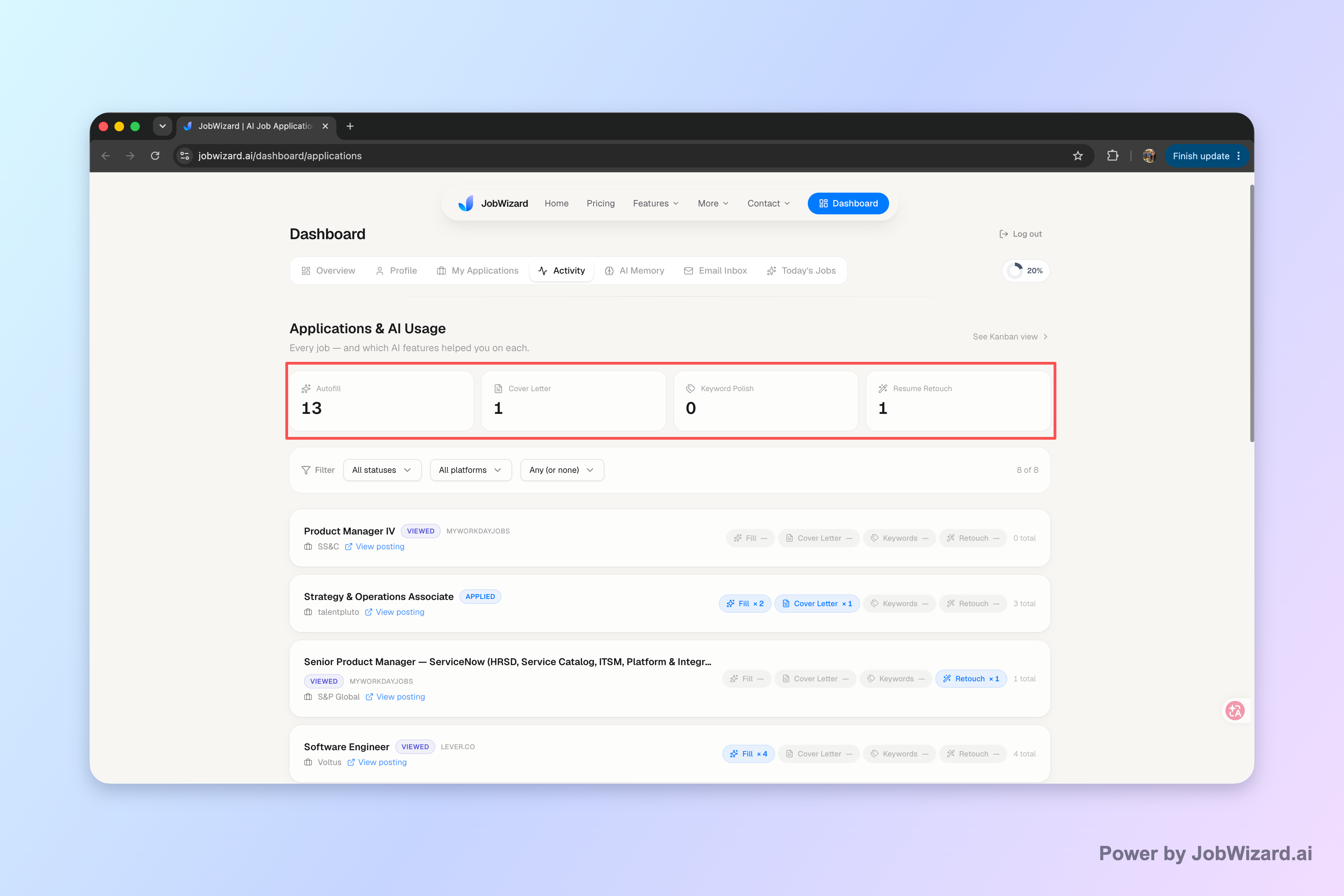
JobWizard’s Activity view helps you keep those details together by showing application status and which JobWizard tools were used for each role. That matters because follow-ups are more effective when you can refer to what happened next (or what you still need to confirm), rather than guessing.
Use this quick timeline (adjust if the posting specifies a schedule)
When there’s no explicit recruiter timeline, aim for a short, practical cadence. Here’s a baseline that works for many US job seekers applying across common ATS pipelines.
- Day 0–1: Apply and save confirmation details (job title, posting link, date, and any contact info).
- Business day 5–7: Send a first follow-up to confirm they’re reviewing candidates.
- Business day 12–15: Send a second follow-up that reinforces fit (one value point) and asks if they need anything else.
- After a response: Stop the “check-in” messages and follow the recruiter’s next step instructions.
Important: Follow-up frequency should stay proportional to the role’s hiring cycle. Also, don’t assume an employer “didn’t get it” just because there’s no reply.
What to track so you never lose context
If you want to know when to follow up, track the facts that make a message easy to personalize. Use your tracker fields consistently across every application.
- Role + location: Copy the exact role title from the posting.
- Date applied: Use the date you submitted, not when you finished filling the form.
- Contact path: Recruiter email vs. web form vs. LinkedIn (so your message matches the thread).
- What you asked/attached: Resume submission, portfolio link, cover letter note, or supplemental info.
- Your next scheduled follow-up: Keep follow-up dates on the same calendar logic each time.
For a more detailed job tracker workflow, use Job Application Tracker: How to Track Every Application and Know When to Follow Up. If you prefer an end-to-end system, pair it with How to Track Job Applications: A Practical System (JobWizard + Beyond).
Write follow-up messages recruiters can answer quickly
Recruiters respond best to messages that are short, specific, and easy to reply to. When you follow up, you’re not trying to “convince” them from scratch—you’re helping them place you in the review stack.
Every follow-up should include three parts: (1) identify the role, (2) confirm your application date, and (3) add one quick value point that matches the job requirements. Then end with a simple question.
Follow-up message template (first check-in)
Copy and personalize this structure:
Subject: Follow-up: [Role Title] — [Your Name] Hi [Recruiter Name], I applied for the [Role Title] position on [Date]. I wanted to see if you’re currently reviewing candidates. I’m especially interested because of my experience with [1 relevant skill/impact]. Would you be able to share whether there’s an expected timeline for next steps? Thanks for your time, [Your Name] [Phone] | [LinkedIn] (optional)
Follow-up message template (second note)
The second follow-up should feel helpful, not repetitive. Reinforce fit with one additional detail (a project, metric, or collaboration style) and keep the ask minimal.
Subject: Re: [Role Title] application — [Your Name] Hi [Recruiter Name], I hope you’re doing well. I wanted to follow up again on my application for the [Role Title] role submitted on [Date]. Since then, I’ve been thinking about how my background in [skill/experience] aligns with [team goal or requirement from the posting]. If it’s helpful, I’m happy to provide [additional info—portfolio, work sample, or references]. Is there anything else you need from me to move forward? Thank you, [Your Name]
Get exact wording + timing guidance
If you want line-by-line phrasing and timing templates for different recruiter scenarios, use What to Say to Follow Up on a Job Application: Exact Lines, Timing, and Templates. And if you need very short notes that still sound professional, see Short and Sweet Follow Up Message for Job Application: 12 Recruiter-Ready Notes.
Follow up across email, LinkedIn, and web portals—without double-messaging
The channel you choose affects how the recruiter experiences your message, so pick the one that matches your original submission path. The goal is to be consistent, not to “spray” the same note everywhere.
As you plan your follow-up, also remember to wait between messages. If you submit a follow-up by email, don’t immediately send the same content again on LinkedIn the next day. Give the recruiter time to read and respond.
When to use email vs. LinkedIn
- Email: Best when you have a recruiter email address or a professional company contact. It’s also a clear, traceable record.
- LinkedIn message: Best when you’re already connected (or can follow up through a relevant conversation). Keep it brief and include role context.
- Web portal: Use this when the company directs applicants there. If you used a portal for the application, follow that same path unless you have direct contact info.
What not to do (common follow-up problems)
- Don’t send vague “just checking in” messages—make the role and application date clear.
- Don’t attach huge documents—send only what’s requested or what’s necessary to support your fit.
- Don’t flood multiple follow-ups back-to-back—timing matters more than frequency.
Use JobWizard to keep follow-ups consistent—and review before you submit
Consistency is the hidden advantage in how to follow up on a job application: when your application details and contact thread stay organized, your follow-up messages become easier to personalize and less repetitive. JobWizard supports that workflow by tracking application activity in one place, helping you connect the dots between “applied” and “next step.”
Across 720,000+ applications submitted and 600,000+ autofill sessions run through JobWizard, the system autofills an average of ~18 repetitive fields per application (typically 11–23). Those fields are filled quickly while sponsorship/salary/EEO/custom questions are left for you to review before submitting—so you remain in control of what gets sent.
Also, of applications submitted through it, ~65% are on Workday, ~19% Greenhouse, ~12% Ashby, and ~4% Lever—Workday is where it saves the most time. Use that as a practical expectation if you apply frequently through one of these platforms.
Bottom line: Treat JobWizard as an “autofill + review-before-submit” helper, not a blind auto-apply engine. The follow-up part still depends on your dates, your role context, and your messages.
To translate activity tracking into follow-up success, schedule your messages based on the timeline you chose—and keep your tracker updated whenever you apply again or receive a reply.
Do this automatically with JobWizard
Skip the manual work — JobWizard's Application Tracker handles this for you.
FAQ: how to follow up on a job application (quick answers)
When should I follow up on a job application?
A safe baseline is to follow up after the recruiter’s stated timeline (if provided), or about 5–7 business days after applying when there’s no guidance. If you emailed a question or provided additional material, wait to give them time to review before your next follow-up.
What should I say when following up on a job application?
Keep it short and specific: reference the role title, the date you applied, and one value point (a relevant skill or achievement). Then ask a simple question like whether they’re reviewing candidates yet, or if there’s anything else they need from you.
How many times can I follow up without being annoying?
In most cases, two follow-ups after your initial application is enough: one early check-in and one later note to confirm continued interest. If the employer replies or moves you forward, stop there and follow their instructions.
How can I track applications so I follow up at the right time?
Use a single job tracker that records the job link/company, date applied, contact name (if you have it), and your follow-up dates/messages. In JobWizard, the Activity view shows application status and which JobWizard tools were used for each role, so you can stay consistent without mixing up threads.
Is it better to email or LinkedIn message recruiters for a follow-up?
Email is often best for formal updates and when you already have an email address. LinkedIn can work if you’re connecting with the recruiter or hiring manager and you want a quick, polite nudge—but keep the message just as specific and professional as an email follow-up.
Ready to follow up with confidence? Keep each application, its status, and your next step together in JobWizard, then use short recruiter-ready messages at the right points in your timeline.
Start with a job application tracker follow-up system—and let JobWizard’s Activity view help you stay organized as you move from “applied” to “next step.”
Frequently Asked Questions
Autofill your next job application
JobWizard is a free Chrome extension that fills applications, tracks statuses, and optimizes your resume.