What to Say to Follow Up on a Job Application: Exact Lines, Timing, and Templates
Learn what to say to follow up on a job application with clear, recruiter-friendly messages. Includes follow-up lines, email copy, and a tracking workflow.
Free Chrome extension
Autofill your next job application
JobWizard is a free Chrome extension that fills applications, tracks statuses, and optimizes your resume.
What to say to follow up on a job application starts with one clear goal: a polite update that makes it easy to respond.
If you’re wondering what to say to follow up on a job application, the winning formula is simple: remind them who you are, name the role and date, then ask for the next step—without sounding demanding.
In practice, that means your message should do four things: (1) reference the application, (2) restate your interest, (3) provide one small value signal (a relevant skill, project, or fit), and (4) end with a direct question such as “Is there an update on next steps?”
One more thing: avoid turning follow-ups into repeated “checking in” notes. Recruiters are busy; you’ll get better results when every message has a purpose and a clear ask.
Follow-up timing matters so your message lands in the right review window.
Your follow-up tone is only half the equation—timing is the other half. If you follow up too early, you’ll interrupt a review cycle; too late, and your application may blend into the background.
Use a consistent cadence and stop when you hear back. If the job posting includes a timeline (for example, “we’ll review applications after X date”), anchor your first follow-up to that signal. Otherwise, aim for a reasonable check-in window and then follow up again only if there’s still no movement.
For deeper timing guidance you can adapt to different company tempos, see When to Follow Up on a Job Application: The Timing That Helps (Without Annoying the Recruiter).
Common follow-up cadence that stays respectful
- First follow-up: After the initial review window has likely begun (often about a week), ask for next steps.
- Second follow-up: Only if you still haven’t heard back—keep it shorter and refer to any new detail you can share (availability, completed work, etc.).
- Final check-in: A last polite note can work if appropriate, but don’t keep re-contacting after you’ve made your request.
Timing examples you can copy
- Example 1 (clear posting): If the job says “review begins 5/20,” follow up a few days after that date.
- Example 2 (no posting timeline): If you applied on Monday, your first message may be around the following week (same weekday timing helps keep it predictable).
- Example 3 (slow-moving company): If there’s no response after two polite emails, pause and resume later only if you can add something genuinely helpful.
What to say in your first follow-up email (copy-and-send lines that don’t overreach).
For the first follow-up, aim for clarity and brevity. Your message should be easy to skim and easy to answer—which is why the best follow-up emails read like a short note, not a mini cover letter.
Start with: greeting, role + application date, interest, one-fit point, and a direct question. Here are ready-to-use options you can tailor.
Template 1: Straightforward next-steps request
Subject: Follow-up: [Job Title] application submitted [Date]
Message: Hi [Name], I’m following up on my application for the [Job Title] role submitted on [Date]. I’m very interested in the opportunity and would welcome any update on next steps. Thank you for your time, [Your Name] [Phone] | [Email] | [LinkedIn or portfolio]
Template 2: Add one value signal (without writing a novel)
Subject: Re: [Job Title] application — any update on next steps?
Message: Hi [Name], I hope you’re doing well. I wanted to follow up regarding my application for the [Job Title] role submitted on [Date]. Given your team’s focus on [specific area from the posting], I’m excited about the chance to contribute—especially with my experience in [1 relevant skill or project]. If the role is still under active consideration, could you share what the next step looks like? Best regards, [Your Name] [Contact info]
Template 3: If you don’t know the recruiter’s name
Subject: Follow-up on [Job Title] application submitted [Date]
Message: Hello, I’m following up on my application for the [Job Title] role submitted on [Date]. I remain very interested and would appreciate any update on next steps. Thank you, [Your Name] [Contact info]
If you want more subject lines and follow-up copy you can reuse across roles, read An Email Template for Job Application That Gets Replies (with Subject Lines + Follow-Up Copy).
What to say if you follow up again (and need a fresh reason to contact them).
Your second follow-up should feel different from the first. Instead of repeating “just checking in,” add something new: a detail you forgot, a relevant update, or a brief reaffirmation of fit.
At this point, your goal isn’t to “prove you’re patient.” It’s to make it easy for them to move you to the next step—or to close the loop politely.
Second follow-up example: availability + fit reminder
Subject: Follow-up: [Job Title] application (submitted [Date])
Message: Hi [Name], I’m reaching out again regarding my application for the [Job Title] role submitted on [Date]. I’m still very interested in the position, and I wanted to share that I’m available for an interview starting [date/timeframe]. If there’s anything else I can provide to help with the review, I’d be happy to send it. Thank you, [Your Name]
Second follow-up example: new proof point (short and specific)
Subject: Quick update on my [Job Title] application
Message: Hi [Name], I’m following up on my [Job Title] application from [Date]. Since then, I’ve been working on [one relevant improvement—e.g., a project, a certification, a portfolio piece]. It’s made me even more confident I could contribute in areas like [posting keyword]. Could you let me know if the role is moving forward and what the next step would be? Best, [Your Name]
What not to say (quick guardrails)
- Don’t demand timelines or accuse silence of ignoring you.
- Don’t send long attachments “just in case” unless you’ve been asked.
- Don’t repeat the same message verbatim multiple times.
Also, be careful with your subject line. Avoid anything that implies urgency like “final follow-up” unless you truly mean it.
Track each application and follow-up so your outreach stays organized and timely.
If you’re not tracking your outreach, it’s easy to forget what you already asked—or when you asked it. That’s how people accidentally spam recruiters.
A simple workflow helps: record the application, record the contact info you used, and log each follow-up date and message purpose. The result is fewer duplicates and better consistency across applications.
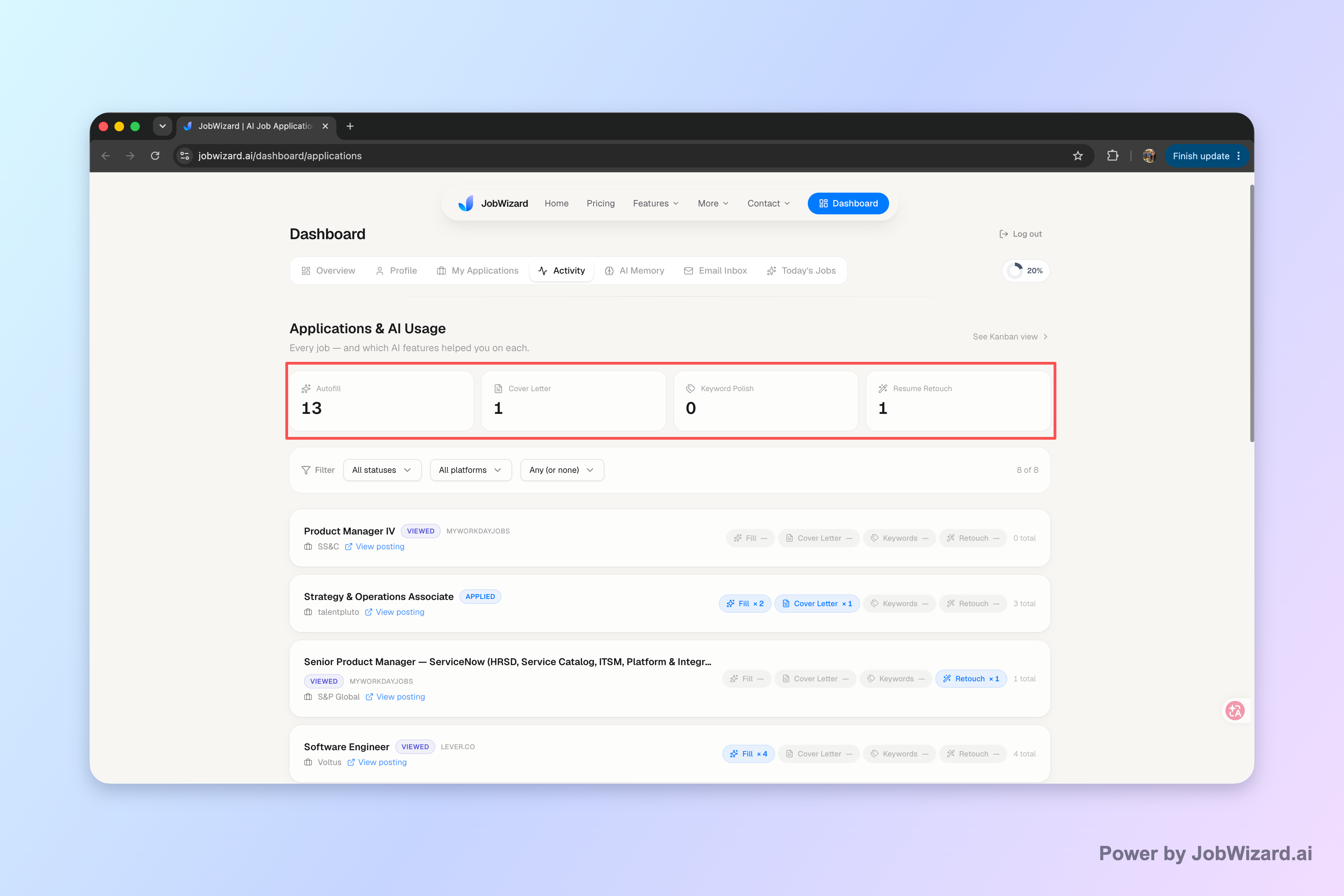
JobWizard’s Activity view shows application status and which JobWizard tools were used for each role—so you can keep your next action aligned with where the application actually stands.
To build a full system (including a place to record next steps and follow-ups), start with Job Application Tracker Template: Build a Simple Workflow to Track Status, Next Steps, and Follow-Ups.
A practical tracking checklist (use this with any tool)
- Job details: company, title, job link, and submission date.
- Recruiter/contact: name (if known), email, and preferred channel.
- Current status: anything you know (submitted, under review, interview, etc.).
- Follow-up log: date sent, subject line, and one-line “why” (next steps, additional info, availability).
- Next action: the exact day you plan to reach out again—or a reminder to stop if you get a response.
Even with tracking, keep expectations realistic. Tracking doesn’t guarantee outcomes or detect every possible update automatically; it helps you stay organized while you do the reviewing and submitting yourself.
Do this automatically with JobWizard
Skip the manual work — JobWizard's Application Tracker handles this for you.
FAQ: what to say to follow up on a job application (quick answers you can use today).
When should I follow up after submitting my job application?
A good rule is to follow up when you’ve given the team enough time to review—often after about a week. If the job posting says a specific timeline, follow that guidance; otherwise, use a polite check-in window and avoid multiple messages in the same day.
What’s the best first follow-up message to send?
Keep it short and reference the role and date you applied. For example: “Hi [Name], I’m following up on my application for the [Job Title] role submitted on [Date]. I’m very interested and would welcome any update on next steps.”
Should I call instead of emailing to follow up?
If a phone number is listed and it’s a reasonable channel for the company, a brief call can work—but email is usually safer for first follow-ups because it creates a timestamped record. If you do call, keep it brief, ask for the best next step, and follow up with an email summarizing your call.
How do I track my follow-ups so I don’t spam recruiters?
Use a simple tracker that logs each application, current status, contact details, and your follow-up dates. When you update something, tie it to the message you sent so you can pause when you hear back and only reach out again if there’s a clear next step.
Want a smoother workflow for follow-ups? Keep every application and its next step in one place with JobWizard’s tracking and activity view—so you can send the right message at the right time without losing context.
Start with How to Track Job Applications: A Practical System (JobWizard + Beyond) and tighten your follow-up process from day one.
Frequently Asked Questions
Autofill your next job application
JobWizard is a free Chrome extension that fills applications, tracks statuses, and optimizes your resume.