Follow Up Email for Job: A Reply-Focused Plan (Templates + Job Tracker)
Learn how to send a follow up email for job applications that gets responses—plus a simple way to track application activity so you always know what to say next.
Free Chrome extension
Autofill your next job application
JobWizard is a free Chrome extension that fills applications, tracks statuses, and optimizes your resume.
Follow up email for job applications are often the difference between “Thanks for your interest” and hearing nothing at all—so you need both the right message and a simple way to track what you already sent. This guide shows you what to write, when to send it, and how to avoid the most common follow-up mistakes.
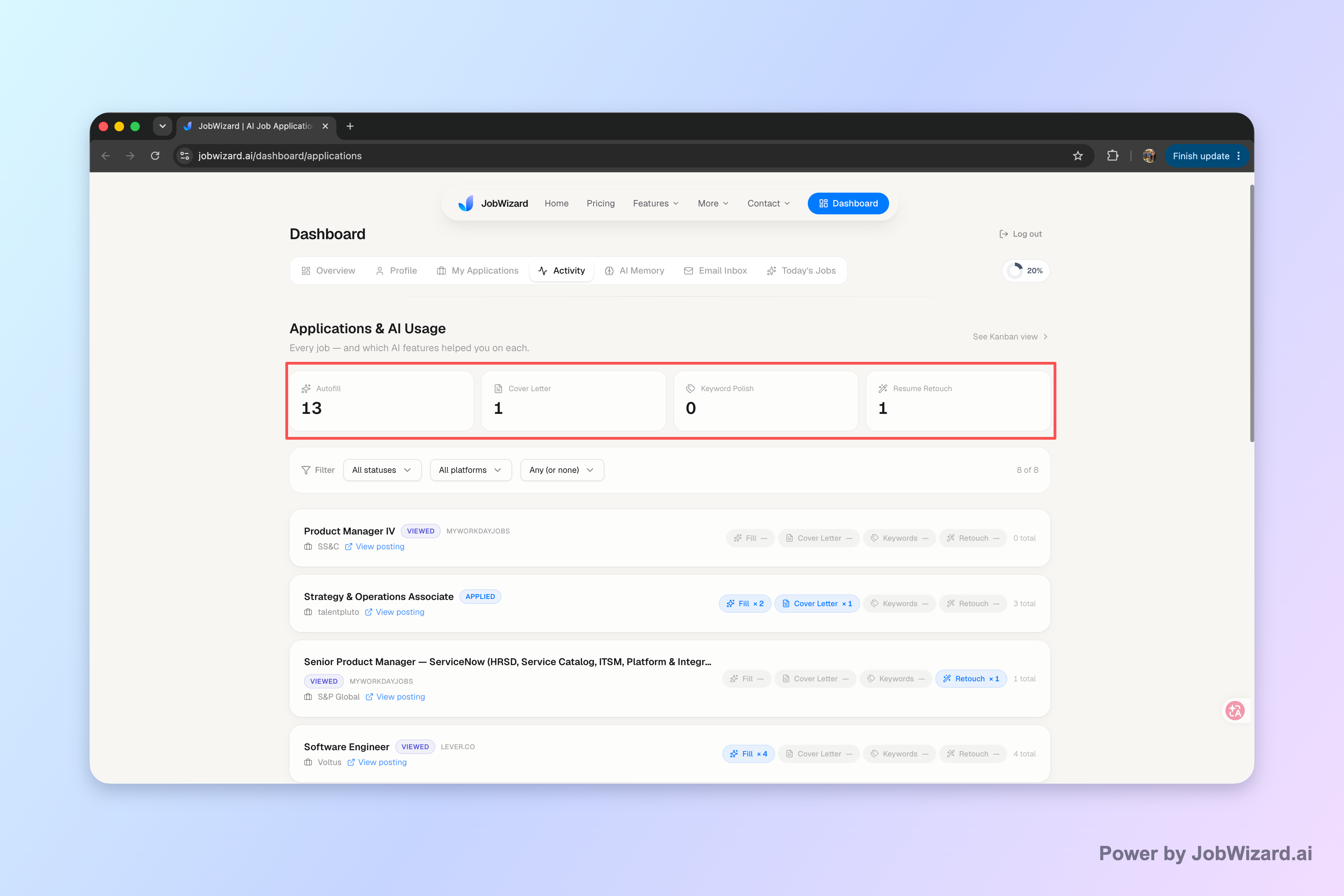
Use an application tracker so you always know the status of each role and what tooling you used on the way—JobWizard’s Activity view shows application status and which JobWizard tools were used for each role.
Why your follow up email for job needs a “next step” question
Most follow ups fail because they ask for attention, not progress. Hiring teams don’t have time to decode a vague email; they’re looking for a clear reference to the role and a question that helps them move the process forward.
Your goal is simple: make it easy for the recipient to reply. Instead of “Just checking in,” aim for something like “Do you have an updated timeline for next steps?” or “Is there any additional information you’d like from me?”
- Reference the role (job title + where you applied if needed).
- Confirm interest without sounding desperate or repetitive.
- Ask about next steps with a single, specific question.
- Keep it short—a hiring manager may skim.
Timing: when to send a follow up email after applying
Timing is about being respectful, not urgent. A safe approach is to wait long enough for the employer’s process to move (often several business days), then send a brief note that references your application.
If the job posting includes a stated timeline—or if you received any status email—use that. If nothing is mentioned, build your follow-up around the date you applied and any changes you notice afterward (including requests for interviews, form submissions, or portal updates).
- First follow up after several business days to confirm you’re still interested.
- Second follow up only if you still don’t hear back, and only after additional time has passed.
- Stop after clarity—once you’re in an interview process or receive a clear “not selected,” don’t keep emailing.
Subject lines that earn replies (and avoid spam filters)
Your subject line should be specific and readable in one glance. Keep it professional and tied to the role. A strong subject line reduces the “what is this?” effect when someone sorts hundreds of messages.
Here are subject line options you can adapt for a follow up email for job applications:
- Follow-up: [Job Title] – Application
- Checking in on: [Job Title] application
- Next steps? [Job Title] application
- Application status: [Job Title]
- Re: [Job Title] – [Your Name]
Tip: avoid overly dramatic phrasing like “URGENT” or “FINAL NOTICE.” If you keep it calm and role-specific, you’re more likely to get a real response.
Follow up email for job: templates you can personalize in minutes
Templates save time—but personalization gets replies. The best follow up email for job is a template with a real reference to the role and a question about next steps.
Template 1: First follow up (short + direct)
Best for your first “checking in.”
Subject: Follow-up: [Job Title] – Application Hi [Hiring Manager Name], I hope you’re doing well. I’m following up on my application for the [Job Title] role submitted on [Date]. I remain very interested in the opportunity, especially given [specific reason tied to the posting]. If there are any updates on the hiring timeline or next steps, I’d appreciate it. Thank you for your time and consideration. Best regards, [Your Name] [Phone] | [Email] | [LinkedIn/Portfolio]
Template 2: First follow up with a proof point
Add one concrete detail to stand out.
Subject: Next steps? [Job Title] application Hi [Hiring Manager Name], I wanted to follow up regarding my application for the [Job Title] position. I’m still very interested in joining [Company Name]. In my recent work, I [brief proof point aligned to the posting—e.g., “built X,” “led Y,” “improved Z”]. I think that experience maps well to what you’re looking for, particularly around [specific requirement]. Would you be able to share whether there’s an updated timeline for next steps? Thank you, [Your Name]
Template 3: Second follow up (polite + non-repetitive)
Best when you already emailed once.
Subject: Application status: [Job Title] Hi [Hiring Manager Name], I’m following up once more on my application for the [Job Title] role. I know you may be busy, so I’ll keep this brief. I remain enthusiastic about the role—especially [specific reason]. If the hiring process is still active, could you share whether there are next steps or timing updates I should be aware of? Thanks again for your time and consideration. Best regards, [Your Name]
Template 4: Follow up after a referral request (if you’re waiting)
Useful when you’ve asked for internal help.
Subject: Follow-up: [Job Title] – Referral/Introductions Hi [Name], Thank you again for your support regarding the [Job Title] role. I wanted to check in and see if there are any updates on next steps or timing. I’m still very interested and happy to provide any additional information that might be helpful. Thanks again, [Your Name]
Template 5: Follow up when the posting closes soon
Best for roles with time-sensitive deadlines.
Subject: [Job Title] application before closing Hi [Hiring Manager Name], I’m following up on my application for the [Job Title] role. I noticed the posting may close on [Date], so I wanted to ensure my interest is on your radar. If there are any updates on the status of applications or next steps, I’d appreciate it. Thank you for your consideration. Best regards, [Your Name]
Build a follow-up workflow that prevents duplicates (and keeps you organized)
A simple system beats “remembering in your head.” When you’re juggling multiple roles, it’s easy to send the same email twice, contact the wrong person, or follow up without knowing what stage the application is in.
Use this workflow for follow up email for job applications:
- Log the role + date applied right after you submit.
- Track the status so you know what to expect next.
- Record what you sent (first follow up, second follow up, any attachments).
- Write from “last known context” so your second email adds something new.
With JobWizard, the Activity view shows application status and which JobWizard tools were used for each role, so you can line up your next message with what’s already happened. And remember: this is about autofill + review-before-submit, not blind sending—your main job is to review sponsorship / salary / EEO / custom questions and submit yourself when you’re ready.
Quick checklist before you hit send
- Role name matches the posting exactly.
- Question is specific (timeline, next steps, additional info).
- One personalization detail is included.
- Signature is clean (name, contact, LinkedIn/portfolio if applicable).
If you want deeper tracking structure, use How to Track Job Applications: A Practical System (JobWizard + Beyond) to set up a repeatable workflow.
And if you want more ready-to-use copy, start with Follow Up Email After Job Application: 9 Templates + a Tracking System That Gets Replies. For email-specific best practices, you can also explore An Email Template for Job Application That Gets Replies (with Subject Lines + Follow-Up Copy).
When you’re polishing wording, you can borrow alternatives from Looking for another word for follow-up? Use these email + hiring tracker phrases (with examples).
Do this automatically with JobWizard
Skip the manual work — JobWizard's Application Tracker handles this for you.
FAQ: Follow up email for job
How soon should I send a follow up email for job applications?
A safe rule is to wait long enough for the employer’s process to move (often several business days). Use your application’s timeline and any updates you received, then send a short, specific note that references the role and asks about next steps.
What should I write in a follow up email for job if they didn’t reply?
Keep it brief and add value: remind them of the role, confirm you’re still interested, and include one concrete detail (for example, a relevant project, credential, or a specific match to the posting). End with a clear question like whether there’s an updated timeline or next step.
Should I send a second follow up email for job after the first one?
If you already sent one and still haven’t heard back, a second follow up email can be appropriate after additional time has passed. Vary the wording, stay polite, and avoid repeating the same message—reference any new context you have or simply re-ask about the hiring timeline.
How can an application tracker help with follow ups?
An application tracker helps you know what stage each role is in and what you already sent. With JobWizard, the Activity view shows application status and which JobWizard tools were used for each role, so you can pick the right follow-up wording and avoid duplicates.
Can I use templates for a follow up email for job every time?
Yes—use templates as a starting point, but personalize the first line and the question you ask. Reference the specific job title, date you applied, and one detail that connects your background to the role, then review-before-sending.
Ready to send better follow ups—without losing track? Keep every role, its status, and your next email step in one place with JobWizard.
Frequently Asked Questions
Autofill your next job application
JobWizard is a free Chrome extension that fills applications, tracks statuses, and optimizes your resume.