Looking for another word for follow-up? Use these email + hiring tracker phrases (with examples)
Need another word for follow-up that sounds natural in emails and job tracking? Here are strong alternatives, plus a simple system to keep every application’s next step clear.
Free Chrome extension
Autofill your next job application
JobWizard is a free Chrome extension that fills applications, tracks statuses, and optimizes your resume.
Looking for another word for follow-up that feels more human than “just checking in”? You’re not alone—most job seekers reuse the same two words until their emails start sounding generic. The good news: a few precise alternatives can make your message clearer, more professional, and easier to act on.
In this guide, you’ll get strong “another word for follow-up” options for email subject lines, recruiter notes, and application tracking—plus a repeatable workflow so you don’t lose timing across roles, ATS portals, and recruiter follow-ups.
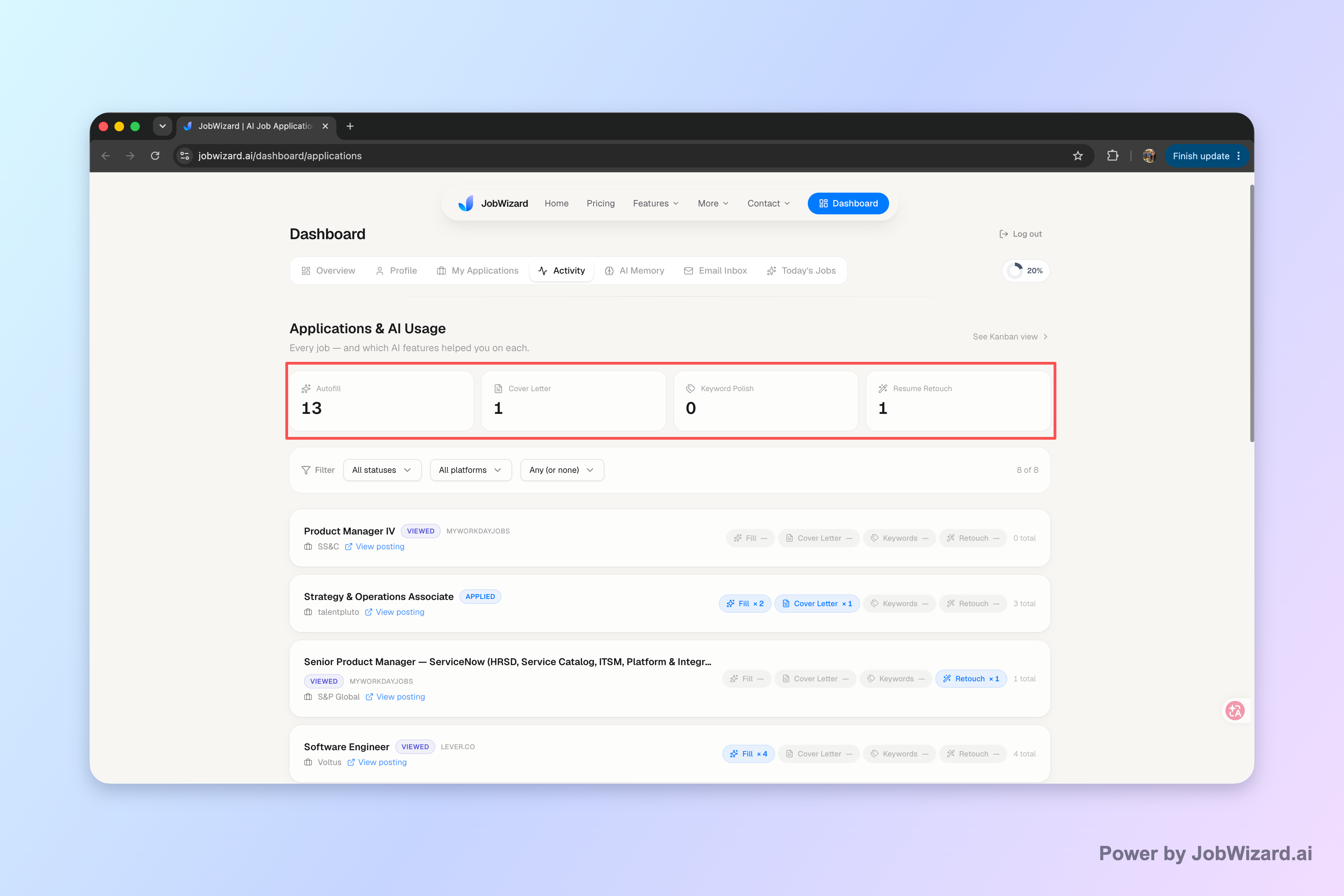
To make follow-ups easier, start by centralizing your job search actions in one place. In JobWizard, the Activity view shows each application’s status and which JobWizard tools were used for that role, so you can decide what to do next without digging through inboxes and tabs.
Best alternatives for “another word for follow-up” (that still sound polished)
If you want to avoid sounding repetitive, use a phrase that matches the intent of your message. The best “another word for follow-up” choice depends on whether you’re asking for status, confirming next steps, or simply nudging the conversation along.
Below are professional, job-search-safe alternatives you can swap in immediately—along with when to use each one.
- Check-in — Light, friendly reminder when you already have context (interview, recruiter thread, prior email).
- Status update request — Direct ask for “where things stand,” especially after an ATS submission or recruiter update.
- Next-steps inquiry — When you’re nearing a decision point and want clarity on timing or process.
- Application follow-up — Formal and clear when you applied and want confirmation the application is under review.
- Progress update — Works well when you previously discussed milestones (screening scheduled, interview completed).
- Scheduling follow-up — Best after you’ve proposed times or are waiting for calendar confirmation.
- Reconfirming interest — Useful if you want to reaffirm fit without sounding demanding.
Rule of thumb: If the hiring team is likely busy, your wording should help them answer quickly. The phrases above naturally push your reader toward a fast, specific reply.
How to choose the right phrase based on where you are in the hiring timeline
“Another word for follow-up” isn’t one-size-fits-all because hiring stages are different. A status request after submitting an application is different from a next-steps inquiry after an interview.
Use this quick match guide to pick wording that aligns with the moment.
| Situation | What you’re really asking | Use this “Another word for follow-up” |
|---|---|---|
| After applying in an ATS | Whether it’s under review / confirmation | Application follow-up or “status update request” |
| After a recruiter phone screen | Where you stand and what happens next | Next-steps inquiry or “progress update” |
| After an interview | Timing and next actions | Check-in or “next steps” phrasing |
| After sending materials (work sample, references) | Receipt confirmation and next stage | Status update request or “check-in” |
| After a no-response period | Re-open the conversation without sounding urgent | Reconfirming interest or “checking in” |
Keep it specific: In the first sentence, name the role and reference a detail (date of interview, project discussed, or the exact stage). Specificity makes any alternative phrase feel intentional—not like word-swapping.
If you’re also trying to manage multiple roles and timelines, you’ll get more value from a process than from perfect wording. Start with How to Track Job Applications: A Practical System (JobWizard + Beyond), then map each phrase above to a specific next-step in your tracker.
Copy-and-paste subject lines that use “Another word for follow-up”
Your subject line sets expectations. If you replace “follow-up” with a clearer intent phrase, you’ll usually get faster, more useful replies.
Here are subject line options that avoid repetition but still read professional. Pick one and keep it short.
- Check-in: [Role Title] interview / conversation
- Status update request: [Role Title]
- Next steps for: [Role Title]
- Quick check-in: [Role Title] — after interview
- Re: [Role Title] — scheduling / timeline
- Application follow-up: [Role Title]
When in doubt, use a “purpose-first” subject. Your reader should be able to tell what you need in under five seconds.
For interview-specific writing, you can also use this collection as a starting point: short and sweet follow-up email after interview sample: 7 ready-to-send notes. Then swap “follow-up” with “check-in” or “next steps” where it makes the message smoother and more specific.
Templates: replace “follow-up” without losing the message
Instead of rewriting everything, keep the structure and only adjust the phrase to match the intent. That way, your “Another word for follow-up” choice stays consistent with what you’re asking for.
Below are practical templates you can customize. Each one uses an alternative phrase in the opening line or subject line.
Template 1: After applying (ATS submission)
Subject: Status update request: [Role Title]
Hi [Name], I hope you’re doing well. I’m reaching out to request a quick status update on my application for the [Role Title] position submitted on [Date]. I’m very interested in the opportunity and would welcome any guidance on next steps.
Thank you for your time, [Your Name] [Phone] | [LinkedIn]
Template 2: After recruiter screen
Subject: Next steps for [Role Title]
Hi [Name], Thank you again for speaking with me about the [Role Title] role. I wanted to check in regarding where the process stands and what the next steps look like.
If there’s anything else I can provide to support my application, I’d be glad to share it.
Best regards, [Your Name]
Template 3: After an interview
Subject: Quick check-in: [Role Title] — after interview
Hi [Name], Thank you for the opportunity to interview for the [Role Title] role on [Date]. I wanted to send a quick check-in to see if there are any updates on timing for next steps.
I enjoyed our discussion about [specific topic], and I’m excited about the possibility of contributing to [company/team].
Thanks again, [Your Name]
If you want a wider set of options—especially for different stages and follow-up cadence—use Follow Up Email After Job Application: 9 Templates + a Tracking System That Gets Replies to pick the closest template and then swap in your chosen “Another word for follow-up” phrase consistently.
Template 4: “Reconfirming interest” when you haven’t heard back
Subject: Re: [Role Title] — quick check-in
Hi [Name], I hope you’re well. I’m reaching out to reconfirm my interest in the [Role Title] position. I remain excited about the role and wanted to see whether there are any updates on next steps.
Thank you for your consideration, [Your Name]
Build a follow-up workflow that makes the wording irrelevant (because you’ll be timely)
The fastest way to improve your follow-ups is to stop treating them as one-off emails. A job search tracker turns “Another word for follow-up” into a controlled step, not a panic button.
JobWizard’s Activity view is designed to keep your application status and actions together, so you can decide when to follow up and with what intent.
Instead of writing “follow-up” and hoping for the best, use a simple loop:
- Log the role + current status so every next email has context.
- Choose an intent phrase (“status update request,” “next-steps inquiry,” or “check-in”).
- Draft a short note with one specific reference (date, interview topic, or stage).
- Review-before-send sponsorship/salary/EEO/custom questions if applicable—and submit yourself.
That “review-before-submit” mindset matters because sending the wrong message (or repeating too early) can create noise. Your goal is clarity, not volume.
If you’re using JobWizard, you can also strengthen your process by keeping your activity tied to the application’s stage. That reduces the chance you send an interview-style message for a pre-screen timeline (or vice versa).
JobWizard usage data shows that users submit 720,000+ applications and run 600,000+ autofill sessions through the platform. Autofill typically fills about ~18 repetitive fields per application (often 11–23), while you review and submit yourself before final send.
You still control the message content—especially anything sponsorship/salary/EEO/custom questions—and that’s where your “Another word for follow-up” choices make the difference.
One more practical advantage: different ATS systems show different status labels. If you’re tracking roles and wondering what the next message should say, this guide helps you translate status language into action: Workday Meaning for Job Seekers: Application Statuses, Timeframes & What to Do Next.
Do this automatically with JobWizard
Skip the manual work — JobWizard's Application Tracker handles this for you.
FAQ: Another word for follow-up
What’s another word for follow-up that still sounds professional?
Try “check-in,” “status update request,” “next-steps inquiry,” or “application follow-up” (as a noun phrase). Pick the one that matches the moment: “check-in” for polite outreach, “status update request” when you’re asking where things stand, and “next-steps inquiry” when the role is close to the next stage.
Should I use “follow-up” or “check-in” after an interview?
“Check-in” usually reads warmer and less repetitive after an interview, especially if you’re referencing a specific topic you discussed. “Follow-up” is fine too—just pair it with a clear reason (e.g., “following up on our conversation about X”) so it doesn’t sound generic.
How do I track follow-ups without losing track of deadlines?
Use an application tracker view that records the role, current application status, and what you did next (email sent, recruiter message, or ATS update). Keep one next-step date per role, then review your list before you send anything so you’re always asking the right question at the right time.
What should I write in a subject line when I’m not using the word “follow-up”?
Good subject lines include “Checking in: [Role Title],” “Status update request: [Role Title],” “Next steps for [Role Title],” or “Re: [Role Title]—quick check-in.” Keep it short, include the role, and make the purpose obvious.
How does Workday status wording relate to my “Another word for follow-up” emails?
When you see a status change (or if it hasn’t changed), your email should match what you’re trying to confirm: a “status update request” if you’re verifying where the process stands, or a “next-steps inquiry” if you’re asking about timing for interviews or decisions.
Ready to send follow-ups that feel timely (not repetitive)? Keep your application statuses and next steps together in JobWizard’s Activity view, then draft your message using a clear intent phrase like “check-in” or “next-steps inquiry.” Start organizing today so every “Another word for follow-up” email has the right context.
Frequently Asked Questions
Autofill your next job application
JobWizard is a free Chrome extension that fills applications, tracks statuses, and optimizes your resume.