Follow Up Email After Job Application: 9 Templates + a Tracking System That Gets Replies
Learn how to write a follow up email after job application that’s concise, specific, and on-time—plus a simple system to track application status and next steps.
Free Chrome extension
Track all your applications in one place
JobWizard auto-tracks status changes across Workday, Greenhouse, and every major job site — free.
Follow up email after job application can feel awkward—until you use a clear timeline, a specific message, and a simple way to track what you’ve already sent.
In this guide, you’ll get ready-to-use templates, practical timing guidance, and a lightweight workflow to help you stay consistent. You’ll also learn how to pair follow-ups with an application tracker so you don’t lose details while you juggle multiple roles.
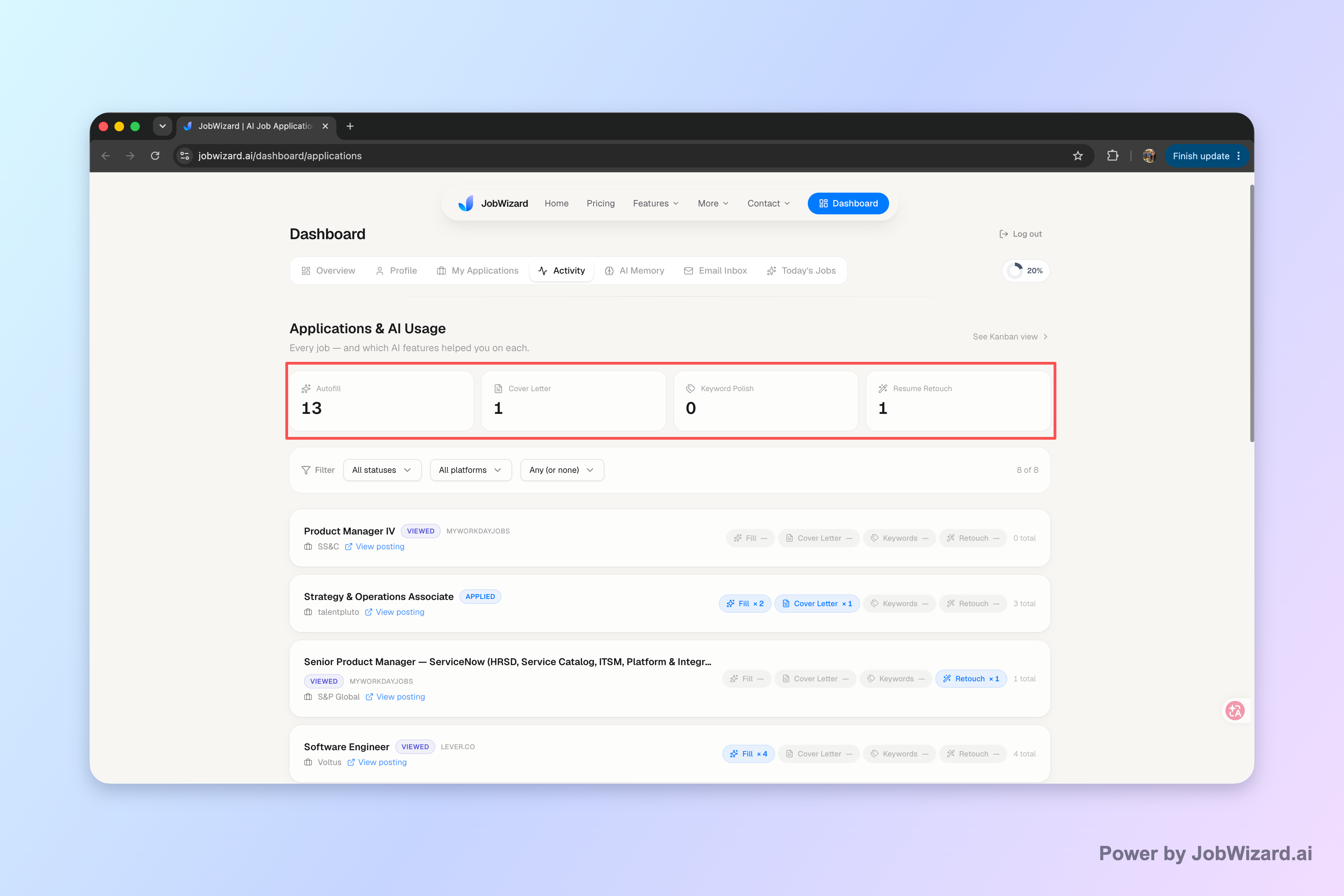
One reason follow-ups go wrong is not writing the email—it’s forgetting which job is which or what stage you’re waiting on. JobWizard’s Activity view shows application status and which JobWizard tools were used for each role, so you can review before you send.
How to time a follow up email after job application (without being pushy)
The simplest way to avoid sounding impatient is to follow up once you give the team enough time to review applications. A good rule is about 5–10 business days after you apply, then adjust based on what you know.
Here are a few timing scenarios to help you decide:
- If you applied through a portal: wait for the review window, then send a short follow up asking about next steps.
- If the job posting lists a timeline: align your message with that stated schedule.
- If you’re networking for referrals: you may follow up sooner—but keep it respectful and specific to the person who can help.
If you’re not sure when you applied (or if you applied to multiple roles at once), don’t guess. Use your tracking system to confirm the date and job details before you hit “send.”
What to include in a follow up email after job application (so it gets read)
Your follow up email after job application should be short, relevant, and easy to answer. Hiring teams skim, so every sentence should help them understand who you are and what you’re asking.
Use this checklist as you write:
- Role clarity: name the position you applied for (and the department if it’s in the posting).
- Reference details: include the date you applied and any job ID or link if you have it.
- A clear question: ask about the hiring timeline or next steps (not “just checking in”).
- Professional close: thank them for their time, sign with your name and contact info.
Also, remember the intent: you’re not trying to “pressure” anyone. You’re reducing friction by making it easy for the team to route your message and respond with the next step.
9 follow up email templates after job application (copy, paste, personalize)
These templates are designed so you can send a confident follow up email after job application in minutes, while still customizing the key details.
Template 1: Standard follow up (most situations)
Subject: Follow up on [Job Title] application — [Your Name]
Hello [Hiring Manager Name/Team],
I’m writing to follow up on my application for the [Job Title] position submitted on [Date]. I remain very interested in the role and would appreciate any update on the hiring timeline or next steps.
Thank you for your time and consideration.
Best regards,[Your Name][Phone] | [Email]
Template 2: Follow up after no response (portal submitted)
Subject: Checking in: [Job Title] application
Hello [Hiring Manager Name/Team],
I applied for the [Job Title] role on [Date]. The application status shows as [“submitted”/“in progress” if applicable]. I wanted to follow up and ask whether there are updates on the next steps in the process.
Thanks again for your time.
Sincerely,[Your Name]
Template 3: Follow up with a new relevant update (light-touch)
Subject: Follow up — [Job Title] application + update
Hello [Hiring Manager Name/Team],
I’m following up on my application for [Job Title] submitted on [Date]. Since then, I’ve been working on [brief, relevant update—1 line: course completed / project shipped / certification started]. If helpful, I’d be glad to share more context.
Would you be able to share any update on next steps or timing?
Thank you,[Your Name]
Template 4: Follow up after a referral (reference the connection)
Subject: [Job Title] — follow up (referral from [Name])
Hello [Hiring Manager Name/Team],
I wanted to follow up on my application for the [Job Title] position. [Referrer Name] mentioned this opportunity, and I’m excited about the work your team is doing.
When you have a moment, could you share the next steps and timing for the hiring process?
Best regards,[Your Name]
Template 5: Follow up when you applied to multiple roles (clarify which one)
Subject: Follow up on [Job Title] application (submitted [Date])
Hello [Hiring Manager Name/Team],
I’m reaching out to follow up on my application for the [Job Title] role submitted on [Date]. I know teams receive many applications, so I wanted to ensure my interest in this specific position is clearly noted.
Do you have an estimated timeline for next steps?
Thank you,[Your Name]
Template 6: Follow up after interview (post-application but before final decision)
Subject: Thank you + follow up — [Job Title]
Hello [Hiring Manager Name],
Thank you again for considering my application for the [Job Title] role. I wanted to follow up to see if there are updates on the timeline for the next steps.
I remain very interested and am happy to provide anything else you may need.
Best,[Your Name]
Template 7: Short follow up (if you want to be extra concise)
Subject: Quick follow up — [Job Title]
Hello [Hiring Manager Name/Team],
I applied for the [Job Title] position on [Date] and wanted to ask about next steps or the hiring timeline. Thank you for your time.
Regards,[Your Name]
Template 8: Follow up to the recruiter (when you applied through a recruiter message)
Subject: Follow up — [Job Title] application
Hello [Recruiter Name],
Thank you for your help with the [Job Title] role. I submitted my application on [Date] and wanted to follow up on the status of next steps.
If there’s anything you need from me to support the process, I’d be happy to provide it.
Best regards,[Your Name]
Template 9: Follow up after changing your availability (only if it’s genuinely relevant)
Subject: Follow up — [Job Title] application (availability update)
Hello [Hiring Manager Name/Team],
I’m following up on my [Job Title] application submitted on [Date]. I wanted to share that my availability has changed—[one short sentence]. If helpful, I’m still very interested in the role and would welcome next steps.
Thank you for your time.
Sincerely,[Your Name]
Use an application tracker so your follow up email after job application matches reality
The fastest way to improve follow-ups is to make sure you’re sending the right message for the right role at the right stage. With application activity tracking, you can verify the application status and review your notes before you hit send.
Here’s a simple workflow you can use—no complicated tooling required:
- Record the basics: job title, company, date applied, and any job ID or link.
- Note the source: portal link, recruiter contact, or referral connection.
- Set a follow-up date: start with ~5–10 business days after applying.
- Write from a template: personalize only what’s specific to that job.
- Review before sending: confirm details match the role and application stage.
- Log the result: update status and whether you sent email #1, #2, etc.
If you want a ready-to-go system, you can also check out:
- How to Track Job Applications: A Practical System (JobWizard + Beyond)
- Job Application Tracker: How to Track Every Application and Know When to Follow Up
And if you prefer spreadsheets, this pairs well with follow-ups:
Finally, if you’re looking for a system that connects autofills with review-before-submit, review this guide too:
A quick comparison: follow up email strategy vs. “auto-apply” habits
Not every workflow is the same, but your best results usually come from combining speed for repetitive work with careful human review for anything that affects your credibility.
Here’s the difference in mindset:
| Approach | What you do | Why it matters for follow-ups |
|---|---|---|
| Tracker-first | Maintain job details and application status, then send a tailored follow up when the timeline hits. | You avoid mixing roles and outdated details, which makes your follow-up easier to answer. |
| Auto-submit mindset | Push applications with minimal review and focus follow-ups on volume. | You may get emails returned to the wrong stage or with mismatched details—so your next step becomes harder. |
JobWizard is designed to support autofill + review-before-submit, so you can move quickly on repetitive fields while leaving sponsorship/salary/EEO/custom questions and anything you need to confirm for you to review before submitting.
Usage context: JobWizard has supported 720,000+ applications submitted and 600,000+ autofill sessions, averaging ~18 repetitive fields filled per application (typically 11–23). Of applications submitted through it, ~65% are on Workday, ~19% Greenhouse, ~12% Ashby, and ~4% Lever.
That’s not a promise of outcomes—it’s just the reality of how people use JobWizard: to reduce repetitive busywork, then review the content that still requires your judgment.
Do this automatically with JobWizard
Skip the manual work — JobWizard's Application Tracker handles this for you.
FAQ about follow up email after job application
When should I send a follow up email after I apply?
A good rule is to follow up after the employer has had enough time to review (often about 5–10 business days). If the job posting has a stated timeline, align your message to that. If you hear back earlier, you can pause or adjust your follow-up.
What should I write in a follow up email after a job application?
Keep it short and specific: remind them which role you applied for, include any reference details you have (date, job ID), and ask a clear, polite question about the hiring timeline or next steps. End with a professional sign-off and your contact information.
Should I send one follow up email or multiple?
Start with one well-timed email, then send at most one additional follow up if you still haven’t heard back (unless the employer asks you not to). Space messages apart enough that you’re not interrupting active review.
How can I avoid sending follow ups to the wrong roles or using outdated details?
Use a job tracker or activity view that captures the job title, date applied, and current application status in one place. Review before you send so your message matches the role and stage you’re actually waiting on.
Is it okay to follow up if the application portal says “submitted” or “in progress”?
Yes. Portal statuses are helpful, but they don’t always explain what happens next. A short follow up email can gently ask about next steps or the expected timeline, while keeping your tone respectful.
Ready to streamline your follow-ups? Use JobWizard to keep each application and its next step in one place—then write your follow up email after job application from the right details, at the right time.
Frequently Asked Questions
Track all your applications in one place
JobWizard auto-tracks status changes across Workday, Greenhouse, and every major job site — free.