How to Write a Follow Up Email After Application (and Get a Real Reply)
Learn how to write a follow up email after application that sounds professional, includes the right details, and helps you stay on top of your application status. Includes templates, timing tips, and a simple tracking workflow.

Free Chrome extension
Autofill your next job application
JobWizard is a free Chrome extension that fills applications, tracks statuses, and optimizes your resume.
How to write a follow up email after application: start with the right timing, details, and ask
Knowing how to write a follow up email after application is less about sounding “polite” and more about being clear: when you applied, what role you want, and what you’re asking for. Hiring teams are busy—your goal is to make it effortless for them to locate your application and respond.
Before you hit send, quickly confirm two things: (1) the job title and posting details match your application, and (2) you’re emailing the correct audience (often the recruiter or hiring manager listed, or a general recruiting contact if that’s all you have).
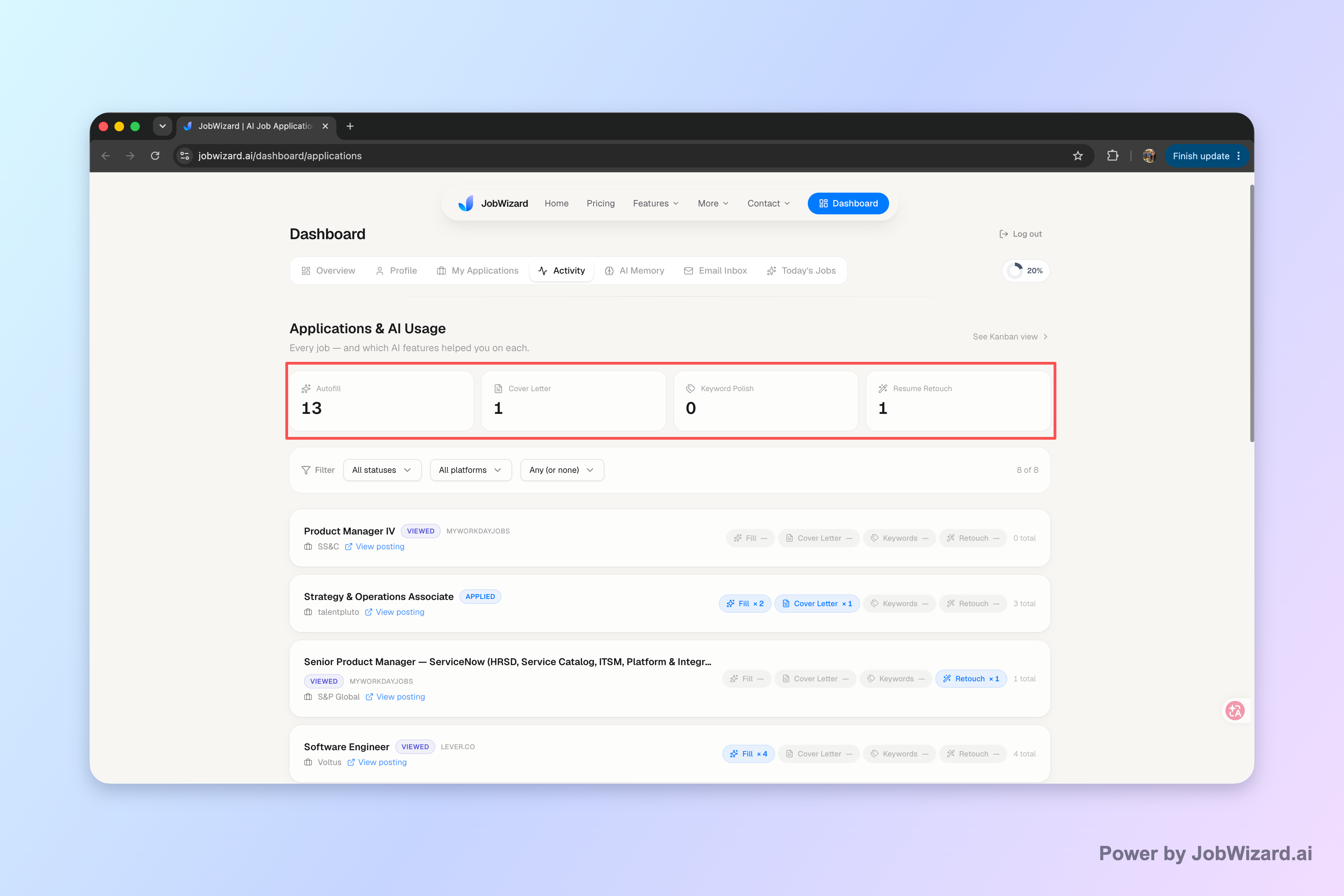
To avoid the common “I followed up… when?” problem, keep each role and its status in one place. JobWizard’s Activity view shows application status and which JobWizard tools were used for each job, so you can pick the right next step instead of guessing.
Choose your follow-up timing and build a simple tracking workflow
Timing is what separates a thoughtful follow up from a noisy ping. If the posting doesn’t give a timeline, use a predictable cadence so you don’t over-message or forget to follow up at all.
Use a timing window that fits the job cycle
If you’re wondering how to write a follow up email after application that gets read, start with a reasonable waiting period. Many candidates follow up after about a week, then again later if there’s still no response.
- First follow up: wait roughly 5–7 business days after you apply, then send a short check-in.
- Second follow up: if no response, send another note about a week later with a new angle (e.g., updated availability or reaffirmed fit).
- Stop point: after two follow ups, it’s usually best to stop messaging the same contact and focus on new applications.
Track each application so your email matches your real status
Your follow up should reflect what you’ve done and what’s known. If you applied multiple times or to multiple roles in the same company, it’s easy to accidentally reference the wrong job title or date.
JobWizard supports this workflow by helping you review your application activity and keep next steps organized in one activity view, rather than relying on memory or scattered spreadsheets. (The goal isn’t blind automation—it’s ensuring you review before you submit.)
For deeper guidance on keeping everything organized, see:
Write the follow-up email structure that earns replies
A strong follow up email after application has one job: make it easy for the recruiter to understand who you are, what role you applied for, and why they should consider you.
Use a 5-part structure (and keep it short)
Here’s a reliable template structure you can reuse for how to write a follow up email after application messages:
- Subject line: job title + check-in tone.
- Greeting: use the recruiter/hiring manager name if you have it.
- Purpose (1–2 sentences): confirm you applied and when.
- Value reminder (1–2 bullets or a single paragraph): 1–2 relevant specifics tied to the job.
- Clear ask + close: confirm receipt or ask about next steps, then thank them.
What to say in each section (with examples)
Subject line examples (pick one):
- Application for [Job Title] — [Your Name]
- Following up on my application: [Job Title]
- [Job Title] application — checking in
Opening sentence examples (choose one):
- Hello [Name], I’m following up on my application for the [Job Title] role submitted on [Date].
- Hi [Name], I hope you’re doing well. I wanted to check whether my application for [Job Title] was received.
Value reminder examples (keep it specific):
- In my most recent role, I [specific responsibility] and achieved [measurable outcome if you have one]—which aligns with your need for [job requirement].
- I’m especially interested in this position because of [company initiative/team focus], and I believe my experience in [relevant skill] would help.
Ask + close examples:
- If you’re able to share the hiring timeline or next steps, I’d appreciate it. Thank you for your time.
- Could you confirm receipt and let me know if there’s anything else you need from me? Thanks again for your consideration.
If you want a ready-made library of follow-up messages, use these guides:
- Follow Up Email After Job Application: 9 Templates + a Tracking System That Gets Replies
- An Email Template for Job Application That Gets Replies (with Subject Lines + Follow-Up Copy)
Follow-up email templates you can send after applying
Use these how to write a follow up email after application templates to remove guesswork—just swap in your role, date, and one relevant proof point.
Template 1: Short check-in (best for most situations)
Subject: Application for [Job Title] — [Your Name]
Hi [Name],
I’m following up on my application for the [Job Title] role submitted on [Date]. I’m very interested in the opportunity, and I’d appreciate it if you could confirm receipt.
In my background, I’ve worked on [1–2 relevant skills or responsibilities]. That experience aligns with what you’re looking for in [a job requirement from the posting].
Thank you for your time, and I look forward to the possibility of speaking with you about next steps.
Best regards,[Your Name][Phone] | [Email] | [LinkedIn/Portfolio]
Template 2: Follow-up that adds a specific fit
Subject: Following up on my application: [Job Title]
Hello [Name],
I hope you’re doing well. I wanted to follow up regarding my application for [Job Title] submitted on [Date].
What draws me to this role is [specific reason tied to the posting]. In particular, I bring [specific strength]—for example, [brief proof point: project, responsibility, or measurable result].
If there’s an opportunity to share next steps when you’re able, I’d be grateful. Thanks again for considering my application.
Sincerely,[Your Name]
Template 3: Follow-up after a form submission (no response yet)
Subject: [Job Title] application — checking in
Hi [Name],
I’m reaching out to check on the status of my application for the [Job Title] role submitted on [Date]. I applied through your online application process and wanted to confirm it was received.
If it helps, here are the best ways to review my fit: [1 line summarizing how your experience matches]. I’m happy to provide any additional information if needed.
Thank you for your consideration.
Best,[Your Name]
Common mistakes to avoid (so your follow up doesn’t backfire)
If you want how to write a follow up email after application to work in your favor, avoid these traps that make recruiters tune out.
- Sending too soon: following up before the team has had a chance to review can read as impatient.
- Being vague: “Just checking in” without the job title and application date makes it harder to find you.
- Over-sharing: don’t paste your entire resume—your job is to remind them of the best match.
- Pressure language: avoid “I need an answer ASAP” or anything that implies consequences.
- Wrong role reference: if you applied to multiple jobs, double-check the exact job title and team.
If you’re following up later in the process (after a conversation), keep the tone appropriate. This separate resource can help:
Do this automatically with JobWizard
Skip the manual work — JobWizard's Application Tracker handles this for you.
FAQ: How to write a follow up email after application
How soon should I send a follow up email after application?
If the posting doesn’t specify a timeline, a common rule is to wait about 5–7 business days after you apply, then send a short check-in. If you applied and received an instant confirmation, you can still wait the same window before you follow up.
What should I include in a follow up email after application?
Include the job title you applied for, the date you applied (or the approximate date), and a brief reminder of why you’re a fit—1–2 specifics from your resume. If you have it, reference the application ID or the resume attachment you used, and end with a clear ask (e.g., confirming they received your application or asking about next steps).
Should I send a follow up email if I used an online application form?
Yes. A follow up email is still appropriate after an online application, especially if you haven’t heard back. Keep it polite and concise, and don’t assume the recipient can see anything beyond what you included (resume/cover letter) when the form submitted.
What subject line works best for a follow up email after application?
Aim for a direct subject line that mirrors the job and signals you’re checking status—e.g., “Application for [Job Title] — [Your Name]” or “Following up on my application: [Job Title].” Avoid anything that looks like spam or pressure (no all-caps, no urgency gimmicks).
How many follow ups should I send after applying?
Two follow ups are a solid baseline: one around 5–7 business days after applying, and a second about another week later if you still haven’t heard back. If there’s no response after that, it’s usually better to move on while continuing your job search.
Ready to follow up without losing track? Use JobWizard to keep each application and its next step organized in one activity view—then write your follow up email after application with the right job title, date, and fit details (so it’s easy to reply).
Start with a job tracker system, and use the templates above to send your first check-in at the right time.
Frequently Asked Questions
Autofill your next job application
JobWizard is a free Chrome extension that fills applications, tracks statuses, and optimizes your resume.