Follow Up Email After Applying: The 3-Step Timing + Copy Framework That Gets Replies
Learn how to follow up email after applying with the right timing and message structure—plus plug-and-play templates you can personalize before you send.
Free Chrome extension
Autofill your next job application
JobWizard is a free Chrome extension that fills applications, tracks statuses, and optimizes your resume.
Follow up email after applying can feel like a guessing game—too early and you annoy them, too late and you fade out. This guide gives you a simple, repeatable 3-step timing + message framework, plus templates you can personalize and send confidently.
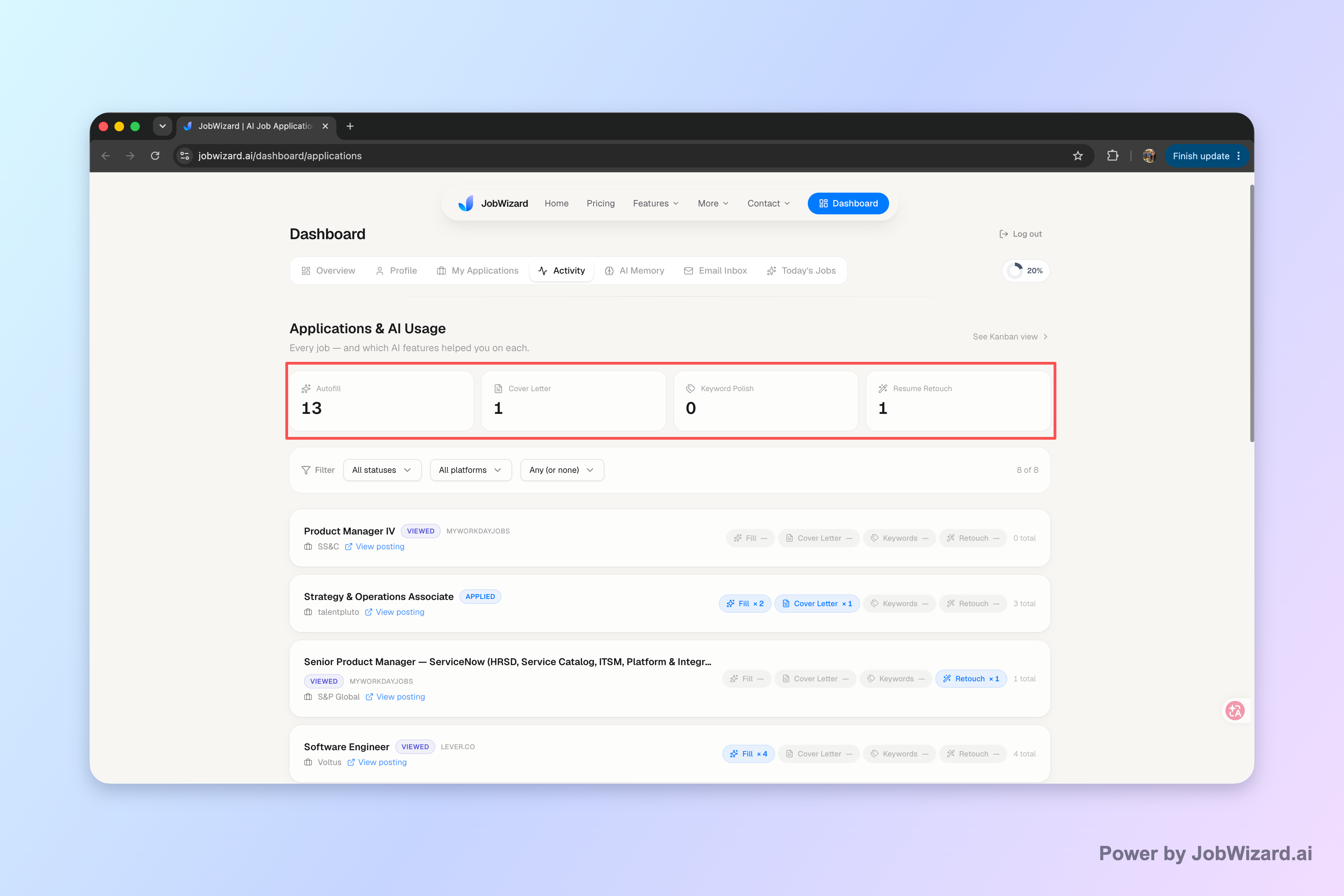
If you’re juggling multiple roles, use an application tracker / JobWizard Activity view to keep each application’s status and your next steps organized in one place. It shows where each application stands and which JobWizard tools were used for each role—so your follow-ups stay grounded in real activity, not memory.
How to follow up email after applying: the 3-step framework
Follow up email after applying works best when your message has a clear purpose, polite timing, and a question that’s easy to answer. Here’s the framework to follow every time.
- Pick timing you can defend—you’re checking in, not chasing.
- Remind them what you applied for—role name + date applied + identity.
- Ask for the next step—a direct, low-friction question that invites a reply.
Step 1: Timing that doesn’t feel pushy
For a follow up email after applying, your goal is to be helpful at the point when review is likely underway. If you don’t know their internal process, use a conservative cadence: a first check-in about a week after applying, and a second only if it’s still appropriate another week later.
Adjust when the posting signals timing (for example: “reviewing resumes on a specific date”) or when there’s a holiday/weekend buffer. And if the job ad says not to contact the team, respect that instruction.
Step 2: Make it easy to match you to the application
Your follow-up should do three things fast: state the role, confirm your submission with the date you applied, and make it unmistakably you (name is enough in most cases, but include any identifier you used—like a resume attachment name—if relevant).
Don’t rewrite your entire resume. Instead, include one tailored line that connects you to the job description or your most relevant accomplishment—enough to jog their memory.
Step 3: Ask a question they can answer
Good follow up email after applying copy doesn’t “request attention”—it invites clarity. Use questions like: “Has the team started reviewing applications?” or “Is there a next step I should prepare for?”
Keep it concise. If your message is long, hiring managers will skim harder—or not reply. Your best chance is an email that’s easy to understand in 10 seconds.
Subject lines and copy that get read (and still sound human)
Follow up email after applying templates work only if the subject line and opening lines make the email obviously relevant. Here are high-performing options and copy patterns you can adapt.
Subject line options
- Quick follow-up: [Role Title]
- Following up on my application—[Role Title]
- Application status for [Role Title]
- Re: [Role Title] application submitted on [Date]
A simple email structure you can reuse
Use this layout for your first follow-up (and tweak for a second):
- 1st sentence: role + date applied
- 2–3 sentences: short reminder + one tailored relevance line
- Last line: direct next-step question + polite close
What to include (and what to avoid)
| Do | Don’t |
|---|---|
| Confirm the role and date so they can match your application quickly. | Don’t demand an update (“You must respond”)—keep it collaborative. |
| Ask an easy question about whether they’ve begun reviewing. | Don’t attach your resume again unless the process explicitly asks for it. |
| Keep it short—most follow-ups should be skim-friendly. | Don’t add new material you can’t support (new claims, salary expectations, etc.). |
| Personalize one line using the job description keywords or your closest experience. | Don’t over-apologize (“Sorry to bother you”) repeatedly. |
If you want more examples and variants, use these related guides to adapt your tone and timing: How to Write a Follow Up Email After Application (and Get a Real Reply) and Follow Up Email After Job Application: 9 Templates + a Tracking System That Gets Replies.
Ready-to-send templates for follow up email after applying
Follow up email after applying gets easier when you start from a proven template and personalize the role, date, and one specific detail. Below are plug-and-play drafts.
Template 1: First follow-up (7 days after applying)
Subject: Quick follow-up: [Role Title]
Hi [Hiring Manager Name], I hope you’re doing well. I’m following up regarding my application for the [Role Title] position submitted on [Date]. I’m particularly interested in this role because [1 tailored sentence—tie your experience to a requirement from the job post]. Have you started reviewing applications yet, and is there anything else you need from me to support my candidacy? Thanks for your time, [Your Name] [LinkedIn URL or Phone (optional)]
Template 2: Second follow-up (another week later, if appropriate)
Subject: Following up: [Role Title] application
Hi [Hiring Manager Name], I wanted to send a quick second note about my [Role Title] application from [Date]. I remain very interested in the opportunity and believe my background in [relevant skill/area] would help the team. If the role is still under consideration, could you share what the next steps in the process look like? Thank you, [Your Name]
Template 3: Follow-up when you applied through a portal and didn’t get confirmation
Subject: Re: [Role Title] application
Hi [Hiring Team / Name], I’m checking in about the [Role Title] position. I applied on [Date] via your application portal and wanted to confirm you received it. Given your focus on [job description focus], I’d welcome the chance to be considered. Would you be able to confirm the status or the expected timeline for review? Best regards, [Your Name]
Template 4: If you’re sending to a recruiter specifically
Subject: Application follow-up: [Role Title]
Hi [Recruiter Name], I hope you’re well. I’m following up on my application for [Role Title] submitted on [Date]. I’m excited about the role—especially [specific reason tied to the posting]. Do you have a sense of whether candidates are being reviewed at this stage? If so, I’d appreciate any guidance on next steps. Thank you for your time, [Your Name]
For even tighter drafts you can adapt quickly, see How to Write a Follow Up Email After Application (and Get a Real Reply) and—if you’re transitioning into post-interview messaging—short and sweet follow-up email after interview sample: 7 ready-to-send notes.
How to track follow-ups so you never miss the right moment
Track applications so your follow-up schedule stays consistent—even when you apply to multiple companies in a single week.
Build a simple workflow
Even the best follow up email after applying strategy fails if you lose track of what you sent and when. Use a lightweight process:
- Log the role immediately with company, role title, and date applied.
- Set a follow-up date (first check-in ~1 week later).
- Draft your message early so you can personalize quickly.
- Review before sending to ensure the role, names, and facts are correct.
- Record what happened (reply, no reply, next step) for future follow-ups.
Use JobWizard Activity to keep next steps in one view
JobWizard’s Activity view helps you see application status and which JobWizard tools were used for each job. That means you can keep your follow-up timing aligned with where each application actually stands—rather than relying on memory or scattered notes.
Key principle: autofill and assistance can speed up repetitive parts of preparing your materials, but you should still review and personalize everything before you submit or send.
If you want templates plus a tracking system approach, go deeper with Follow Up Email After Job Application: 9 Templates + a Tracking System That Gets Replies.
Do this automatically with JobWizard
Skip the manual work — JobWizard's Application Tracker handles this for you.
FAQ: Follow up email after applying
Follow up email after applying questions usually come down to timing, tone, and whether follow-ups are worth the effort. Here are direct answers.
When should I follow up email after applying?
A practical rule is to wait long enough for the application to be processed—then send a short check-in. In most cases, your first follow-up goes about a week after applying, and a second (only if needed) can follow another week later. Always adjust for longer posting timelines, holidays, or if the job asks for a specific schedule.
What should I say in a follow up email after applying?
Lead with a clear subject line, remind them of the role and your key identifier (name + date applied), then ask a direct, polite question like whether they’ve started reviewing applications. Keep it concise, avoid adding new claims you can’t support, and end with an invitation to reply.
Should I send a follow up email if I don’t hear back?
Yes—if it’s been long enough that a review is likely underway, a follow-up can be appropriate. Use fewer, calmer messages: one check-in, then (optionally) one more. If the posting has a “no contact” instruction, follow it.
Can I use templates for a follow up email after applying?
Absolutely—templates help you move fast, but you should personalize at least the role title, the date you applied, and one detail from your resume (or the job description) to make it feel specific. Proofread for accuracy and double-check any company or role names before you send.
How can I track my applications so I don’t miss follow-ups?
Use an application tracker or job activity view to keep each role’s status and your next action in one place. The key is pairing tracking with follow-up timing, so you know what to send and when—without assuming every update is automatic. Review-before-submit also applies to content: generate or autofill drafts as a starting point, then you review and send.
If you want the follow-up workflow to feel automatic (without losing control), keep everything in one place: track each application’s next step, draft your follow-up, then review and send. Try JobWizard to manage your job activity and stay consistent with follow-ups after applying.
Frequently Asked Questions
Autofill your next job application
JobWizard is a free Chrome extension that fills applications, tracks statuses, and optimizes your resume.