When to Follow Up on a Job Application: The Timing That Helps (Without Annoying the Recruiter)
Wondering when to follow up on a job application? Use a simple timeline tied to typical review cycles—and track status so you don’t guess.
Free Chrome extension
Autofill your next job application
JobWizard is a free Chrome extension that fills applications, tracks statuses, and optimizes your resume.
If you’re stuck asking when to follow up on a job application, you’re not alone—timing is one of the few things you can control. Follow up too soon and you may interrupt a review; follow up too late and you risk being forgotten among hundreds of candidates.
Below is a practical, recruiter-friendly timing system you can use right away, plus how to track each application so your follow-up feels intentional—not random.
Know the core timing rule for when to follow up on a job application
Start with business days, not exact “24 hours after applying” instincts. Most hiring teams need time to move candidates from “received” to “reviewing,” and many postings don’t update status the moment you submit.
A reliable default for when to follow up on a job application is:
- First follow-up: 5–7 business days after you apply.
- Second follow-up: about 1 week later if you still haven’t heard back.
- After that: only follow up if you have new, relevant information (a new certification, updated portfolio, or a role-specific accomplishment) or if the company requests it.
Adjust timing based on what the posting (or your gut) tells you
Use the posted details to tighten the window. If the job listing includes a “consideration ends” date, align your first follow-up shortly after that date—rather than before.
Also consider signals you can observe:
- Job closes fast: If the posting says applications will be reviewed quickly, aim for the earlier end (closer to day 5).
- Job is competitive: If it’s a highly visible role, your follow-up should be short and value-focused (no long history—just the basics plus interest).
- You used a referral: Keep it a bit more conservative; referral paths often create internal review activity that you won’t see from the outside.
What to avoid (even if you feel anxious)
- No daily pings: Multiple emails in a short stretch can look like low judgment.
- No “checking in again?” without context: Every message should reference the role and what you previously sent.
- No vague subject lines: “Following up” is okay once, but be specific after that.
Build a simple follow-up workflow so you never guess
The quickest way to get timing right is to track each application in a system that tells you what to do next. That means recording when you applied, what you submitted, and which follow-up step is next.
If you want a practical structure, use a workflow like this:
- Log the application date: Store the exact day you submitted (and the role title as written).
- Set “first follow-up” for day 5–7: Pick your timing based on the default rule above.
- Set a second follow-up: Schedule it for about 1 week later, only if you still haven’t heard back.
- Write one reusable follow-up draft: Then customize it with one role-specific line.
- Review before sending: Confirm sponsorship/salary/EEO-related details and any custom questions you may have answered earlier, so your follow-up stays accurate and professional.
Use an application tracker to link “applied” to “next step”
A tracker isn’t just a list—it’s your decision engine. When you can see application status and your intended next message, it becomes much easier to answer when to follow up on a job application without second-guessing.
Start here for a complete approach: How to Track Job Applications: A Practical System (JobWizard + Beyond). Then, if you prefer a focused follow-up workflow, use Job Application Tracker Template: Build a Simple Workflow to Track Status, Next Steps, and Follow-Ups.
How JobWizard helps with application activity and follow-up timing
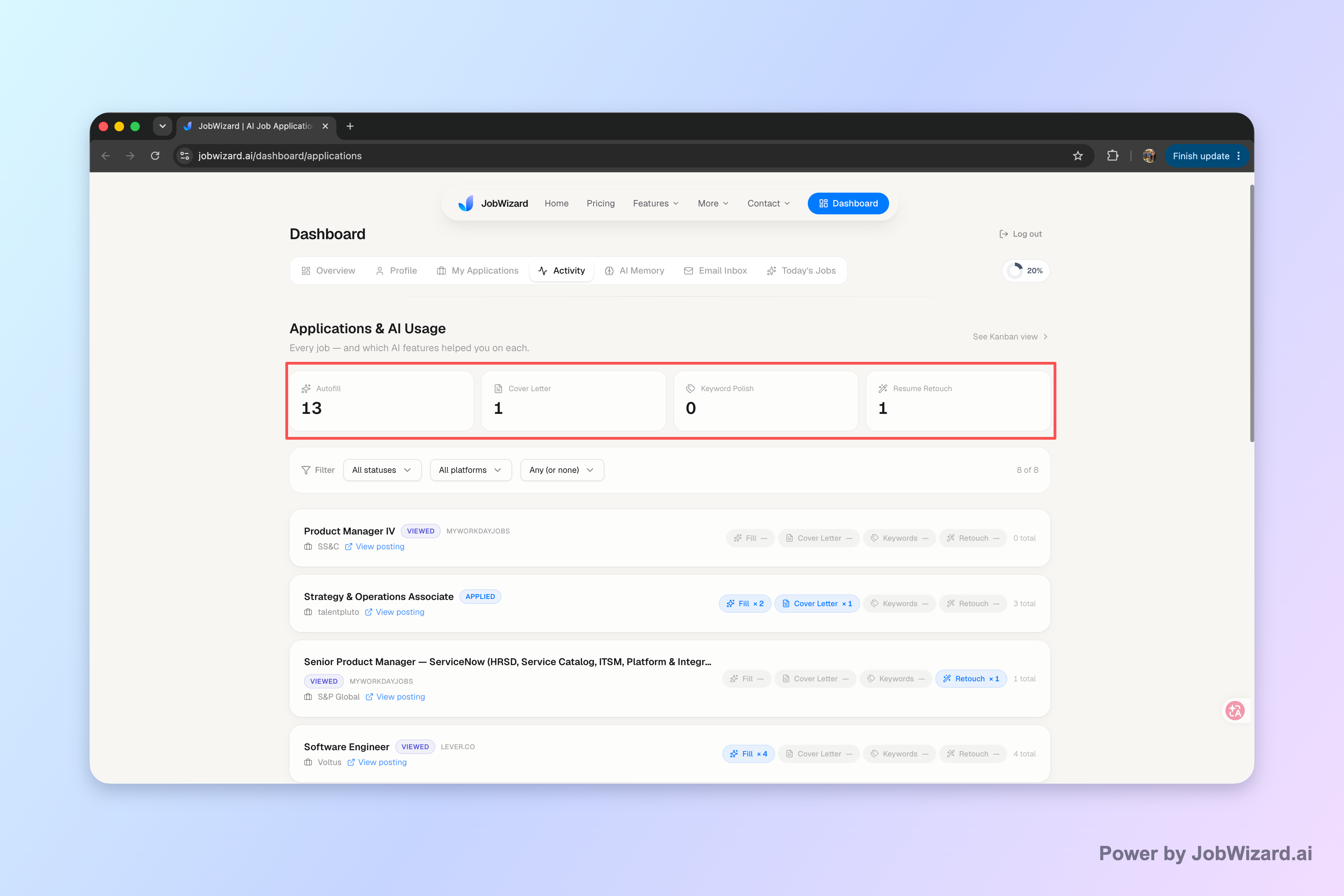
In JobWizard, the Activity view shows application status and which JobWizard tools were used for each role. That makes it easier to keep follow-ups consistent, because you can see where each application stands before you decide what to send next.
To understand the workflow end-to-end, see: Job Application Tracker: How to Track Every Application and Know When to Follow Up.
Choose follow-up content that’s confident, not demanding
Your follow-up email should be short enough to scan and specific enough to show you’re paying attention to the role. A good message reads like a respectful nudge, not a negotiation.
When deciding when to follow up on a job application, the content matters just as much as the timing. If you send on day 6, the email should still be calm and concise.
A follow-up structure that works in most cases
Use this formula:
- Line 1 (context): Role you applied for + when you applied.
- Line 2 (continued interest): One sentence on why you want the job.
- Line 3 (relevance): One concrete detail (a project, outcome, or skill match).
- Line 4 (single question): “Is the role still under consideration?” or “Is there a next step I should prepare for?”
- Close: Thank them and include your availability.
Subject lines that set the right tone
Subject lines can be simple and recruiter-friendly. If you want ready-to-use options and follow-up copy, use this resource: An Email Template for Job Application That Gets Replies (with Subject Lines + Follow-Up Copy).
Keep it specific: include the job title and “follow-up” so your email doesn’t get lost in a long inbox thread.
Example: first follow-up (day 6)
Subject: “Follow-up: [Job Title] application”
Hi [Hiring Manager Name/Team],
I applied for the [Job Title] position on [date]. I’m very interested in the role because [one sentence on fit]. In particular, I recently [relevant accomplishment/project outcome]—which aligns with what you’re looking for.
Is the role still under consideration, or is there a next step I should prepare for?
Thank you for your time,[Your Name] [Phone] [LinkedIn/Portfolio]
Example: second follow-up (about 1 week later)
Subject: “Re: Follow-up — [Job Title]”
Hi [Name/Team],
Following up again on my application for the [Job Title] role. I’m still very interested, and I wanted to ask whether you anticipate any updates to the hiring timeline.
Thank you, and I’d be happy to provide any additional information if helpful.
Best regards,[Your Name]
Handle “no response” with a disciplined, non-annoying cadence
No response doesn’t mean no—but it does mean you should get more systematic. The goal of when to follow up on a job application is to find the point where your message is timely without turning into spam.
Here’s a practical cadence for “silent” applications:
- First message: day 5–7 business days with a short, value-focused note.
- Second message: about 1 week later, even shorter and centered on the hiring timeline.
- Stop or pivot: after the second follow-up, pause unless you have new information to share or the posting reopens/updates.
If you see a status update, adjust—don’t double down
Status updates can be inconsistent, but when you do see movement (for example, “reviewing,” “in progress,” or “under consideration”), use that as guidance. Don’t send a follow-up in the middle of an obvious “finalize next steps” window—wait and let the process catch up.
Keep your follow-ups separate from your applications
Even if you use tooling to speed up repetitive fields, remember the final responsibility is on you: review and confirm what you send before it’s submitted. Your follow-up should be accurate, consistent with your application, and written in your own voice.
Track results and refine your timing over time
The best follow-up strategy improves with feedback. Each application teaches you something: whether you needed earlier timing, whether your email was too long, or whether the role’s review cycle runs slower.
Use tracking to spot patterns:
- Which industries respond faster? You may find day 5–6 works well in some sectors.
- Which roles ask for specific follow-up? Some teams prefer email over portal messages.
- Which emails get replies? Shorter, single-question follow-ups often perform better.
For a strong foundation, revisit your tracking system and update your “next follow-up” rules. Start with How to Track Job Applications: A Practical System (JobWizard + Beyond), then refine with the template workflow at Job Application Tracker Template: Build a Simple Workflow to Track Status, Next Steps, and Follow-Ups.
Do this automatically with JobWizard
Skip the manual work — JobWizard's Application Tracker handles this for you.
FAQ: When to follow up on a job application
When should I follow up on a job application if the posting doesn’t say a deadline?
A good default is to follow up after 5–7 business days, then send a second, shorter check-in about another week later if you still haven’t heard back. If the job listing provides a hiring timeline (or a candidate deadline), align your follow-up to that stated date instead of using a guess.
Is it better to follow up by email or through the job site?
If you applied through a portal, email is still usually the most direct option when contact info is available, because it’s easy for a recruiter to forward or log. If the posting specifically asks you to use a particular channel (for example, “no phone calls” or a specific email), follow that instruction first.
What should I include in a follow-up email so I don’t sound pushy?
Keep it short: remind them which role you applied for, add one line showing continued interest (or a relevant detail like a project outcome), and ask a single, low-pressure question such as whether the role is still under consideration or if there’s a next step. Close with your availability and thank them for their time.
How do I avoid following up too early when a company uses an applicant tracking system (ATS)?
Track application status and your next step in one place, and base your “first follow-up” on business days—not exact dates—so your message lands after the team has likely had time to review. Also, treat every application update as something you confirm and review before submitting any follow-up communications.
Can an application tracker help me know when to follow up?
Yes. A job tracker helps you remember when you applied, what you submitted, and what you plan to do next, so you don’t miss the window. In JobWizard, the Activity view shows application status and which JobWizard tools were used for each role, which makes follow-ups easier to schedule and manage.
Ready to stop guessing? Use JobWizard to keep each role and its follow-up step in one place—so you always know when to follow up on a job application, and what to send next.
Frequently Asked Questions
Autofill your next job application
JobWizard is a free Chrome extension that fills applications, tracks statuses, and optimizes your resume.