Application Follow Up Email Template That Gets Replies: A Reply-First Plan for “Under Review”
Use this application follow up email template to send a clear, respectful follow-up when a role is “under review.” Includes subject lines, timing cues, and a job tracker workflow.
Free Chrome extension
Autofill your next job application
JobWizard is a free Chrome extension that fills applications, tracks statuses, and optimizes your resume.
Waiting for an update is one of the most frustrating parts of the job search. The fix isn’t guessing—it’s having an application follow up email template that’s short, specific, and easy for a recruiter to reply to. This article gives you a practical template you can use right away, plus a simple workflow to keep each follow-up tied to the right application status.
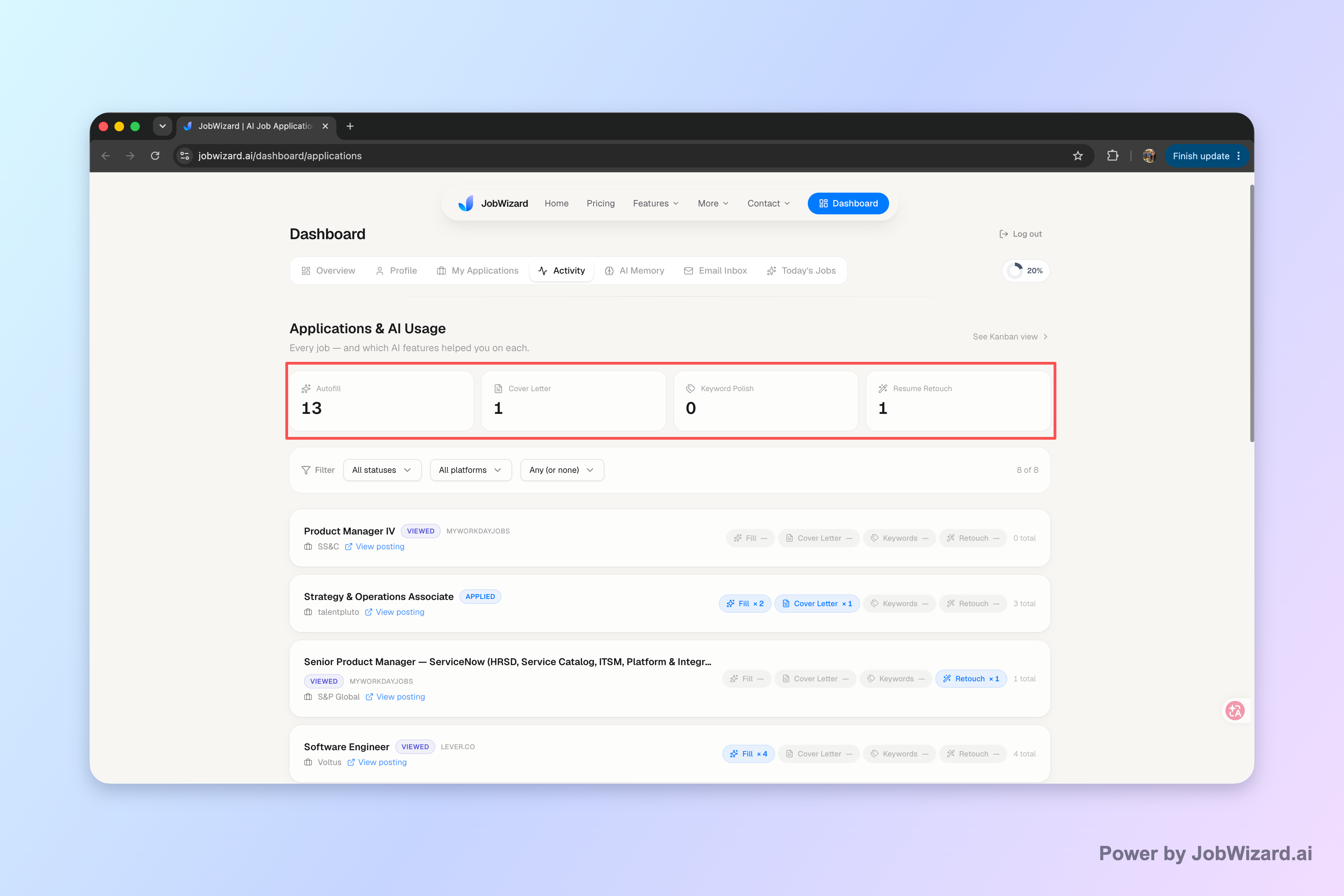
When you track applications consistently, you can follow up based on real status instead of vibes. In JobWizard, the Activity view shows where each application stands and which tools were used along the way—so you always know what you’re following up on.
Use a reply-first application follow up email template (not a “just checking” note)
The best follow-up emails do two things: (1) they make it effortless to identify your application, and (2) they ask a single question that has a clear, low-effort answer. That’s why this application follow up email template is designed to be reply-first.
Before you paste anything into an email client, quickly gather what you need: the role title, the company name, and the date you applied (or the week, if you don’t have the exact day). If you used autofill for repetitive fields, still read through the message—your follow-up is a human touch, not a form letter.
Application follow up email template (copy/paste)
Subject: Follow-up: [Role Title] (Applied [Date])
Email body: Hi [Recruiter/Hiring Manager Name], I’m following up on my application for the [Role Title] position, submitted on [Date]. I remain very interested in the opportunity and wanted to see whether there’s any update on the next steps. If helpful, I’d be glad to provide anything else you need. Would you be able to share the approximate timeline for moving forward? Thank you for your time, [Your Name] [Phone Number] | [LinkedIn or Portfolio URL]
Quick tweak options:
- When you don’t know the recruiter’s name: “Hello [Company Team/Recruiting Team],” works fine—keep the rest identical.
- If you want a shorter version: remove the “If helpful…” sentence and keep the timeline question.
- If the application portal asked questions: don’t repeat them—reference only the role title and your interest.
Choose the right timing using application activity (and avoid over-following)
Your follow-up timing should depend on the application status you’re seeing, not just how long it’s been. That’s where an application tracker helps: you can align your message to what’s actually happening.
JobWizard’s Activity view shows application status plus which JobWizard tools were used for each role. This helps you send a follow-up that matches the context—like “under review” versus “not retained.”
Note: Tracking can help you stay organized and review-before-submit your details, but it doesn’t guarantee every system will surface every recruiter update. Treat follow-ups as respectful outreach, not a promise of outcomes.
A simple follow-up rhythm you can repeat
- First follow-up: Send the template after you’ve allowed a reasonable review window.
- Wait for a response: Don’t send multiple messages back-to-back—give the hiring team time.
- Optional second follow-up: If you still haven’t heard back and the job remains active, send one more later.
- Stop when the signal changes: If you hear back, the posting closes, or you get a clear outcome, pause follow-ups for that role.
If you’re trying to decide whether it’s “too soon,” use your tracker and the posting context. If you applied only briefly ago, adjust expectations and keep your follow-up extra concise.
Follow up when you’re “under review” or “in progress” without sounding impatient
Recruiters don’t mind follow-ups—they mind ambiguity. When a role is “under review” or “in progress,” your job is to sound calm, specific, and easy to respond to.
Under review follow-up template (slightly adjusted)
Subject: Checking in: [Role Title] (Applied [Date])
Email body: Hi [Recruiter/Hiring Manager Name], I hope you’re doing well. I’m reaching out regarding my application for the [Role Title] position, submitted on [Date]. I understand the team may be reviewing candidates, and I remain very interested in the role. Is there an updated timeline for next steps or interviews? Thank you, [Your Name] [Phone Number] | [LinkedIn or Portfolio URL]
What to avoid: long paragraphs, repeated resume summaries, or demands for a decision. Keep it to one clear ask.
Not retained / dispositioned: use a closure note instead of a “why” email
If your tracker shows you’re not retained (or the system indicates disposition), pivot to a professional close. You can send a brief note only if you have an appropriate contact and the job is still relevant for future opportunities.
Subject: Thank you — [Role Title] Hi [Name], Thank you for reviewing my application for the [Role Title] position. I appreciate your time and would welcome any feedback you can share. If there are future roles that match my background in [1 relevant area], I’d be grateful to be considered. Best regards, [Your Name]
Keep your follow-ups accurate: autofill speed + review-before-submit
Fast follow-ups are only helpful when they’re correct. If you use autofill tools to populate repetitive fields, treat the message as a draft and always review what’s been filled before sending.
Across JobWizard usage, it autofills an average of about ~18 repetitive fields per application (typically 11–23). And it’s used for job application workflows on major platforms, including Workday and Greenhouse. The repetitive fields are filled quickly, while details like sponsorship/salary/EEO/custom questions are left for you to review before submission.
In other words: autofill helps you move faster, but you stay in control of the message and the final send.
How to pair your tracker with template sending
- Before sending: confirm the role title, date applied, and the current status (from your tracker).
- Before clicking “send”: review the recipient name and any content that requires your personal context.
- After sending: log it in your tracker so you don’t accidentally double-email.
This is also where JobWizard can help: the Activity view gives you one place to keep each application and its next step in view, rather than searching your email or inbox for clues.
Templates, subject lines, and quick variations to match recruiter responses
Even a great template benefits from smart variations. Below are a few plug-and-play options you can swap depending on what you’re trying to learn.
Subject line options (choose one)
- Follow-up: Follow-up: [Role Title] (Applied [Date])
- Next steps: Checking in on [Role Title]—Next Steps?
- Concise: [Role Title] Application Follow-Up
- Warm: Re: [Role Title] application
One-question variations (so you get an actual reply)
- Timeline: “Would you be able to share the approximate timeline for next steps?”
- Status check: “Is the role still in process, and is there anything else needed from me?”
- Interview path: “If the process is moving forward, I’d love to know what the next step typically looks like.”
If you only change one thing, change the question. Recruiters are more likely to respond when you ask for one specific piece of information.
Do this automatically with JobWizard
Skip the manual work — JobWizard's Application Tracker handles this for you.
FAQ: application follow up email template questions, answered
When should I send an application follow up email template after applying?
A good rule: follow up after enough time for a review cycle to start, and then stop if the posting closes or you receive a response. Keep your follow-up short, ask one specific question (like timeline or next step), and always review any autofilled details before sending.
What should I say in a follow-up email if the job is “under review” or “in progress”?
Lead with the role title and date you applied, then confirm you’re still interested. Ask about next steps or the approximate timeline for moving to interviews. Avoid adding new claims—your goal is to make it easy for the recruiter to reply.
Can I use an application follow up email template with autofill tools?
Yes—use autofill to speed up repetitive details (like role title, company, and dates), but treat the message as draft content. You should review the sponsorship/salary/EEO/custom questions or any fields that require your personal answers, and submit only after you’re confident everything is correct.
What’s a strong subject line for an application follow up email template?
Keep it simple and specific. Examples: “Follow-up: [Role Title] (Applied [Date])” or “Checking in on [Role Title]—Next Steps?” If you can’t include the exact date, use “recently applied” without sounding vague.
Should I send a second follow-up if I don’t hear back?
If you don’t receive a response, you can send one additional follow-up later—keep it even shorter, and restate your interest once. If you get a rejection or the job is clearly closed, stop following up and move on to other applications.
Ready to follow up with confidence? Keep each application and its next step in one place with JobWizard, then use the template above as your reply-first follow-up email. Start tracking now in your JobWizard Activity view.
For more follow-up options and checklists, see Job Application Follow Up Email Sample: 9 Templates + a Reply-First Checklist, and if you want subject-line-ready variations, read An Email Template for Job Application That Gets Replies (with Subject Lines + Follow-Up Copy).
To build the full workflow around your sends, use Follow Up Email After Job Application: 9 Templates + a Tracking System That Gets Replies, and for a broader tracker system, start with How to Track Job Applications: A Practical System (JobWizard + Beyond).
Frequently Asked Questions
Autofill your next job application
JobWizard is a free Chrome extension that fills applications, tracks statuses, and optimizes your resume.