Job Tracker App Free: A No-Fluff System to Track Application Status and Follow Up
Looking for a job tracker app free? Use a review-first activity workflow to track application status, see what you used, and follow up without losing context.
Free Chrome extension
Track all your applications in one place
JobWizard auto-tracks status changes across Workday, Greenhouse, and every major job site — free.
“Job tracker app free” works best when it’s an activity-first workflow
If you’re searching for a job tracker app free option, the real win isn’t paying less—it’s keeping every application’s application status and next step in one place so you can follow up without guessing.
Many job seekers try to track roles as a spreadsheet with “Submitted” and then freeze when the status changes. The result: you lose context (“Did I apply yesterday? Did I submit a tailored answer? Did I follow up?”), and your follow-up becomes inconsistent.
A better approach is to track where each application stands and what you did—then update quickly as you go. In practice, that means using a single system that supports both tracking and review-before-submit automation.
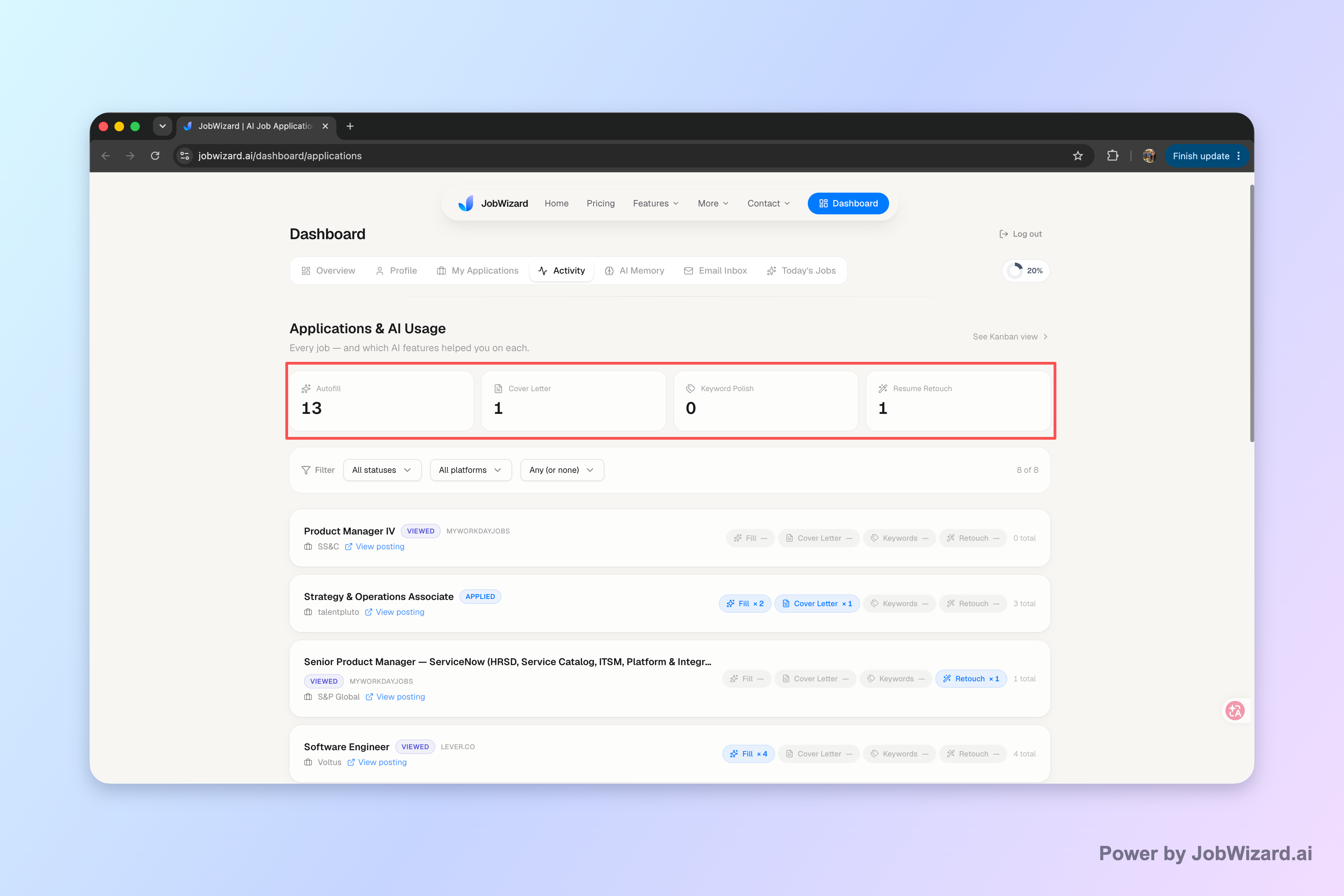
Use JobWizard’s Activity view to track application status and tool history in one pass
Job tracking gets easier when your “what happened” log is automatic, and JobWizard’s Activity view is designed for exactly that—showing application status plus which JobWizard tools were used for each role.
Instead of wondering whether a change happened because you edited something, copied something, or submitted something, you get an activity trail per application. That matters for follow-ups because your next message should match the latest state.
- Application status: see where each role stands (for example, under review / in process / pending approval).
- Activity context: understand what tools you used along the way so you can replicate what worked (and avoid repeating what didn’t).
- Follow-up readiness: update your workflow immediately so you don’t follow up on roles that already moved, were viewed, or were dispositioned.
The Activity view shows application status and which JobWizard tools were used for each role.
Important limitation: don’t assume every application update is detected automatically or that tracking alone improves hiring outcomes. Your system should help you organize and review—especially before you submit.
Pick a “free” tracking structure: central pipeline + next step, not just dates
If you want a job tracker app free setup, start by defining the columns that make follow-ups predictable. You’re not just recording history—you’re managing the next action.
Here’s a simple structure that works whether you’re using a spreadsheet, notes, or a lightweight tracker. The key is that each row answers: What is the status right now, and what do I do next?
| Field | Why it matters for follow-up | Example |
|---|---|---|
| Company + role | Prevents mix-ups when you apply to similar titles | Acme Inc — Product Analyst |
| Date applied | Sets your timing baseline for follow-ups | 2026-09-01 |
| Current application status | Stops wasted effort (e.g., don’t follow up on “not retained”) | Under review |
| Next step | Turns tracking into an action system | Follow up on 9/15 |
| What you changed / used | Helps you reproduce strong submissions | Tailored answers; autofill + review |
If you want template-style support, you can build this with proven formats like the approaches in our guides to keep your pipeline follow-up-ready and organized.
- How to Track Job Applications: A Practical System (JobWizard + Beyond)
- google sheets job application tracker template for a follow-up-ready pipeline that stays organized
- Job Application Tracker Excel: Build a Simple, Follow-Up-Friendly System (Without Losing the Thread)
Automate responsibly: autofill repetitive fields, then review before submit
If you’re combining a tracker with speed, the safest “free” approach is autofill + review-before-submit. That keeps you fast without losing control of the parts that often change from job to job.
In JobWizard workflows, autofill is focused on repetitive fields—so you can complete applications faster while still verifying the content that matters (like the exact answers to custom questions). Across applications run through JobWizard, users typically experience autofill of ~18 repetitive fields per application (often 11–23), and the repetitive fields are filled fast while sponsorship/salary/EEO/custom questions are left for you to review before submitting.
Also, across applications submitted through JobWizard, ~65% are on Workday, ~19% Greenhouse, ~12% Ashby, and ~4% Lever—Workday is where it saves the most time. Use this as a planning signal for what to expect, not a promise of outcomes.
JobWizard autofills an average of ~18 repetitive fields per application (typically 11–23), and you review key questions before submitting.
Why this matters for tracking: your tracker should reflect what you actually sent. When you rely on automation, update your pipeline immediately after you submit so your “next step” stays aligned with the latest application status.
If you prefer a browser-extension-first workflow for tracking and follow-up context, pair your tracker with an autofill-first approach:
Do this automatically with JobWizard
Skip the manual work — JobWizard's Application Tracker handles this for you.
FAQ: job tracker app free questions job seekers actually ask
Is a job tracker app free actually enough to manage application status?
Yes—if it’s built around a clear “next step” workflow. Track each role’s status (for example, under review/in process) and the action you took, then review any autofilled content before you submit.
How do I track applications without losing details from different job sites?
Use one central pipeline and keep the key context per role: company, role, date applied, current status, and your next follow-up date. If you use JobWizard, the Activity view also shows application status and which JobWizard tools were used for each role.
What’s the safest way to use automation if I want faster tracking and fewer repeats?
Prefer autofill + review-before-submit. Fill repetitive fields quickly, but leave sponsorship/salary/EEO/custom questions for you to verify, then update your tracker so the application’s “next step” stays accurate.
What should I do when an application doesn’t move for weeks?
Move the role into a deliberate follow-up step in your tracker (and note what you already sent). If your status is “not retained,” “dispositioned,” or similar, stop repeating submissions and focus on new targets instead.
Ready to track without the busywork? Start by keeping every application and its next step in one activity view—then use JobWizard’s review-first workflow so your tracker stays accurate as you apply.
Get the full job application tracking system, then add JobWizard Activity to keep status and tool history aligned from submission to follow-up.
Frequently Asked Questions
Track all your applications in one place
JobWizard auto-tracks status changes across Workday, Greenhouse, and every major job site — free.