Sample Follow-Up Letter for Job Application Status: 7 Templates + What to Say Next
Need a sample follow-up letter for job application status? Copy a recruiter-ready template, then use the right timeline and wording for common statuses.
Free Chrome extension
Track all your applications in one place
JobWizard auto-tracks status changes across Workday, Greenhouse, and every major job site — free.
Sample follow-up letter for job application status: what do you do when the silence is real?
You’re not imagining it—you applied for a role, waited a week, and now you’re staring at your inbox wondering if the recruiter even saw your application. This guide gives you a sample follow-up letter for job application status you can copy today, plus exact wording for common outcomes.
We’ll also show you a simple tracking flow so you follow up at the right time and don’t message too early or too often.
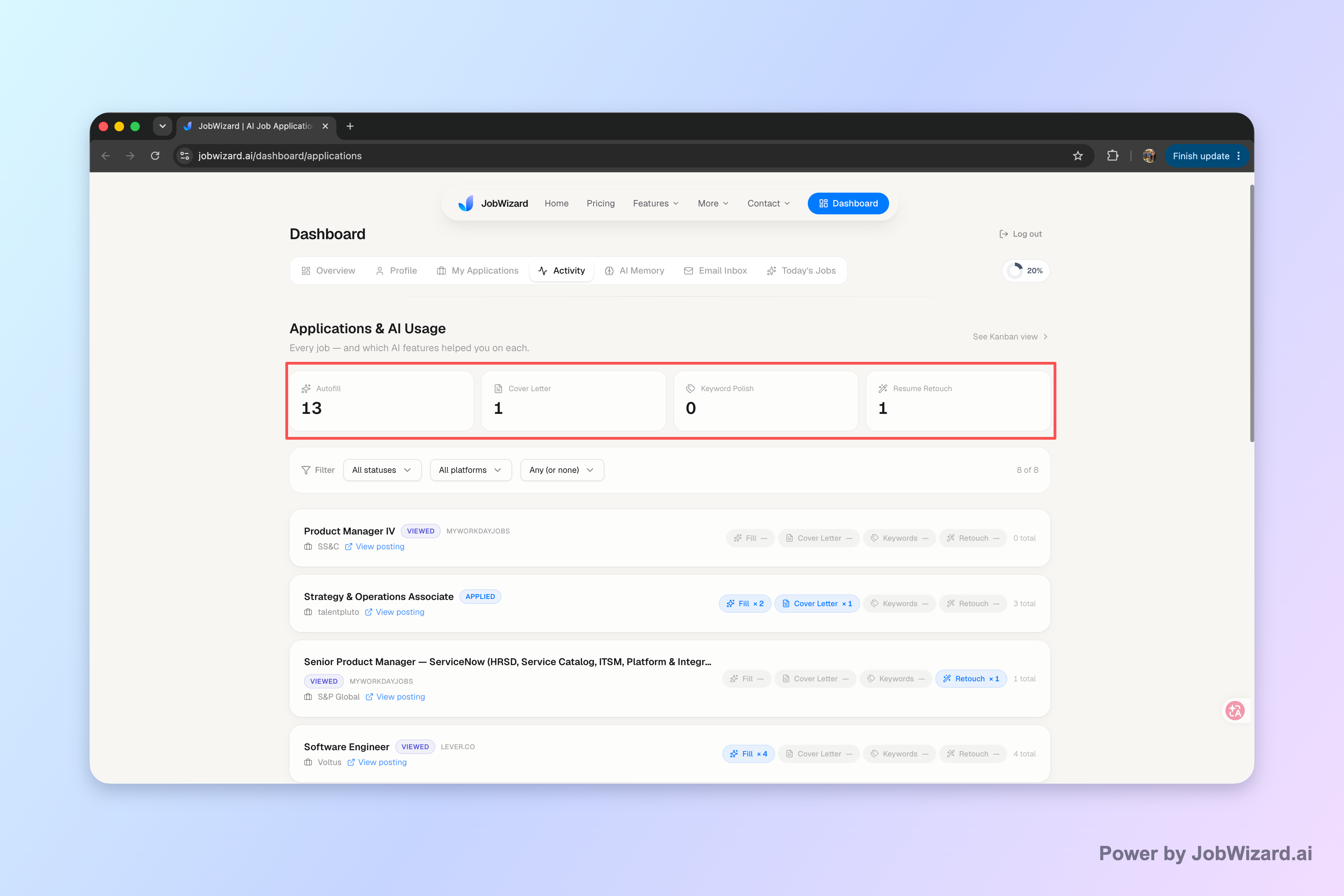
JobWizard’s Activity view is designed to help you keep your application status and what happened next in one place, including which JobWizard tools were used for each role.
When should you send a sample follow-up letter for job application status?
Timing sets the tone—too soon can sound impatient, too late can mean you missed the recruiter’s internal cadence. For most roles, a practical window is after the first review checkpoint, often about 5–10 business days after you apply.
If the job posting lists a timeline (e.g., “reviewing applications starting Monday”), anchor your follow-up to that. And if you’re following up after an interview, use a different set of language focused on scheduling and next steps.
Key takeaway: Wait until the employer’s likely “first pass” is over, then send one short follow-up asking for an update on timeline.
- Apply date: Use it to reference the exact submission.
- Business days: Avoid follow-ups on weekends unless the employer is clearly active.
- Posting timeline: If they gave a date, follow it.
- Frequency: Two to three total attempts per application is usually enough.
What should a sample follow-up letter for job application status include?
Your follow-up should be easy to answer. Most replies happen when the recruiter can scan your message and immediately connect it to the role and your application.
Use a structure like this: role + date, a one-line reminder of fit, then a clear status question, then a polite close.
- Subject line: Role-specific and obvious.
- First sentence: Role title + application date (or “submitted on”).
- Fit line: One relevant skill or proof point (keep it to one sentence).
- Status request: Ask for the current stage or expected timeline.
- Close: Offer anything additional and thank them.
Copy-paste follow-up letter for job application status (email template)
Here’s a recruiter-ready template you can customize in under five minutes. Swap in the bracketed fields and keep it short.
Subject: Follow-up: [Role Title] application Hi [Recruiter Name/Team], I’m writing to follow up on my application for the [Role Title] position, submitted on [Application Date]. I’m still very interested in the role, especially because of [one specific reason tied to the job]. If there are any updates on the hiring timeline or next steps, I’d appreciate any information you can share. If you need anything else from me, I’m happy to provide it. Thank you for your time, [Your Full Name] [Phone Number] | [LinkedIn URL] (optional)
Key takeaway: The fastest path to a response is clarity: role, date, one fit line, and a single status question.
What if the job posting says “no phone calls”—can I still follow up?
Yes, you can follow up—the key is to respect the instruction. If they say “no phone calls,” keep your follow-up to email and/or LinkedIn messages.
Keep your tone polite and concise. Avoid multiple “checking in” emails that don’t add new value. If you want to add value, do it with a single line (e.g., a relevant project, certification, or portfolio update).
How do you follow up on “application received” vs “under review”?
Different wording fits different stages. When a recruiter has only confirmed receipt, your goal is to learn the timeline; when it’s “under review,” you’re asking what comes next.
| Application/status phrase you see | What it usually signals | Recommended action to take |
|---|---|---|
| Application received | Your materials made it into the system; review may be pending. | Send one brief follow-up asking about next steps and estimated timeline. |
| Under review | Someone is actively evaluating your application or shortlist is forming. | Reconfirm interest and ask if there’s anything needed to support the evaluation. |
| In progress | Hiring workflow is active (may involve internal approvals or moving to later stages). | Ask whether the process is on schedule and if they anticipate next steps soon. |
| No longer under consideration | They may have moved on, or the posting is paused/closed. | Send a polite “future roles” message if appropriate; avoid repeated status requests. |
| Not selected | They likely decided not to move forward for this role. | Ask to be considered for similar future openings; keep the tone appreciative. |
Key takeaway: Match your request to the stage—timeline for “received,” next steps for “under review,” and future consideration for “not selected.”
What does “In Progress” mean in Workday (and how should you respond)?
“In progress” generally means the workflow is active, not that a decision has been made. Your follow-up should sound confident but non-pushy: ask for status and whether they anticipate next steps.
Keep the message tight and role-specific. If you previously tailored your resume, you can mention that briefly once—then get out of the recruiter’s way.
Key takeaway: Treat “In Progress” as “still moving” and ask about anticipated next steps or timeline.
What does “Under Review” mean in Greenhouse (and what should the letter ask for)?
“Under review” usually indicates evaluation is happening. This is the moment to ask a question that’s useful even if they can’t share details—like whether there’s anything you can provide to support consideration.
Avoid asking for instant decisions. Instead, request an updated timeline or confirmation of next steps.
What should you write for a “not selected” or “rejected” application status follow-up?
Even if you’re not moving forward, you can leave a strong impression. A “not selected” follow-up is best as a short, professional note asking to be considered for future roles.
Don’t argue the decision. Thank them, reinforce interest in the company, and—if relevant—offer a single line about your fit for similar roles.
Key takeaway: For “not selected,” switch from “status” to “future consideration” and keep it respectful.
How do you ask about an application update without sounding repetitive?
Repeat the minimum, add one useful detail. Your first follow-up should simply ask for an update. If you send a second one, avoid re-stating everything—include one new piece of relevance (new accomplishment, refreshed portfolio link, or availability change).
If you have nothing new to add, it’s often better to wait and avoid sending multiple messages close together.
- First follow-up: status/timeline request + one value reminder.
- Second follow-up: only if enough time passed + one new relevant detail.
- Stop after: 2–3 total outreach attempts for the same application.
Should you follow up by email or LinkedIn (and can you reuse the sample follow-up letter)?
Email and LinkedIn serve different purposes. Email is best for HR inboxes and formal correspondence; LinkedIn works when you already have an established connection or the recruiter is active there.
You can reuse the same core content, but tighten it: skip long signatures, remove attachment references, and keep it to a few lines.
Key takeaway: Reuse the message structure, but match the channel’s expectations and keep it shorter on LinkedIn.
How does JobWizard help you track application status and follow up at the right time?
JobWizard helps you manage the “what’s next” part by keeping your application status and related activity in one activity view. That means you can track where each role stands and which JobWizard tools were used along the way.
It’s not blind auto-submission—you still review the details before you submit, so sponsorship/salary/EEO/custom questions can stay under your control.
Key takeaway: Use a single activity view to track status and plan follow-ups—so you don’t guess or spam.
In our aggregated usage data, JobWizard has supported 720,000+ applications submitted and 600,000+ autofill sessions run through JobWizard. On average, JobWizard autofills about ~18 repetitive fields per application, while you review before submitting.
Do this automatically with JobWizard
Skip the manual work — JobWizard's Application Tracker handles this for you.
FAQ
When should I send a sample follow-up letter for job application status after I apply?
A good rule is to wait until the employer’s next checkpoint—often about 5–10 business days after applying—then follow up politely and briefly. If the posting lists a specific timeline, follow that instead, and avoid repeated messages.
What should I say in a job application status follow-up letter if I haven’t heard back?
Lead with the role title, your application date, and a simple request: whether there’s an update on the status or timeline. Keep it short, add one relevant line (skill or proof point), and end with an easy next step (e.g., “If there’s anything else you need, I’m happy to provide it.”).
How do I ask about “in progress” vs “under review” vs “not selected” statuses?
For “in progress/under review,” ask whether anything is needed to move to the next step and confirm interest. For “not selected,” ask if they’d consider you for future roles that match your background. Avoid debating the decision—keep it professional.
Should I follow up by email or LinkedIn, and can I use the same sample follow-up letter?
Email is usually best for recruiters and HR inboxes; LinkedIn is helpful if you already connected. You can reuse the same core message, but tighten it for LinkedIn and remove the “attachment/subject line” language. Always match the channel the employer expects.
How many follow-ups are too many for a job application status letter?
Most candidates stay within 2–3 total outreach attempts for a single application: an initial follow-up, a short second follow-up if no response, and then stop. If they provide an explicit deadline or next-step date, align with that and don’t message repeatedly before that date.
What subject line works best for a job application status follow-up email?
Use a clear, role-specific subject line such as “Follow-up: [Role Title] Application” or “Checking in on [Role Title] application.” If you submitted a referral or through a specific program, include that detail too.
Can I use JobWizard to track my applications so I know when to follow up?
Yes—JobWizard’s Activity view supports tracking by showing application status and which JobWizard tools were used for each role, so you can keep each application and its next step in one place before you submit anything.
What’s a copy-paste sample follow-up letter for job application status that I can customize today?
Start with: greeting + role + application date, then a single-line value reminder, then your status question. Use the template under the “Copy-paste follow-up letter” section and swap in your role, date, and one relevant detail.
Ready to follow up—without guessing?
Use JobWizard to keep your application status organized, so your follow-up timing and wording stay consistent across roles. Start by building your trackable application activity in JobWizard, then send one concise update when it’s time.
Want a stronger system for next steps? See How to Track Job Applications: A Practical System (JobWizard + Beyond) and pair your follow-up templates with an organized pipeline like Job Application Tracker Google Sheets: Build a Status + Follow-Up System You’ll Actually Use or google sheets job application tracker template for a follow-up-ready pipeline that stays organized. If you want shorter notes, use Short and Sweet Follow Up Message for Job Application: 12 Recruiter-Ready Notes.
Frequently Asked Questions
Track all your applications in one place
JobWizard auto-tracks status changes across Workday, Greenhouse, and every major job site — free.