Follow Up Letter Format That Gets Replies: A Simple Template + Tracking Checklist
Use this follow up letter format to write a clear, professional note after applying—plus a checklist for what to check before you send. Includes a ready-to-send template.
Free Chrome extension
Autofill your next job application
JobWizard is a free Chrome extension that fills applications, tracks statuses, and optimizes your resume.
If you’re searching for a follow up letter format, you’re probably stuck between “write too much” and “send nothing.” The good news: a reply-friendly follow-up is usually short, specific, and easy to act on—especially when you pair it with a simple way to track what happened to your application.
In JobWizard, you can keep your next steps straight in one place using the Activity view, which shows application status and which JobWizard tools were used for each role.
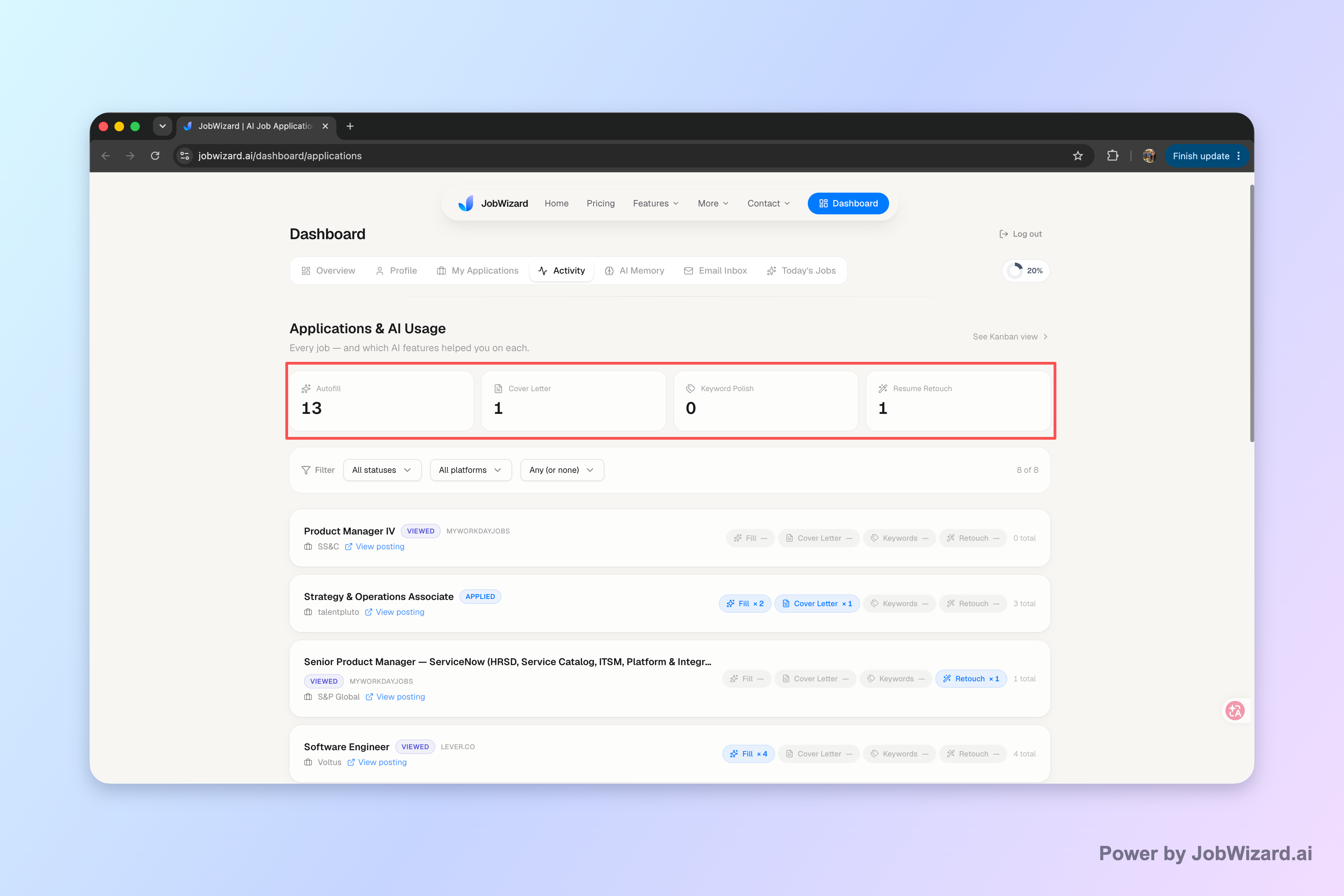
That means your follow-up letter format isn’t guesswork—you can reference the role and what you know without inventing details, and then review your note before you send.
Start with a reply-ready follow up letter format (template you can fill in)
A strong follow up letter format follows a simple order: remind them, add a quick “why me,” ask a clear question, then close professionally.
Use this template as your baseline. Replace bracketed text and keep the total length to about 150–250 words.
Template (Job application follow-up)
[Your Name] [Phone] | [Email] | [LinkedIn (optional)] [Date]
[Hiring Manager/Recruiter Name] [Company] [Company Address (optional)]
Subject: Follow-up on [Job Title] application — [Your Name]
Hi [Name], I hope you’re doing well. I’m following up on my application for the [Job Title] position submitted on [Date]. I’m very interested in the opportunity because [1 specific reason tied to the role]. In particular, my experience with [relevant skill/achievement] aligns with [what the role needs—use language from the posting]. If the role is still under consideration, I’d appreciate any update on next steps or timing. Thank you for your time and consideration—I'd be glad to provide any additional information. Best regards, [Your Name]
Make these lines do the heavy lifting
Your follow-up should be scannable in 10 seconds. To make it reply-friendly, focus on:
- Role + date in the first sentence so they can place you quickly.
- One “fit” sentence that mirrors the job description (skills, responsibilities, outcomes).
- A specific, low-friction question (e.g., “Any update on next steps?”).
- A clean close with contact info and a polite tone.
Choose the right timing: when your follow-up letter format actually lands
Timing changes whether your follow-up sounds helpful or like noise. A simple rule: follow the posting’s guidance first, then use a reasonable window after applying.
As a general approach, many applicants wait about 7–14 days after submitting before sending a brief follow-up. If the job posting lists a hiring timeline (or says “no calls”), follow that instead.
Use tracking so you don’t chase the wrong step
Instead of emailing “just in case,” check your application activity to see where each application stands and what tools were used along the way. The JobWizard Activity view is designed to show application status and which JobWizard tools were used for each role.
Important limitation: while activity tracking helps you stay organized, don’t assume every application update is detected automatically or that tracking alone improves hiring outcomes. Your goal is to review what you know, then follow up thoughtfully.
Before sending, re-check:
- Role title matches the posting exactly.
- Date submitted is correct in your first line.
- Any new context (e.g., you were contacted, an update was shared, or the status changed) is referenced neutrally.
- Your “fit” line still matches what you want to be hired for.
Follow-up wording that gets replies (and avoids the common pitfalls)
The difference between “polite” and “effective” is usually your wording. In a follow up letter format, clarity beats cleverness.
Say this
- “I’m following up on…” followed by the role and submission date.
- “I’m interested because…” with one specific tie to the posting.
- “Any update on next steps?” to make it easy for them to respond.
Avoid these phrases
- Over-explaining your situation (keep it tight—this isn’t a life story).
- Demanding timelines (“When will I hear back?” reads aggressive).
- Attaching extra files unless requested.
- Assuming they saw your application—you can ask about next steps without asserting a status.
When you’re following up with an “application status” note
If you want to reference status language you saw (like “in progress” or “under review”), keep it neutral. For example:
“I wanted to check whether there’s any update on next steps for the [Job Title] role.”
In general, don’t mention that you used a tracking tool. Instead, reference what you know about the role and ask for the next step.
JobWizard-ready workflow: write, review, and send your follow up letter format
A clean follow-up is mostly writing, but a practical workflow matters too—especially if you apply to multiple roles.
JobWizard supports a review-before-submit approach: repetitive fields can be filled fast while the user reviews sponsorship/salary/EEO/custom questions before submitting. In practice, that reduces the “retyping” burden so you can put your energy into writing strong follow-ups.
Across JobWizard usage, there have been 720,000+ applications submitted and 600,000+ autofill sessions run. JobWizard autofills an average of ~18 repetitive fields per application (typically 11–23). Of applications submitted through it, ~65% are on Workday, ~19% Greenhouse, ~12% Ashby, and ~4% Lever—Workday is where it saves the most time.
Remember: this is autofill + review-before-submit—not blind auto-apply/auto-submit. The goal is faster data entry so your follow-up letter format can be thoughtful.
How to connect your follow-up letter to your application activity
- Log your next step in the same place you track the role’s status.
- Reference the right application so you don’t mix up dates or job titles.
- Review before sending so your follow-up remains personalized and accurate.
Want more follow-up wording?
If you’re looking for examples beyond the template above, you can adapt these related guides:
- How to Track Job Applications: A Practical System (JobWizard + Beyond)
- Follow Up Letter Sample: Write a Confident Note That Gets a Real Reply
- Follow Up Application Letter: 7 Templates + a Review-First Next-Step System That Gets Replies
- Get a sample of follow up letter for interview—plus a ready-to-send template
Do this automatically with JobWizard
Skip the manual work — JobWizard's Application Tracker handles this for you.
Follow up letter format FAQ (quick answers you can use today)
What’s the best follow up letter format for a job application I submitted online?
Use a short, scannable follow up letter format: (1) one line reminding them you applied, (2) 1–2 lines on why you fit, (3) a brief question about next steps, and (4) a polite close with your contact info. Keep it to one page and avoid attachments unless requested.
How long should I wait before sending a follow up letter?
A common approach is to wait until there’s been enough time for a review cycle to start (often about 7–14 days after applying), then send a brief follow-up. If the posting lists a specific timeline, follow that instead. If you’re unsure, check your application activity and send the note only when you have something new to reference.
Should my follow up letter format mention “tracking” or an application status update?
In most cases, don’t mention tracking tools. Instead, reference verifiable details (role title, date submitted, and any status phrasing you were given). If you’re following up because you saw a change like “under review” or “in progress,” phrase it neutrally: “I wanted to see if there’s any update on next steps.”
Can I use the same follow up letter format after an interview?
Yes—keep the structure, but shift the focus. After an interview, reference the conversation (a topic you discussed or the interviewer’s priority) and reiterate your fit. If you’re sending after a panel or recruiter screen, mention the specific role and date of the interview in the first line.
Do I need a different follow up letter format for recruiters vs. hiring managers?
Use the same core follow up letter format, but tailor the first line. If you’re emailing a recruiter, say you’re following up on the application to the role they shared and ask about timeline or next steps. If you’re emailing a hiring manager, keep it role-focused and ask whether they’re reviewing candidates for the next stage.
Ready to follow up faster (and keep everything straight)? Start using JobWizard’s Activity view to track your application status in one place, then write your follow up letter format from the template above—review it carefully, and send with confidence.
Frequently Asked Questions
Autofill your next job application
JobWizard is a free Chrome extension that fills applications, tracks statuses, and optimizes your resume.