Follow Up Letter Sample: Write a Confident Note That Gets a Real Reply
Need a follow up letter sample that sounds professional and timely? Use this ready-to-send framework to check application status and keep your momentum.
Free Chrome extension
Autofill your next job application
JobWizard is a free Chrome extension that fills applications, tracks statuses, and optimizes your resume.
Follow up letter sample: what to write (and when) so your message lands
If you’re looking for a follow up letter sample, the goal is simple: confirm the role you applied for, ask about next steps, and sound professional—not pushy. A strong follow-up email is short, specific, and easy for a recruiter to act on.
In this guide, you’ll get a ready-to-send template, plus a follow-up plan you can repeat for different application stages. You’ll also see how to keep your follow up letter sample consistent with your application tracker workflow.
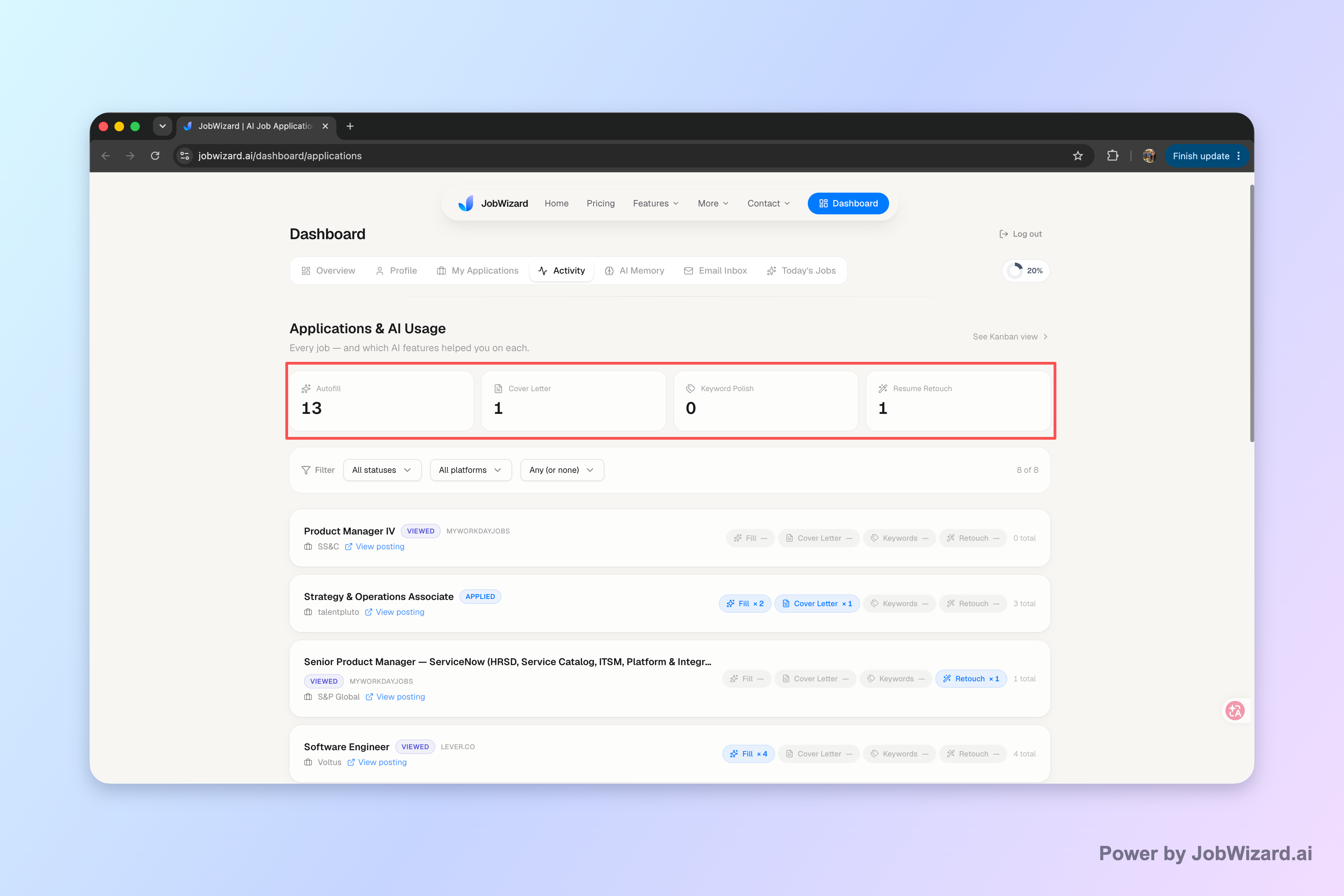
A quick way to stay organized is to track where each application stands. With JobWizard, the Activity view shows application status and which JobWizard tools were used for each role, so you can follow up at the right moment and avoid duplicate outreach.
Follow up letter sample template (application status email)
Use this follow up letter sample when you’ve applied and want to check whether your application is under review or if there’s a next step. Keep it under 150–200 words so it’s easy to read quickly.
Subject options (pick one): “Checking on my application: [Role Title]” / “Application status: [Role Title]”
Email template:
Hi [Hiring Manager Name], I hope you’re doing well. I’m writing to follow up on my application for the [Role Title] position submitted on [Date Applied]. I’m very interested in the opportunity, especially because my experience with [1 relevant skill or achievement from the posting] aligns with what you’re looking for. Could you share whether the role is still under consideration and if there are next steps I should be aware of? Thank you for your time and consideration. [Your Full Name] [Phone Number] | [Email] | [LinkedIn or Portfolio URL]
Pro tip: If you don’t have the hiring manager’s name, “Hi [Team/Recruiting Team]” is a clean fallback. Your template should still include the role title, application date, and one tailored line.
How to customize your follow up letter sample for each stage
Follow ups work best when they match your stage—application review, interview scheduling, or post-interview consideration. Below are practical ways to adjust the tone and question you ask.
After applying (no response yet)
- Status-focused: Ask whether the application is under consideration and what the timeline looks like.
- Low-commitment question: “Is there anything else you need from me?” helps if you’re not sure what they expect.
- One proof line: Mention one relevant skill or project that connects to the job description.
After an interview
- Reinforce fit: Briefly restate how your experience matches the conversation topic.
- Ask about next step: “Do you have an estimated timeline for next steps?” sounds confident and helpful.
- Keep it warm: This isn’t a second interview invitation—it’s a polite reminder of interest.
If you were asked to wait or provided a timeline
- Reference the timeline: “As we discussed, I wanted to check in regarding next steps.”
- Short and respectful: Avoid long explanations; recruiters appreciate clarity and brevity.
Want additional role-specific wording? Use these related templates to match your situation quickly: Get a sample of follow up letter for interview—plus a ready-to-send template.
When and how to send: a follow-up schedule that stays professional
The timing of your follow up letter sample affects how it’s received. Aim for follow-ups that are frequent enough to show interest, but not so frequent that they feel repetitive.
Because each company moves at its own pace, use the posting context and your own records to decide when to check in. If you can see the role has moved into a new stage (or the posting timeline has passed), that’s a solid signal to send your next note.
- Step 1: Apply and save the details. Record the role title, application date, and any confirmation details.
- Step 2: Set a reminder to check status. Choose a date that’s reasonable based on the job’s timeline.
- Step 3: Send one concise status request. Use the template above and keep the question clear.
- Step 4: Wait, then decide next action. If there’s no response, you can follow up again later—but avoid repeated messages that ask for the same thing.
If you want a structured set of messages for different status scenarios, use: Sample Follow-Up Letter for Job Application Status: 7 Templates + What to Say Next and Follow Up Application Letter: 7 Templates + a Review-First Next-Step System That Gets Replies.
Keep it organized: use your activity tracker to avoid duplicate follow-ups
A follow-up letter sample is only useful if you know what you’ve already sent. Otherwise, you can accidentally repeat outreach at the wrong time or lose track of which roles are still active.
JobWizard’s Activity view shows application status and which JobWizard tools were used for each role, helping you manage each next step. That means you can focus on writing stronger messages—because you’re not guessing where each application stands.
Key takeaway: Track application status so your follow-up emails align with what’s happening—then personalize your note so it’s easy to respond to.
Because this is a review-before-submit workflow, you still control the content and sponsorship/custom question answers. Your job is to double-check details and submit yourself—automation should remove the repetitive typing, not replace your judgment.
Ready to streamline your follow-ups? Start by keeping every application and its next step in one place with JobWizard—so your next follow up letter sample goes out at the right time.
Do this automatically with JobWizard
Skip the manual work — JobWizard's Application Tracker handles this for you.
FAQ: follow up letter sample questions recruiters actually expect answers for
How soon should I send a follow up letter sample after applying?
A good rule of thumb is to wait until the job’s posting timeline has passed and you can reasonably expect your application to be reviewed. Then send a short, status-focused note that asks about next steps without sounding demanding.
What should I include in a follow up letter for application status?
Include the role title, when you applied, and one specific detail (a skill or project) that matches the posting. Then ask a clear question about status or timing, and end with a polite closing and your contact info.
Can I reuse the same follow up letter sample for every job?
You can reuse the structure, but you should customize at least the role title, company name, and one line that ties your background to the job. Personalizing those parts keeps the message credible.
Should I follow up by email or through the company’s application portal?
Email is often best when you have a contact address, while the portal can be appropriate if it’s the only channel the posting mentions. If you use email, keep it concise; if you use a portal, follow the required fields and avoid re-submitting anything unnecessary.
How can an application tracker help with follow ups?
An application tracker helps you remember what you sent, when you applied, and which stage each role is in—so your follow ups stay timely. With JobWizard’s Activity view, you can see application status and which JobWizard tools were used for each role.
CTA: Keep your follow-ups on schedule with JobWizard—track application activity in one place so your next message is timely, relevant, and easy to respond to.
Frequently Asked Questions
Autofill your next job application
JobWizard is a free Chrome extension that fills applications, tracks statuses, and optimizes your resume.