Follow Up Email Application Playbook: Get Clear Answers Without Guessing
A follow up email application strategy that pairs smart tracking with a reply-first message. Here’s how to ask for the right next step—fast.

Free Chrome extension
Autofill your next job application
JobWizard is a free Chrome extension that fills applications, tracks statuses, and optimizes your resume.
If you’re sending a follow up email application and getting silence, the problem usually isn’t your tone—it’s that your message isn’t tied to the application stage. The fastest way to get clarity is to combine application activity tracking with a reply-first follow-up that asks for one clear next step.
Pair your follow up email application with real application activity
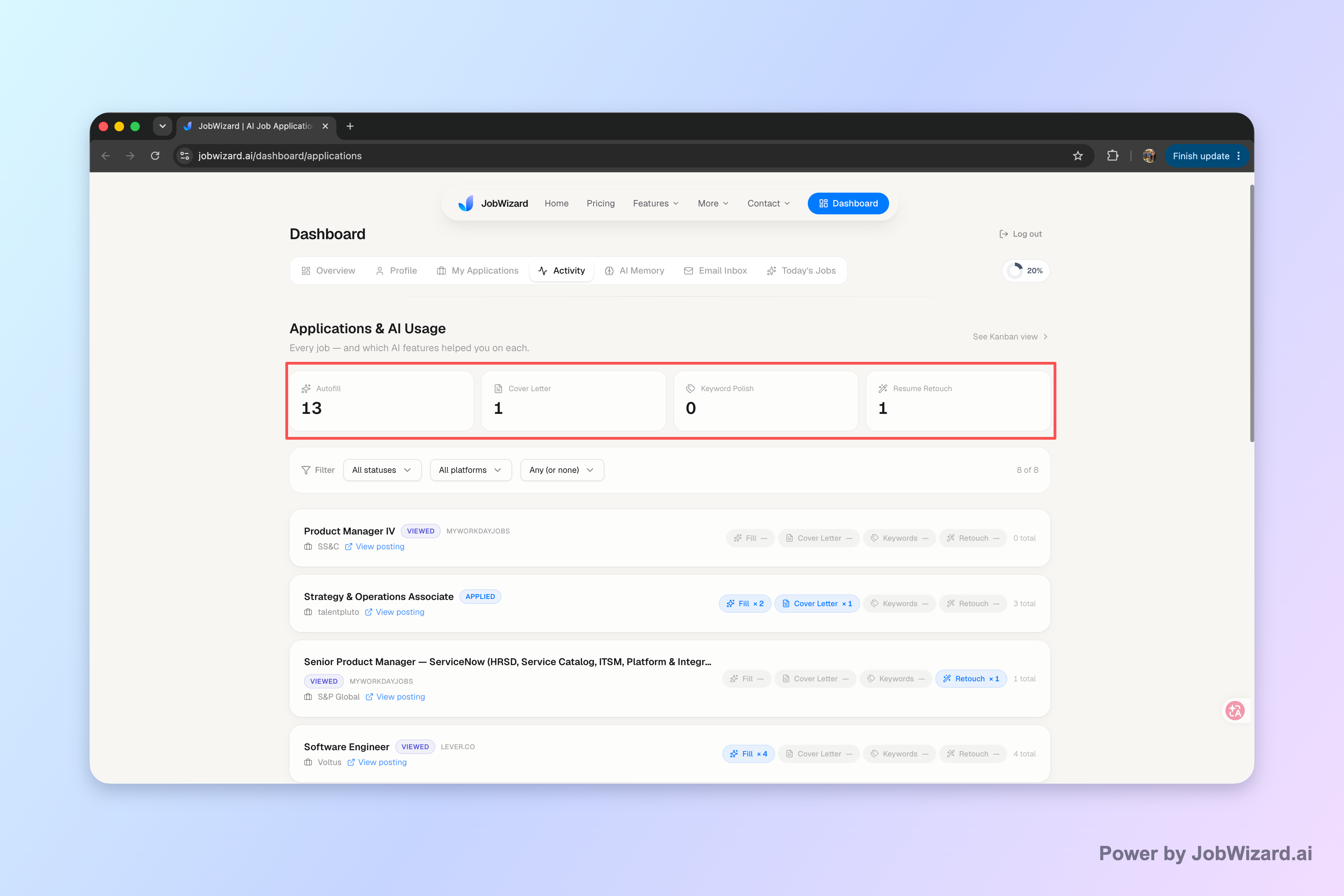
Your follow up email application works best when it’s grounded in what the employer actually sees. That means tracking status and your own application activity so you’re not emailing “just to check” without context.
JobWizard’s Activity view is designed for exactly this: it shows application status and where each role stands, along with which JobWizard tools were used along the way. Instead of guessing, you can align your follow-up with the current stage—especially when a job moves through phases like “under consideration” or later “in process” states.
- Track application status so your email matches the stage (not your assumptions).
- Use a tracker to prevent overlap when you’ve applied to multiple roles and don’t want to email the wrong one at the wrong time.
- Review before you submit—the Activity view helps you coordinate next steps while you stay in control of the content you send.
In total, JobWizard users have submitted 720,000+ applications and run 600,000+ autofill sessions; the repetitive fields are filled fast while sponsorship/salary/EEO/custom questions are left for the user to review before submitting.
Important limitation to keep in mind: a tracker can help you stay organized and align your follow-up with what you’ve observed—but you can’t assume every update will be detected automatically, or that tracking itself guarantees better hiring outcomes. Think of tracking as a way to reduce randomness and make your follow-up more relevant.
Know what “under review” should change in your follow up email application
When a job is “under review,” your follow up email application should ask for the next milestone—not demand an outcome. Employers are filtering applicants, and your email should support that process.
If your tracker shows a stage like “under review” or “under consideration,” your follow-up should be brief and process-focused. Avoid sounding like you’re worried something went wrong. Instead, confirm you’re still interested and ask what happens next.
Use this quick structure for your message:
- 1-line role reminder: “I applied for the [Job Title] role on [date].”
- 1-line continued interest: “I’m still very interested because [relevant fit].”
- 1 clear question: “Is there a next step I should prepare for?”
- Close + availability: “I’m available to provide anything else you need. Thank you for your time.”
If the employer’s timeline is unclear, you’re better off asking about process than pushing for a date. A reply-first approach tends to work better because it makes it easy for the recruiter to respond with instructions, even if they can’t share specific timing.
For a deeper walkthrough that includes what “under review” typically means and the follow-up email that fits, use this guide: Application Under Review: What It Usually Means, How Long It Takes, and the Follow-Up Email That Fits.
Write a reply-first follow up email application (template you can adapt)
The goal of a follow up email application isn’t to “check in”—it’s to earn a reply with the next step. That means your subject line and your question should make responding effortless.
Below is a reply-first template you can adapt for most roles. Keep it short, and tailor the role title and one detail you genuinely match.
Subject: Follow-up: [Job Title] application
Email: Hi [Recruiter/Hiring Team Name], I applied for the [Job Title] role on [date]. I’m still very interested, especially given my experience with [1 relevant skill/impact]. Could you share what the next step looks like for candidates at this stage? If there’s anything else you need from me to move forward, I’m happy to provide it. Thank you, [Your Name] [Phone] | [LinkedIn/Portfolio]
- Ask one question so the recruiter can respond in one line.
- Keep it stage-aware: if your tracker says “under review,” don’t ask about interview logistics yet.
- Make replying low-effort: give an easy way to direct you (status update, next step, or “we’ll reach out if selected”).
If you want additional subject lines and variations (including versions that are intentionally reply-first), this resource helps you send a consistent message without starting from scratch: Job Application Follow Up Email Sample: 9 Templates + a Reply-First Checklist.
Use a job tracker status to choose the right follow up email application timing
A job tracker turns “when should I email?” into a decision you can justify. Instead of choosing a random day, you can follow a simple sequence based on what your tracking shows.
Here’s a practical approach:
- Apply and log it: add the role to your tracker so it’s tied to the correct job, date, and status.
- Wait for meaningful stage movement: if the job progresses (for example, toward “under review” or later phases), then follow up with a message that matches that stage.
- Follow up once, briefly: keep the email focused on next steps and your continued interest.
- If no reply, follow up again later: only after additional time and/or status movement so your second email still feels relevant.
If you’re building your tracking workflow, start here: How to Track Job Applications: A Practical System (JobWizard + Beyond). And if your problem is specifically “I don’t know what to do next,” this one connects the tracker to the next email you should send: Follow Up on Job Application Fast: Use a Job Tracker to See Status, Then Email the Right Next Step.
Another limitation worth stating clearly: a tracker won’t magically prevent a recruiter from not responding. What it improves is your consistency—fewer mismatched messages, fewer lost dates, and fewer “wrong job/wrong stage” follow-ups that reduce response chances.
Do this automatically with JobWizard
Skip the manual work — JobWizard's Application Tracker handles this for you.
FAQ: follow up email application
When should I send a follow up email after I apply?
Send it based on your application’s activity and the job’s timeline—not on guesswork. If you can see whether your application is “under review” or progressed to a later status in your tracker, follow up after that point so your email matches the current stage. If you don’t have any signal yet, wait until the job posting’s typical screening window passes (or 5–10 business days) before sending a brief first follow-up that asks for the next step.
What should I say in a follow up email application message?
Keep it short, specific, and action-oriented. Reference the role title and where you applied, then ask a single clear question like: “Is there anything else you need from me to move forward?” If you’re using a reply-first approach, offer an easy next-step option (e.g., a short call or instructions to reply with status). Leave salary/sponsorship/EEO/custom-question answers for the user to review before submitting anything—your goal is a reply, not another form.
How do I track application status so my follow up email application doesn’t feel random?
Use an application tracker that shows application status and captures your application activity. In JobWizard’s Activity view, you can see where each application stands and which JobWizard tools were used for each role, so your follow-up aligns with the actual stage rather than your best guess.
Should I use autofill or auto-submit for follow ups?
Treat follow-ups as “autofill + review-before-submit,” not blind automation. Autofill can quickly populate repetitive fields while you review sponsorship/salary/EEO/custom questions before submitting. For follow-up emails specifically, you should always tailor the message to the current application stage and your specific role details.
Can a follow up email application help if the job is marked “under review”?
Yes—if your email asks for the next step in a way that fits the stage. When a role is “under review,” your follow-up should be brief and focused on timing and process (e.g., whether they’re still considering applicants and what the next milestone is). Use your tracker’s stage signal so you don’t ask about interview scheduling too early or sound like you missed information.
Ready to follow up with confidence? Use JobWizard to keep each role and its current next step in one Activity view—then send a reply-first follow up email application message that matches where the application actually stands.
Frequently Asked Questions
Autofill your next job application
JobWizard is a free Chrome extension that fills applications, tracks statuses, and optimizes your resume.