Example of a Follow Up Email After Application: A Reply-First Message + Timing Rules
Looking for an example of a follow up email after application that gets replies? Use this reply-first template and timing rules, plus how to track status updates.
Free Chrome extension
Autofill your next job application
JobWizard is a free Chrome extension that fills applications, tracks statuses, and optimizes your resume.
You don’t need a “perfect” follow-up—what you need is an example of a follow up email after application that’s easy to reply to, sent at the right moment, and grounded in what the employer likely needs next (not what you want to hear).
Below is a reply-first message you can copy, plus the timing rules and checklist that keep your follow-up from sounding pushy or generic.
Use this example of a follow up email after application (reply-first and specific)
This example of a follow up email after application is written to prompt a quick response—yes/no, a status update, or a next step—without forcing the hiring team to dig.
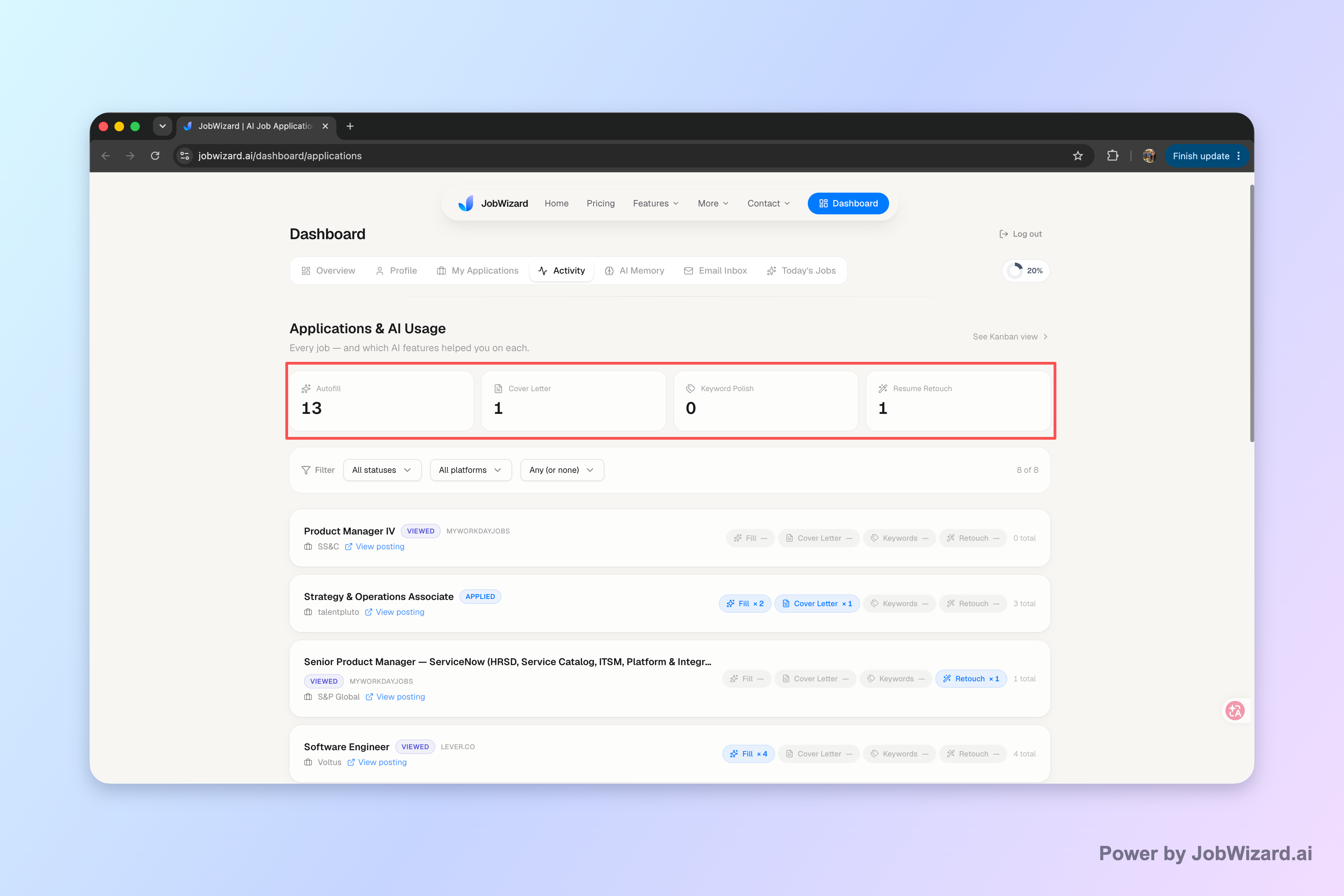
Before you send, use an application tracker so you know what stage you’re in and what you submitted. JobWizard’s Activity view shows application status and which JobWizard tools were used for each role, so you can follow up with confidence instead of guessing.
Template: reply-first follow-up email after applying
Copy/paste, then replace the brackets.
Subject: Quick follow-up: [Role Title] application
Hi [Hiring Manager Name/Team],
I applied for the [Role Title] position on [Date you applied]. Could you share whether it’s currently under consideration or if there’s anything else you need from me?
In case it helps, my background in [1–2 relevant strengths] aligns with [specific job requirement]—especially my experience with [brief, concrete example].
Thanks for your time, and I look forward to your update.
Best regards,[Your Name][Phone] | [LinkedIn] | [Email]
Why this works (and what to keep)
- It asks for something easy to answer: “share whether it’s under consideration” or “is there anything else you need.”
- It includes one tight proof point: a concrete example tied to one job requirement.
- It stays short: hiring teams often scan; your goal is to be readable in one pass.
Choose the right timing: when to follow up after applying
Timing affects whether your message feels helpful or annoying—so use a predictable cadence and keep it limited.
Simple timing rule you can actually follow
- First follow-up: wait about 5–7 business days after you apply.
- Second follow-up (only if appropriate): send another note after another 5–7 business days if you still have no response.
- Then stop: after two follow-ups, pause and shift focus to other targets and interview prep.
Adjust when the posting changes
- If the job listing says “no phone calls”: keep follow-up email-only.
- If the listing mentions a review date: follow that timeline rather than rushing.
- If you’ve had an interview: move into post-interview thank-you follow-ups instead of “application status” messages.
Make your follow up sound personal—without rewriting your whole story
The difference between “spammy” and “credible” is usually specificity, not volume.
Swap these placeholders with real details
- Date applied: match it to when you submitted.
- One requirement: pick a phrase from the posting and reflect it (e.g., “stakeholder reporting,” “customer onboarding,” “data analysis”).
- One example: a result, project, or responsibility you can explain in one line.
Subject line options that don’t feel demanding
- “Quick follow-up: [Role Title] application”
- “Following up on my [Role Title] application”
- “Checking in: [Role Title] submission”
What not to do in your example of a follow up email after application
- Don’t rewrite your entire resume. Keep it to one sentence of fit plus your proof point.
- Don’t over-apologize. Confidence beats nervousness when you’re asking for a status update.
- Don’t threaten. Avoid “If I don’t hear back” language that can trigger defensiveness.
Know what to say based on the employer’s likely status
You can’t see the internal hiring timeline, but you can still write a follow-up that fits common scenarios.
Message angle by status (use the phrasing that matches)
| What you’re trying to learn | Use this question | Example line to include |
|---|---|---|
| Are you being reviewed? | “Could you share whether it’s currently under consideration?” | “I’m excited about the team’s focus on [area], and I’d love the chance to contribute.” |
| Is anything missing from your submission? | “Is there anything else you need from me to support my application?” | “If helpful, I can also share additional details about [relevant experience].” |
| Are you next in line for interviews? | “Do you have an updated timeline for next steps?” | “I’m available for interviews [days/times], and I can adjust quickly to your schedule.” |
Optional add-on for high-signal follow-ups
If you have a relevant connection, reference it in one line—otherwise, keep it clean.
- Connection add-on: “We previously discussed [topic] during [event/date].”
- Portfolio add-on: “If you review work samples, mine are here: [link].”
Track applications so your follow-up email after application stays accurate
When you follow up without tracking, you risk contradicting your own timeline—especially if a company updates an application portal or if you applied to multiple roles.
What to track for every application
- Submission date: the exact day you applied.
- Role and posting details: role title, department, and any reference code.
- Next-step expectation: “waiting on review,” “scheduled interview,” or “no response yet.”
- Follow-up dates: so you don’t double-message too early or too late.
Where JobWizard fits in
JobWizard’s Activity view helps you keep your workflow organized by showing application status and which JobWizard tools were used for each role. That matters because follow-ups work best when you’re consistent: you review the repetitive information, fill it quickly, and submit yourself—then track what happens next.
If you want a tighter system, start with:
- How to Track Job Applications: A Practical System (JobWizard + Beyond)
- Job Application Follow Up Email Example: Reply-First Notes for After You Apply
- How to Write a Follow Up Email After Application (and Get a Real Reply)
- Follow Up Email After Job Application: 9 Templates + a Tracking System That Gets Replies
Do this automatically with JobWizard
Skip the manual work — JobWizard's Application Tracker handles this for you.
FAQ: example of a follow up email after application
How long should I wait before sending an example of a follow up email after application?
A common approach is to wait about 5–7 business days after you apply, then follow up once. If the posting lists a specific timeline, follow that instead, and keep your follow-up respectful and brief.
What subject line should I use for a follow up email after applying?
Use a clear, low-pressure subject line that references the role and your action, such as “Quick follow-up: [Role Title] application” or “Following up on my [Role Title] application.”
Should I attach my resume again in a follow up email after application?
Usually no—unless the job posting explicitly asks for it or the company asked you to re-send materials. Instead, include a one-line reminder of your fit and point them back to the original application.
What if I don’t hear back after the first follow up?
If you don’t get a reply, you can send one more short follow-up after another 5–7 business days. Then pause—focus your time on new applications and interview prep rather than sending repeated emails.
How can I track my applications so I know what to say in the follow up?
Keep an application tracker with status notes and any interactions (like who received it and what you included). JobWizard’s Activity view shows application status and which tools were used for each role, helping you keep next steps organized while you review and submit.
Ready to send your next follow-up? Keep each submission and its next step in one place with JobWizard—then use the reply-first example above to write a follow-up you’d actually want to receive.
Frequently Asked Questions
Autofill your next job application
JobWizard is a free Chrome extension that fills applications, tracks statuses, and optimizes your resume.