Follow Up Application Letter: 7 Templates + a Review-First Next-Step System That Gets Replies
A follow up application letter helps you stay professional after applying. Use these templates and a review-first workflow to reference your application status without sounding pushy.
Free Chrome extension
Autofill your next job application
JobWizard is a free Chrome extension that fills applications, tracks statuses, and optimizes your resume.
If you’ve been staring at “submitted” for days, a follow up application letter is the simplest way to re-introduce yourself—without sounding like you’re chasing. The key is timing, specificity (role + reference), and a review-first message you can personalize before you send.
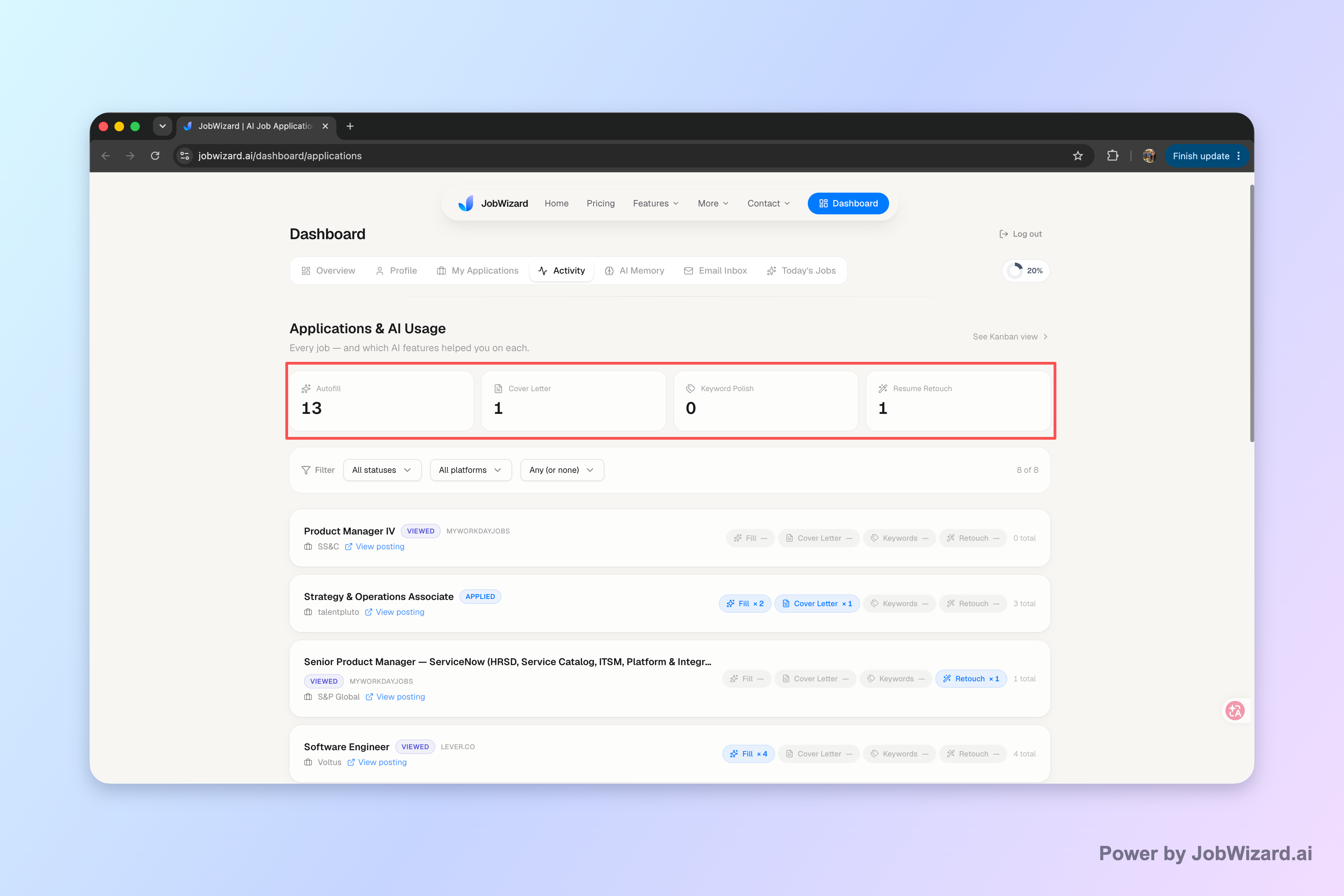
JobWizard’s Activity view helps you keep context: it shows application status and which JobWizard tools were used for each role, so your follow up doesn’t start from scratch.
What a Follow Up Application Letter Should Accomplish (and What It Should Avoid)
A follow up application letter should move your application from “unknown” to “reviewed/considered” by prompting an update—professionally. Your goal isn’t to pressure; it’s to make it easy for the hiring team to locate you and understand your interest.
Think of it as a short nudge with value. A good letter typically does three things: references the role you applied for, adds one relevant proof point (skill or result), and asks a clear question about timing or next steps.
Here’s what to avoid so your follow up doesn’t backfire:
- Vague statements like “Just following up” without role or timeframe.
- Long rewrites of your resume/cover letter (paste only a sentence or two of relevance).
- Frustration or demand language (“I need an answer now”).
- Too many follow ups in a short window. One well-timed message beats multiple quick pings.
When to Send Your Follow Up (Timing Rules That Keep You Polite)
Send your follow up application letter when it’s reasonable for the team to have received and reviewed your materials. If you follow a simple cadence, you’ll sound proactive—not desperate.
Use these timing guidelines as a default:
- 7–14 days after applying is a common baseline for first follow ups.
- After a posting closes (if listed) can be a smart alternative to “day 7.”
- If they mention an internal deadline or “reviewing resumes starting X,” align your message to that date.
- If you’re invited to screening or an assessment, switch to a thank-you + logistics follow up instead of repeating status requests.
If you don’t hear back after the first note, wait a bit and then send a second message that’s even shorter—often focused on continued interest plus one updated detail (availability, a recent relevant achievement, or a clarification you forgot to include).
7 Follow Up Application Letter Templates You Can Customize Fast
Templates help you stay clear and respectful—but you should customize at least the role line, the proof point, and one specific reference (date, posting link, or job requisition number).
Below are seven templates written for email or letter use. Replace bracketed fields and keep each message readable in under a minute.
Template 1: First Follow Up (Status + Continued Interest)
Best for: 7–14 days after applying.
Subject: Follow up on [Job Title] — [Your Name]
Hello [Hiring Manager/Team],
I applied for the [Job Title] position on [Date]. I’m very interested in the opportunity and wanted to check whether there is an update on the status of my application.
In my recent work at [Company/Team], I [one concrete value point—skill/result]. I believe this aligns well with what you’re looking for in the role.
If there’s anything else you need from me, I’d be happy to provide it. Thank you for your time and consideration.
Best regards,[Your Name][Phone] | [Email] | [LinkedIn or Portfolio]
Template 2: First Follow Up (Short + Direct)
Best for: when the job listing said they’re reviewing quickly.
Subject: Application follow up — [Job Title] ([Your Name])
Hi [Name],
I hope you’re doing well. I’m following up on my application for the [Job Title] role submitted on [Date].
Would you be able to share whether the team has started reviewing applications and what the next steps might look like?
Thank you,[Your Name]
Template 3: Second Follow Up (No Response Yet)
Best for: a polite second nudge, slightly later.
Subject: Re: [Job Title] application — [Your Name]
Hello [Hiring Manager/Team],
I’m writing again to follow up on my application for [Job Title]. I remain very interested in the role and wanted to see if there’s an update on timelines.
Since applying, I’ve continued to focus on [relevant area—e.g., customer onboarding, data analysis, pipeline improvement], and I’d welcome the chance to discuss how I could contribute to [specific goal or team mission if you can infer it].
Thank you for your consideration.
Sincerely,[Your Name]
Template 4: Follow Up After a Referral
Best for: when someone referred you and you want to stay coordinated.
Subject: [Job Title] — thank you + status check
Hi [Name],
Thank you again for referring me for the [Job Title] position. I wanted to follow up and ask whether there’s any update on the application review process.
I’m excited about the opportunity—especially because [one reason tailored to the role]. If there’s anything I can provide to support the review, please let me know.
Best regards,[Your Name]
Template 5: Follow Up After You Applied via a Portal
Best for: when you submitted through an online form and didn’t get a confirmation email.
Subject: [Job Title] application — [Your Name]
Hello [Hiring Manager/Team],
I submitted an application for the [Job Title] role through your portal on [Date]. I’m following up to confirm it was received and to express continued interest.
My background in [relevant skill/experience] matches well with what you’re seeking, particularly regarding [one alignment point].
Thank you for your time, and I look forward to the possibility of connecting.
Kind regards,[Your Name]
Template 6: Follow Up With a Clarification (If You Missed a Detail)
Best for: when a question in the application is unclear or you forgot something small.
Subject: Application follow up — [Job Title] ([Your Name])
Hi [Name],
I’m following up regarding my application for [Job Title]. I realized I may not have answered [specific question/requirement] as clearly as I intended.
For clarity: [one short clarification sentence]. If helpful, I can also share [document/link] immediately.
Thank you for your consideration.
Best,[Your Name]
Template 7: Follow Up After an Assessment or Interview Prep (Not a “Status” Ping)
Best for: when you want to keep momentum after a process step.
Subject: Thank you + next steps — [Job Title] ([Your Name])
Hello [Name],
Thank you for your time and for the opportunity to participate in [assessment/interview step]. I enjoyed learning more about [team/project topic].
I wanted to follow up briefly to ask about the next steps and timeline. I remain very interested in joining the team and contributing to [relevant outcome].
Thank you again,[Your Name]
How to Use a Review-First Workflow So Your Follow Up Feels Personal
A strong follow up application letter looks tailored, even when you’re trying to respond quickly. The fastest way to do that is a review-first workflow: fill structure fast, then personalize the parts that matter.
Here’s a practical process you can repeat for every application:
- Log the role first so you’re referencing the correct job title, date submitted, and any requisition details.
- Choose the template match (first follow up, second follow up, referral follow up, clarification).
- Add one proof point that reflects the job’s likely needs (a skill you used or an outcome you delivered).
- Check tone: polite, curious, and specific—no frustration and no copy-paste spammy phrasing.
- Review-before-submit: confirm the recruiter/hiring manager name and the role alignment line.
If you’re juggling multiple roles, organization is what keeps your follow ups consistent. JobWizard’s Activity view is designed to help you see where each application stands and which JobWizard tools were used—so you can coordinate the next message without losing the thread.
Quick example: Suppose you applied to a “Customer Success Manager” role and used JobWizard to autofill repetitive fields. Before sending your follow up letter, you review the role line, add a specific customer outcome (e.g., churn reduction you worked on), and ask the hiring team for next steps. The repetitive parts stay consistent; your value point stays human.
Do this automatically with JobWizard
Skip the manual work — JobWizard's Application Tracker handles this for you.
FAQ: Follow Up Application Letter Questions (Quick Answers)
Get answers fast so you can write and send a follow up application letter with confidence.
When should I send a follow up application letter after I apply?
Typically, wait about 7–14 days after submitting (or after the posting closes, if it’s listed). If you’re on a tight timeline—like a near-term interview window—send sooner, but keep it brief and polite.
What should I say in a follow up application letter if I don’t get a reply?
Re-state the role, add one concrete value point from your background (a relevant skill or accomplishment), and ask a clear question about timing or next steps. Avoid repeating your entire resume or sounding frustrated—professional curiosity works best.
Can I use email instead of a formal letter?
Yes. A follow up application letter can be an email as long as it’s concise, references the posting and your submission, and matches the tone of the company. If they provided an application-specific portal, you can also use that channel for updates.
Should I mention that I applied through an automated tool?
No—don’t mention automation. The letter should focus on you: the role you applied for, why you’re a fit, and a respectful request for the status or next steps. Keep the message short enough that it’s easy to read.
How do I keep track of follow ups so I don’t miss anyone or repeat myself?
Use an application tracker to log the job, date submitted, and where you applied. Then schedule your next follow-up date and record what you already said. JobWizard’s Activity view shows application status and which JobWizard tools were used for each role, so you can coordinate your next step without losing context.
Ready to send your follow up application letter without losing track?
Keep every next step in one place. Use JobWizard to stay organized with application activity and status, then write your follow up letter from a clear, role-specific context—so your message sounds timely, tailored, and professional.
Start using JobWizard to track your applications and move from “submitted” to “next step” faster.
Frequently Asked Questions
Autofill your next job application
JobWizard is a free Chrome extension that fills applications, tracks statuses, and optimizes your resume.