Get a sample of follow up letter for interview—plus a ready-to-send template
Need a sample of follow up letter for interview that sounds professional and timely? Use this recruiter-ready template, plus an interview status checklist and tracking tips.

Free Chrome extension
Autofill your next job application
JobWizard is a free Chrome extension that fills applications, tracks statuses, and optimizes your resume.
Turn “no response yet” into a clear sample of follow up letter for interview
If you’re searching for a sample of follow up letter for interview, you don’t need a long essay—you need a short, specific note that reminds the team who you are, reinforces your fit, and gently asks about next steps.
This guide gives you a ready-to-send template (and variations) plus a simple way to keep your interview timeline straight so follow-ups feel intentional, not random.
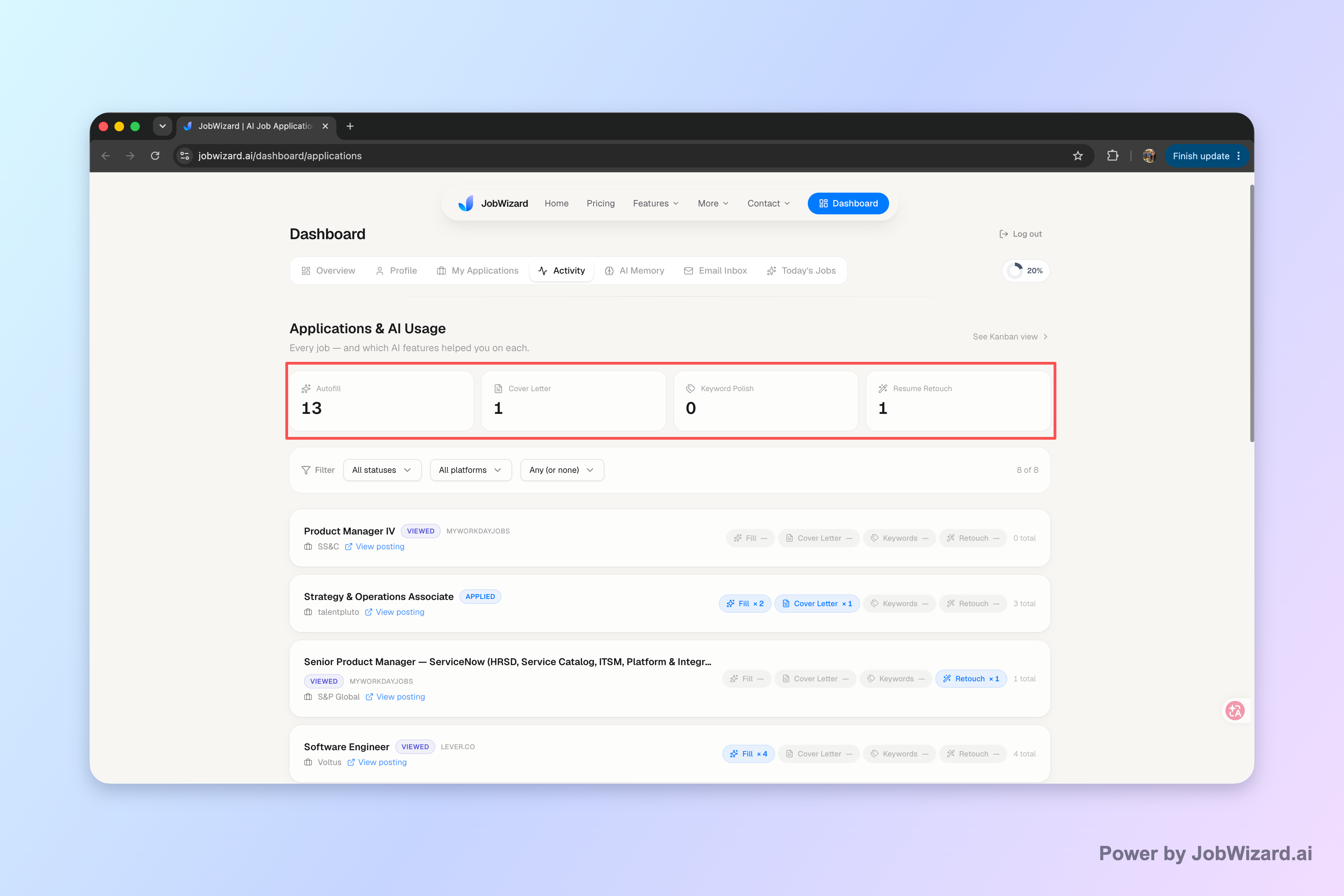
Use an activity view to keep interview follow-ups on the right timeline
Before you send any follow-up, sanity-check your timeline with an application tracker so you’re not repeating yourself or messaging out of sync with where the team is in their process.
JobWizard’s Activity view shows the application status and which JobWizard tools were used for each role, so you can see where things stand and then draft your next note accordingly.
Key limitation to keep in mind: don’t assume every application update is detected automatically or that tracking alone improves hiring outcomes. Use it as a planning aid for your outreach—not as a guarantee of what the employer will do next.
If you prefer a simple workflow, treat each application as a “thread” with one question you’re trying to answer next (for example: “Has the role moved to interviews?” or “Is there an updated decision date?”). That’s how your follow-up letter stays relevant.
Quick checklist: what to confirm before you email
- Role + company: Make sure you’re following up on the correct position (especially if you interviewed for multiple roles).
- Interview date: Your first follow-up should reference timing (“Thank you for your time on Tuesday…”).
- What you discussed: Include one concrete detail to avoid sounding templated.
- Next-step expectations: If they gave a date or process description, echo it.
Here’s a recruiter-ready sample of follow up letter for interview (copy/paste)
This sample of follow up letter for interview is designed to be easy to skim, professional, and specific—so it works whether you’re following up after a first screen or a final round.
Template: follow up letter after interview (24–48 hours)
Subject: Thank you — [Role Title] interview ( [Your Name] )
Hi [Interviewer Name],
Thank you for taking the time to speak with me on [Day, Date] about the [Role Title] position at [Company]. I enjoyed our conversation—especially [one specific topic you discussed].
I’m still very interested in the role, and I believe my experience with [relevant skill/experience] would help the team with [a related goal or need mentioned in the interview].
If there’s anything else I can provide, please let me know. Otherwise, I’d appreciate any update on the timeline for next steps.
Thanks again, [Your Name] [Phone] | [Email] | [LinkedIn or portfolio, optional]
Template: follow up letter after interview (about a week later)
Subject: Following up — [Role Title] interview ( [Your Name] )
Hi [Interviewer Name],
I hope you’re doing well. I’m following up on my interview for the [Role Title] position on [Day, Date]. Thank you again for your time—I appreciated the chance to discuss [specific topic].
I’m still interested in the opportunity, and I’m confident I could contribute by [short value statement tied to the interview].
Do you have an updated timeline for the next steps? If there’s anything I can clarify to help your decision, I’m happy to provide it.
Best regards, [Your Name] [Phone] | [Email]
Tailor your interview follow-up letter for common status signals
To make your follow-up feel relevant, match your wording to what you’re hearing (or seeing). Here are options for the most common scenarios.
When the status is “under review” or “in process”
Keep the tone steady and non-urgent. Your goal is to confirm whether there’s an updated timeline—not to pressure for an immediate decision.
Example line you can reuse: “I understand you’re reviewing candidates, and I wanted to check whether there’s any updated timeline for next steps.”
When you’re waiting after a recruiter screen
Reinforce availability and help them route you to the next stage if needed.
- Availability: “I’m available for interviews the week of [date range].”
- Continuity: “I’m excited about the team’s focus on [topic].”
- Ask: “Is there anything I should prepare for as you move forward?”
When you interviewed with the hiring manager
Make it feel like a continuation of your conversation: reference a problem they described and show how you’d approach it.
Example line you can reuse: “Our discussion about [problem/initiative] stood out—my approach would be to [brief approach].”
When you suspect things stalled (but you don’t want to sound frustrated)
Ask one clean question and keep it short. Over-explaining can weaken the message.
Example line you can reuse: “If it’s helpful, I’d be glad to provide any additional information to support your process.”
Planning note: Autofill tools can speed up repetitive sections, but you should still review everything before submitting or sending—especially anything that’s company-specific (like sponsorship/EEO details or custom questions). The best follow-up is accurate and clearly tied to your interview.
How to avoid common follow-up mistakes (and still sound confident)
If you want your message to land well, avoid the “too generic / too pushy” extremes. Confidence comes from clarity, not intensity.
Replace vague phrases with specific reminders
- Instead of “I’m very interested,” try: “I’m excited about [team goal] and how my [skill] supports it.”
- Instead of “Just checking in,” try: “I wanted to ask whether there’s an updated timeline for next steps.”
- Instead of repeating your resume, try: “Our conversation about [topic] helped me understand [need].”
Use a two-touch follow-up rhythm
A simple pattern is: one timely note after the interview, then one follow-up about a week later. If they provided a decision date, anchor your second message to that—don’t fight their schedule.
If you draft quickly with AI/autofill, do a “human final pass”
Job search messaging is sensitive—small inaccuracies can create doubt. Review for role name, interviewer name, and any interview-specific detail you mentioned.
- Names + dates: Confirm the interview day and spelling.
- One detail: Ensure you referenced a real conversation point.
- Tone: Keep it warm, concise, and forward-looking.
Optional: link your follow-up workflow to tracking
Since JobWizard’s Activity view helps you see where each application stands, you can use that context to decide which template version fits—first note vs later check-in. Keep your follow-ups consistent with the status you’re seeing, not just your calendar.
CTA: Keep each application and its next step in one place—use JobWizard’s Activity view to track application status and stay ready to send your follow-up with the right timing.
Do this automatically with JobWizard
Skip the manual work — JobWizard's Application Tracker handles this for you.
FAQ: sample of follow up letter for interview questions
When should I send a sample of follow up letter for interview after the meeting?
A common approach is to send it 24–48 hours after your interview, then wait about a week before a second follow-up. If the interviewer shared a specific date (“we’ll decide next Friday”), align your first note to that timeline.
What should I say in a follow up letter for interview if I haven’t heard back?
Thank them for their time, restate your interest in the role, and include one specific detail you discussed (a skill, project, or takeaway). Close with a simple question like whether there’s anything else they need from you.
How do I tailor a sample follow up letter for interview when the status is “under review” or “in process”?
Keep the tone steady and non-urgent: acknowledge the process (“I understand you’re reviewing candidates”), reiterate fit, and ask if there’s an updated timeline. Avoid sounding like you’re pressuring for a decision.
Should I track applications and interview status before sending follow-ups?
Yes—tracking helps you avoid duplicate messages and lets you reference the right context (which company, role, and date). Use an activity view to see where each application stands and which tools were used, then send follow-ups based on that timeline.
Can I use autofilled or AI-drafted wording, or should I always customize the follow up letter?
Use drafts to save time, but customize before sending—especially anything that touches your availability, EEO/sponsorship details, or answers to custom questions. Review each note to ensure it matches your interview and your voice.
More templates and next steps: For interview timing and phrasing by status, see Follow Up Email After Interview Status: What to Send for “Pending,” “In Review,” and More and short and sweet follow up email after interview sample: 7 ready-to-send notes. If you want to focus on what to say next after applying, use Sample Follow-Up Letter for Job Application Status: 7 Templates + What to Say Next. To keep your outreach organized, start with How to Track Job Applications: A Practical System (JobWizard + Beyond).
Frequently Asked Questions
Autofill your next job application
JobWizard is a free Chrome extension that fills applications, tracks statuses, and optimizes your resume.