Follow Up Message After Interview: 7 Ready-to-Send Lines (With Timing That Gets Replies)
A follow up message after interview should be clear, respectful, and tied to your timeline. Use these ready-to-send lines and a simple job tracker plan to stay organized.
Free Chrome extension
Autofill your next job application
JobWizard is a free Chrome extension that fills applications, tracks statuses, and optimizes your resume.
Use this follow up message after interview framework to get responses—and avoid sounding repetitive
If you’re searching for a follow up message after interview, the goal is simple: remind them you’re interested, ask for next steps, and do it at the right time. The best follow-up messages don’t chase—they clarify.
Most candidates either send too soon, or they send the same note over and over. Instead, send one message that’s easy to answer, then—if needed—a second one later with a slightly different purpose (status check vs. closing the loop).
Before you start drafting, confirm what you already sent: the initial thank-you, any recruiter messages, and whether you discussed a timeline. If you want a clean way to stay organized, keep each role’s “where we are” details in a single activity view.
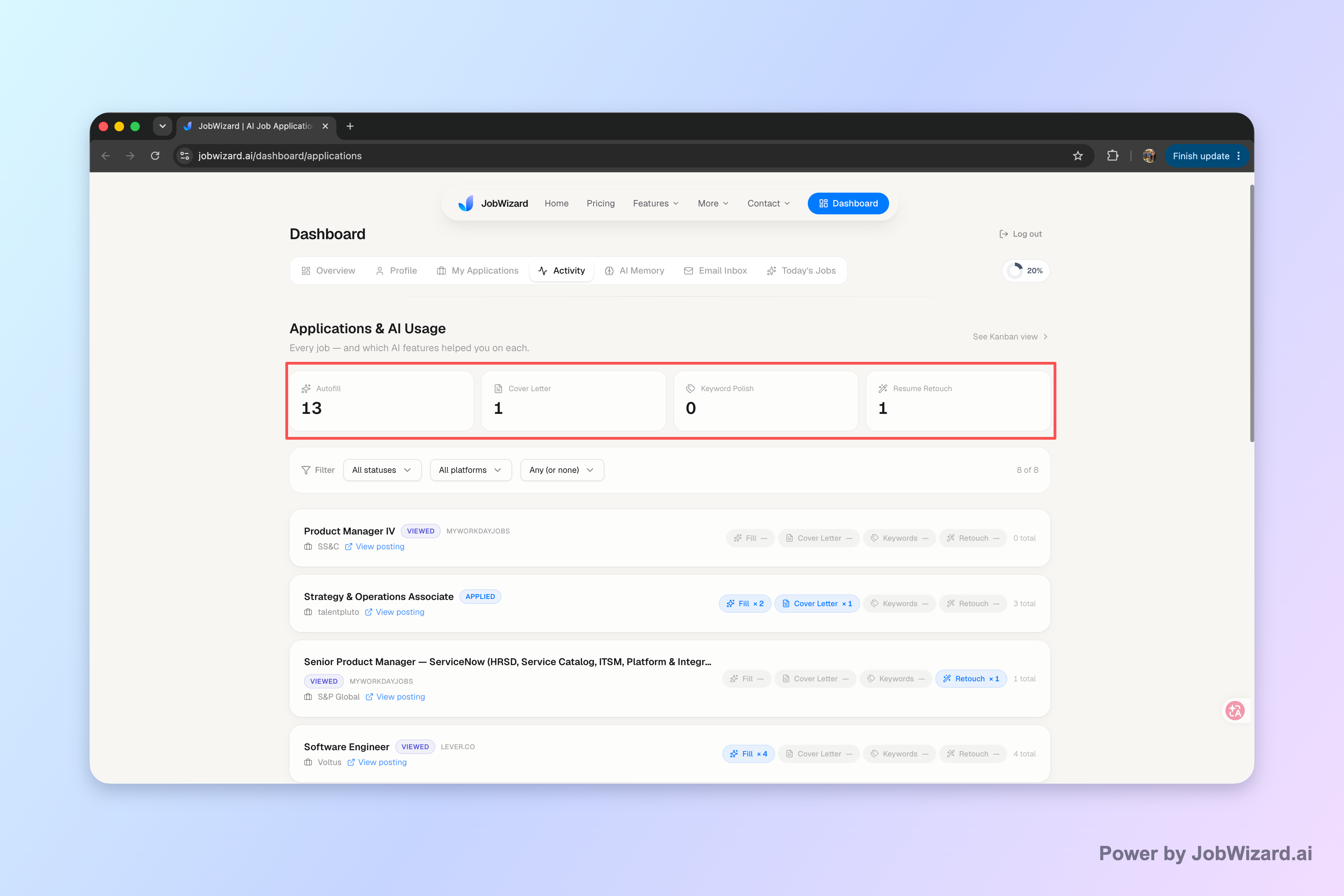
JobWizard’s Activity view helps you see application status and which JobWizard tools were used for each role, so your follow-ups line up with what’s actually happening.
Timing rules for a follow up message after interview that doesn’t feel impatient
Timing is where great follow up message after interview notes separate from generic check-ins. If you follow a simple rhythm, you’ll sound confident—not desperate.
Use these rules to decide when to message:
- Follow their stated timeline if you were given a date or “we’ll reach out by…”
- Wait a few business days after the interview before your first follow-up if no date was provided.
- Send one check-in if you still don’t hear back, then pause and reassess your search.
To match real hiring pace, use a simple timeline approach: the first message checks status, the second message asks about next steps, and after that you stop and move forward. If you want a ready-to-use view of timing, reference How Long to Hear Back After Interview? A Follow-Up Timeline That Matches Real Hiring Pace.
Also, it helps to connect timing with what you’re sending. Here’s a quick pairing:
- Status check → short follow-up after the initial waiting window
- Next-steps question → a second follow-up later if there’s still no update
- Close the loop → if you reach your last polite check-in, don’t keep reopening the thread
7 ready-to-send follow up message after interview templates (copy + customize)
Below are seven messages designed specifically for a follow up message after interview. They’re written to be brief, recruiter-friendly, and easy to reply to. Replace only the bracketed parts.
1) First follow-up (general status check)
Subject: [Role] Interview — Any updates on next steps?
Hello [Name], Thank you again for your time on [Day/Date]. I wanted to follow up regarding the [Role] position and see if there are any updates on next steps. Best regards, [Your Name] [Phone] | [Email]
2) Follow-up that references a detail from the interview
Subject: [Role] — Follow-up on our conversation
Hi [Name], I appreciate the chance to speak about [specific topic you discussed]. I’m still very interested in the [Role] position, and I’d welcome any updates on the process or timing for next steps. Thank you, [Your Name]
3) Recruiter follow-up (after phone screen or recruiter interview)
Subject: Following up — [Role]
Hello [Name], Thanks again for connecting with me about the [Role] opportunity. I’m checking in to see whether you have any updates on where things stand and what the next step would be. Sincerely, [Your Name]
4) Follow-up after the hiring manager interview
Subject: [Role] Interview — Next steps?
Hi [Name], I enjoyed our discussion about [team/company goal or project]. I’m very interested in contributing to [briefly connect to what you heard]. When you have a moment, could you share any updates on next steps for the [Role] interview process? Best, [Your Name]
5) Follow-up if you were told a decision date (and it passed)
Subject: [Role] — Decision timing follow-up
Hello [Name], I hope you’re doing well. I’m following up regarding the [Role] timeline you mentioned for [date]. If there are any updates on next steps, I’d appreciate the information. Thank you, [Your Name]
6) Follow-up after no response (polite, brief “one more time”)
Subject: Quick follow-up — [Role]
Hi [Name], I wanted to send a quick check-in regarding the [Role] position. If you’re able to share any updates on next steps, I’d be grateful. Either way, I appreciate your consideration. Regards, [Your Name]
7) Closing-the-loop message (final polite check-in)
Subject: [Role] — Following up one last time
Hello [Name], I wanted to follow up one last time regarding the [Role] position. Thank you again for the opportunity to interview. If you’re able to share whether the role is still in process, I’d appreciate it—otherwise, I understand and will plan accordingly. Sincerely, [Your Name]
Want to keep your messaging consistent from day one? Start with your thank-you email. See Follow Up Thank You Email After Interview: The Message That Keeps You in the Loop for how the thank-you and follow-up fit together.
What to include (and what to avoid) in a follow up message after interview
To make your follow up message after interview more likely to get a reply, focus on clarity and restraint.
Include these 3 things
- Reference the role (and the interview date if helpful)
- Ask a simple question (“Could you share any updates on next steps?”)
- Re-confirm interest in one line
Avoid these common mistakes
- Long recaps of the entire interview (keep it to one sentence)
- Multiple asks in one email (one question is easier to answer)
- Pressure language that implies urgency or demand
- Copy-paste repetition without adding value or changing the purpose
If you want a broader “message plan,” use How to Follow Up After an Interview (Timing, Messages, and a Tracking Plan). It’s a strong way to prevent over-messaging while still staying visible.
Key idea: a follow-up should be a short, easy-to-reply check-in—not a thread marathon.
Track every follow-up so you never resend the wrong message
The fastest way to improve your follow up message after interview strategy is to stop guessing what you already sent. A simple tracking workflow reduces accidental duplicates and keeps your next message aligned with the hiring timeline.
Here’s a practical approach you can use immediately:
- Create one row per role (company + role name + interview date).
- Log what you sent (thank-you date, first follow-up date, any responses).
- Set the next “check” date based on whether they gave a timeline.
- Update the status when you hear back or move to a new stage.
JobWizard supports this by letting you view application status and see which JobWizard tools were used for each role in the Activity view, so your follow-ups are tied to real progress—not memory.
For a complete system that you can reuse across the rest of your job search, visit How to Track Job Applications: A Practical System (JobWizard + Beyond).
Do this automatically with JobWizard
Skip the manual work — JobWizard's Application Tracker handles this for you.
FAQ: follow up message after interview questions (quick, practical answers)
When should I send a follow up message after interview?
If you interviewed recently, wait for the timeframe you were given (or a typical business-window of a few days) before checking in. If they gave a specific date, follow that date; otherwise, send a short check-in, then a second message later if you still don’t hear back.
What should I say in a follow up message after interview if I haven’t heard back?
Re-state your interest in the role, reference the conversation (and optionally one detail you discussed), and keep the ask simple: “Could you share any updates on next steps?” Keep it brief, polite, and easy to reply to.
Should I send another message after my thank-you email?
Yes—sending a thank-you is a great first step, and a later follow up message after interview can help when there’s no response. Space them out so the second message is truly a check-in, not a repeat.
How many times should I follow up after an interview?
Aim for a small number of polite check-ins (for example, one after the initial wait and one later if there’s still no update). If you still don’t hear back, stop and keep your search moving.
How can I track which follow-ups I’ve sent?
Use a job tracker workflow so each role has its current status and notes about what you’ve already sent. Keeping everything in one place makes it easier to follow up at the right time without repeating yourself.
Ready to follow up with confidence? Keep each role’s status and your next-step notes in one place. Try JobWizard and use the Activity view approach to stay organized as you send your follow up message after interview.
Frequently Asked Questions
Autofill your next job application
JobWizard is a free Chrome extension that fills applications, tracks statuses, and optimizes your resume.