Interview Follow Up Email: A Tracking-First System That Gets You Seen (and Responded To)
Learn how to write an interview follow up email that matches each hiring status—using a tracking-first workflow so nothing slips. Includes templates and timing.
Free Chrome extension
Autofill your next job application
JobWizard is a free Chrome extension that fills applications, tracks statuses, and optimizes your resume.
Interview follow up email: Start with the next step, not the next paragraph
If you’ve ever thought, “I sent a nice interview follow up email and nothing happened,” the problem is usually not politeness—it’s timing, context, and tracking. The fastest way to improve your odds is to write an interview follow up email that matches the hiring status you’re in, then send it on a clear schedule.
In this guide, you’ll get a tracking-first workflow, status-specific wording, and ready-to-send templates you can customize in minutes. You’ll also learn how to keep follow-ups from falling through by tying your message to what you can actually see for each role.
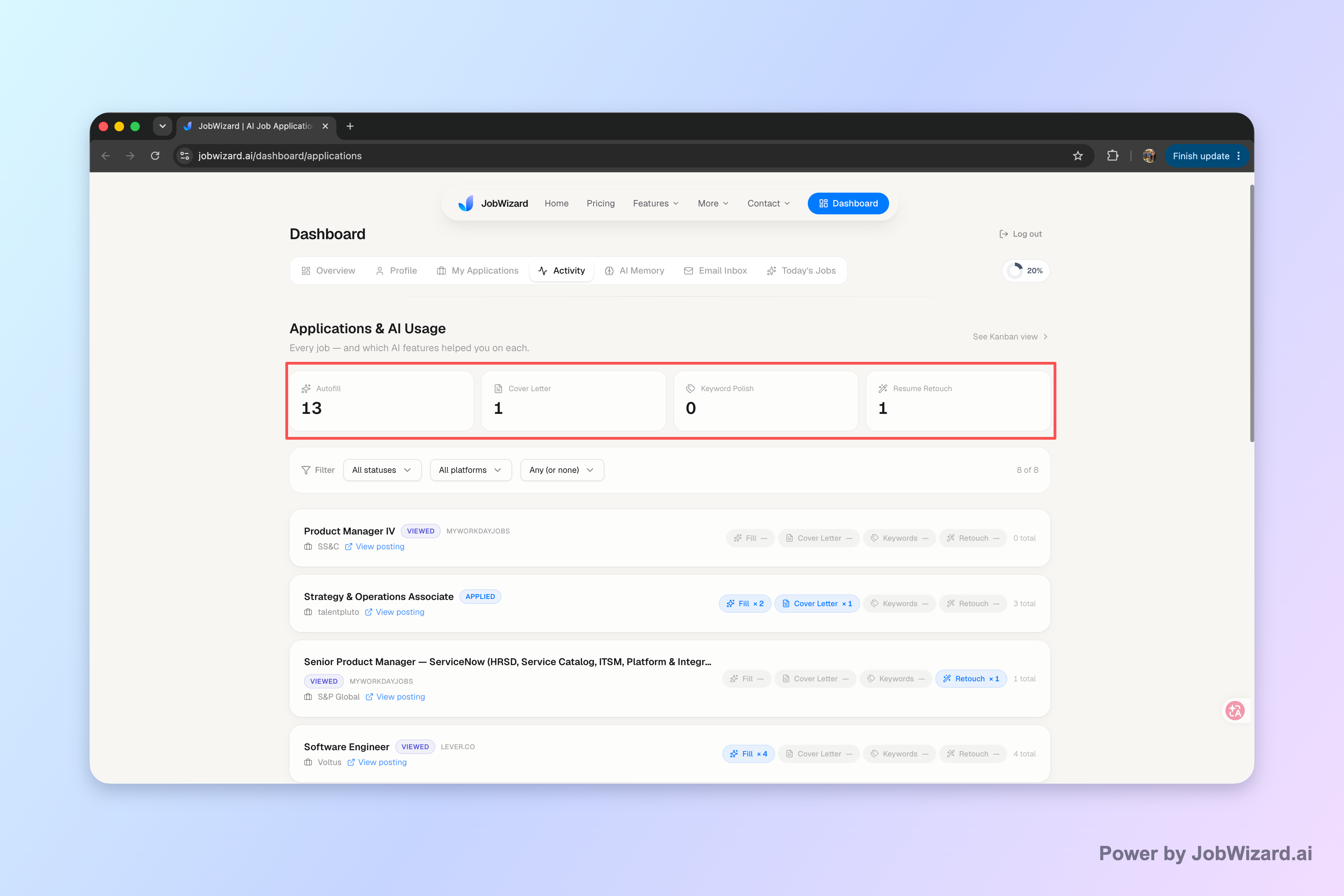
JobWizard’s Activity view helps you see where each application stands and which JobWizard tools were used for each role, so your follow-up emails line up with real application status instead of guesswork.
Use a status-aware follow-up plan: your 7-day timeline that prevents awkward chasing
Hiring teams move at different speeds, so the best interview follow up email strategy is to anchor each email to a timeline and a status you can reasonably infer from what you know. That keeps you professional—and prevents you from over-emailing.
Here’s a simple 7-day plan you can reuse for most interviews:
- Day 0–2: Send “thank you + next step” within 24–48 hours (or same business day if you finished early).
- Day 5–7: Send “status check” only if you haven’t heard back and you have a clear ask (timeline/next step).
- After 7 days: Add one useful detail if relevant (a resource you promised, a short clarification, or updated availability).
- Stop at 2–3 total messages for a given interviewer/thread unless they invite additional contact.
Key rule: every follow-up email should either (a) confirm the next step, (b) add a small, relevant update, or (c) politely ask for timing—never just “checking in.”
Turn “I’m following up” into one crisp question
The most effective interview follow up email reads like you’re helping the hiring process, not interrupting it. Keep your ask to one sentence.
- Timeline ask: “Would you be able to share the expected timeline for next steps?”
- Next-step ask: “Is there anything else you need from me to move forward?”
- Status phrasing: “Are you still reviewing candidates for the role?”
If you’re unsure what to ask, default to timeline + a reminder of your fit in one line.
Interview follow up email templates: plug in your details and send with confidence
Below are templates designed to work for the most common situations after an interview. You’ll notice the same structure in each: reminder → value → one ask → thanks.
Choose one template, replace bracketed fields, and keep it short.
Template A: Thank you + next step (best for Day 0–2)
Subject: Following up after [Role] interview — thank you, [Interviewer First Name]
Hi [Interviewer First Name], Thank you again for taking the time to speak with me on [Day/Date]. I enjoyed our conversation about [specific topic you discussed]. I’m especially excited about [role/team goal], and I believe my experience with [relevant skill/achievement] would help me contribute quickly. If possible, could you share the timeline for the next steps in the process? Thanks again, and please let me know if there’s anything else I can provide. Best regards, [Your Name] [Phone] | [Email] | [LinkedIn if you want]
Template B: Status check (“in review” / “still deciding”)
Subject: Checking in on [Role] interview follow-up
Hi [Interviewer First Name], I hope you’re doing well. I wanted to follow up regarding my interview for the [Role] position on [Day/Date]. I remain very interested in the role, particularly [specific reason tied to conversation]. I wanted to see whether there’s an update on next steps or timing. Thank you for your time, and I appreciate any guidance you can share. Best regards, [Your Name]
Template C: Pending / waiting on internal review
Subject: Follow-up: [Role] interview — next steps
Hi [Interviewer First Name], Thank you again for the opportunity to interview for the [Role] position on [Day/Date]. I understand there can be internal timelines for decisions. If anything else is needed from me to support the review process—such as additional information or references—please let me know. Thanks for your consideration, and I look forward to hearing from you. Best regards, [Your Name]
Template D: Not retained or unclear outcome (ask for future consideration)
Subject: Thank you — and future opportunities with [Company]
Hi [Interviewer First Name], Thank you for letting me know about the [Role] process. I appreciated the chance to speak with you and learn more about the team. If there aren’t plans to move forward with this role, I’d still welcome consideration for future openings that match my experience in [relevant area]. If there’s anyone else I should connect with, I’d appreciate your guidance. Best regards, [Your Name]
If you want shorter options, see short and sweet follow-up email after interview sample: 7 ready-to-send notes and adapt the one that fits your tone.
Write better follow-ups by pairing email with a “one place” tracker
The biggest follow-up mistake isn’t wording—it’s losing track of what you already sent and what the recruiter last said. When you can’t see status and next steps in one place, you end up repeating yourself or emailing too soon.
That’s why an application tracker matters after the interview: you can align your interview follow up email to what’s happening with each role.
What to track (so your messages stay relevant)
- Interview date + interviewer name (so your reminder is specific).
- Last message you sent (thank-you, status check, or value update).
- Any status language you saw (e.g., “in review” or “not retained”).
- Your next step reminder (timeline ask vs. “anything else needed?”).
With JobWizard, you can keep each role’s application status and the JobWizard tools used along the way visible in the Activity view, so your follow-up emails reflect the actual stage of your applications—not your memory or assumptions.
Where to get a full tracking system
If you want a complete approach (beyond just interview follow-ups), start with How to Track Job Applications: A Practical System (JobWizard + Beyond). For a step-by-step schedule for follow-up emails, use Position Follow Up Email That Gets Replies: The 7-Day Plan to Track, Write, and Send.
Do this automatically with JobWizard
Skip the manual work — JobWizard's Application Tracker handles this for you.
FAQ: fast answers to the situations that cause the most follow-up anxiety
When should I send an interview follow up email?
Send your first interview follow up email within 24–48 hours after the interview (or the same business day if the interview ended early). Then send a second note only if you still haven’t heard back after about a week, and keep it short—one clear question plus a reminder of who you are.
What should I include in an interview follow up email?
Include: (1) a subject line that states the purpose (“Following up after [role] interview”), (2) a one-sentence reminder of the interview (date or interviewer name if you have it), (3) one value reminder tied to the role, and (4) a single, polite ask (timeline, next step, or confirmation of status). Close with thanks and your contact info.
How do I tailor an interview follow up email for different statuses like “in review” or “pending”?
Use the same core structure, but adjust the language to match the status: “in review” → ask about the next step and timeline; “pending” → ask whether anything else is needed from you; “not retained” → ask if they’d consider you for future roles that match your experience.
Should I send a second interview follow up email if they haven’t replied?
Yes—send one more email after a reasonable wait (about a week), and only if it adds value (a brief reiteration, a new relevant detail, or a clear next-step question). Avoid multiple pings in a row; if you have more than one contact, space messages out rather than blasting the same note everywhere.
Can I track my follow-ups in one place so I don’t miss a deadline?
Yes. Keep every role and its next step in one activity view so you can see application status and which tools you used along the way—then align your interview follow up email to what’s actually happening in that role.
Ready to stop guessing? Start using JobWizard to keep each role’s application status and next step visible in one activity view—then write your interview follow up email based on where the process actually is.
Want status-specific wording to match your situation? See Follow Up Email After Interview Status: What to Send for “Pending,” “In Review,” and More, then pair it with your tracker so you send the right message at the right time.
Frequently Asked Questions
Autofill your next job application
JobWizard is a free Chrome extension that fills applications, tracks statuses, and optimizes your resume.