How to Follow Up After an Interview (Timing, Messages, and a Tracking Plan)
Learning how to follow up after an interview is about timing, clarity, and knowing what to send when the recruiter says “we’ll be in touch.” Use a simple tracking plan to keep every interview follow-up organized.
Free Chrome extension
Autofill your next job application
JobWizard is a free Chrome extension that fills applications, tracks statuses, and optimizes your resume.
How to follow up after an interview works best with a timing plan plus a clear message
Knowing how to follow up after an interview is less about “being persistent” and more about being useful: sending the right note at the right time, then checking in again only when it makes sense. The fastest way to improve your odds is to pair your message with a lightweight system that tells you what the employer already knows—and when you last reached out.
If you want a simple workflow, think in two tracks: (1) your email (or call) that stays concise and recruiter-friendly, and (2) your tracking plan so you never wonder “Did I already follow up?” or “What did they say the timeline was?”
Use your interview follow-up timing to match the hiring pace you were given
The first rule of how to follow up after an interview: match your timing to the signals you received (and if you didn’t get any, use a standard cadence). Recruiters often juggle multiple candidates, so your goal is to stay visible without spamming.
Timing that fits most interview conversations
Use this practical baseline, then adjust based on what they told you in the interview:
- 24 hours to 2 business days: Send your first follow-up note (especially if your interview was late in the day, send within 24 hours).
- 5–7 business days later: If you haven’t heard back, send a shorter “checking in” message that doesn’t repeat your entire story.
- One final follow-up: If they gave a specific timeline, align your last message to that date (or 5–7 business days after the timeline passes).
When to speed up (or slow down)
If the interviewer mentioned urgency, you can send your first follow-up toward the earlier end of the window. If they said something like “we’ll reach out after next week’s review,” don’t “check in” sooner—wait and send a respectful message once the timeline makes sense.
- Urgent hiring signal: Interviewer references “rolling interviews” or near-term start dates.
- Structured process signal: They mention a panel, a calibration meeting, or a formal week-of review.
- Unclear signal: No timeline given—use the baseline cadence above.
Write follow-up messages that add one new value point—no long recap
For how to follow up after an interview, your writing should feel like a professional nudge, not a second interview. Recruiters want clarity and respect for their time.
Your first email: the “thank you + specific reminder + next step” formula
Your first follow-up email should do three things:
- Thank them for their time and the specific opportunity.
- Remind them of one point from the interview (a project, decision you discussed, or how your experience matches their needs).
- Ask for the next step in one line—something low-pressure and easy to answer.
Here’s a plug-and-play template you can adapt:
Subject: Thank you + next steps for [Role Title] Hi [Interviewer Name], Thank you for speaking with me about the [Role Title] position today. I appreciated the discussion about [specific topic you discussed]. I’m especially excited about the chance to [one-sentence tie-in to what they need], and I believe my experience with [relevant skill/experience] aligns well. Is there anything else I can provide to support your decision? Thank you again, [Your Name]
Second follow-up: shorter, status-aware, and still confident
When you follow up again, don’t re-send the entire thank-you. Instead, reference the role’s process and keep the ask simple. If they mentioned a step (“reviewing candidates,” “internal alignment,” “final interviews”), mirror that language.
If you’re not sure what stage they’re in
If you don’t know the interview status, you can still send a useful check-in:
- Option A (generic but respectful): “I wanted to see if there’s an update on next steps.”
- Option B (timeline-based): “Given we discussed [timeline], I wanted to check in.”
- Option C (value-based): “If helpful, I can share [work sample / additional references / a quick clarification].”
For more status-specific guidance and wording, see Follow Up Email After Interview Status: What to Send for “Pending,” “In Review,” and More.
Track interview follow-ups so you never lose the thread (and can follow up strategically)
One reason how to follow up after an interview can feel stressful is that your brain ends up carrying all the details: when you applied, when you interviewed, who you emailed, and what stage the role is in. A light tracking plan removes that mental load.
What to track (at minimum) for every role
- Interview dates: the day(s) you spoke with them and who attended.
- Follow-up dates: when you sent each email and what you asked.
- Any timeline promises: dates they gave or “we’ll be in touch after…” notes.
- Attachments/resources offered: examples you promised to send later.
How JobWizard helps you keep “next steps” visible
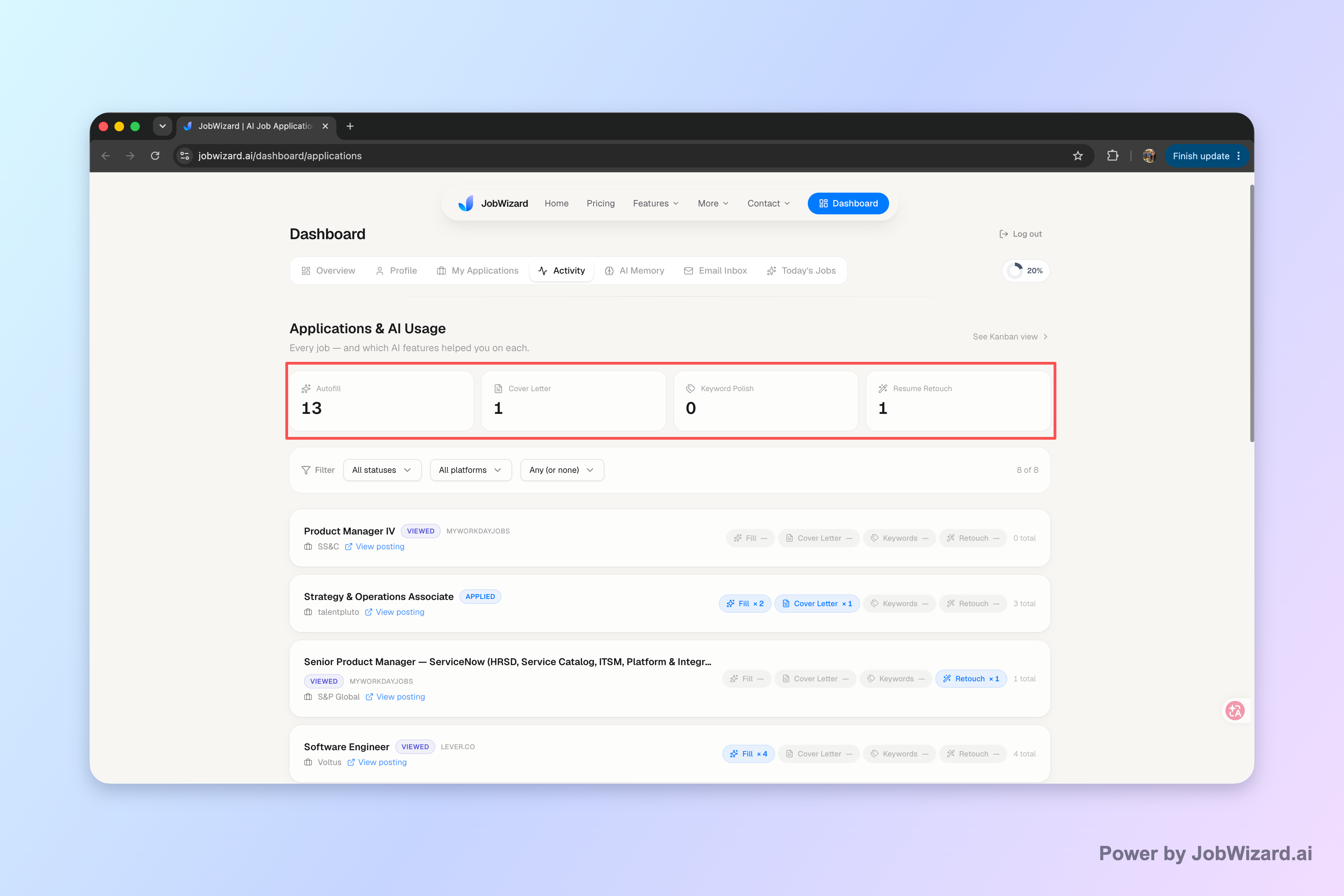
If you use a job tracking workflow, you need a place that shows where each role stands and what happened along the way. In JobWizard, the Activity / Job Track view shows application status and which JobWizard tools were used for each role—so your follow-up efforts align with what you already did, not what you’re guessing.
JobWizard can be especially helpful when you’re juggling multiple roles and the process updates vary across employers. With the Activity view, you can quickly see the status and your prior steps, then write the next follow-up accordingly.
Reality check: Tracking improves your organization and reduces repeated work—but it doesn’t guarantee you’ll catch every internal employer update, and it can’t replace thoughtful review-before-submit decisions.
For a fuller system, read How to Track Job Applications: A Practical System (JobWizard + Beyond). And if you want messaging help for other points in the process, these are great companions: How to Write a Follow Up Email After Application (and Get a Real Reply) and short and sweet follow-up email after interview sample: 7 ready-to-send notes.
Common interview follow-up mistakes (and how to avoid them)
The quickest way to make your follow-up less effective is to accidentally “over-send” or “over-explain.” If you want how to follow up after an interview to work, keep these pitfalls out of your emails and your schedule.
Mistake 1: Following up at random times
Random follow-ups feel like noise. Use a cadence (first note 1–2 business days after, then 5–7 business days later) unless the interviewer gave you a specific timeline.
Mistake 2: Repeating your entire resume in the email
Your follow-up should be short enough to read in under a minute. Focus on one specific interview moment plus a small next-step ask.
Mistake 3: Sending long, emotional notes
Recruiters are busy. Keep your tone professional and confident—no guilt, no “just checking again” fatigue, and no pressure.
Mistake 4: Asking for a “yes/no” decision too early
Instead of “Have you decided?” ask for next steps: “Is there anything else you need from me?” or “Do you have a sense of timing for next steps?”
Mistake 5: Not offering anything new
Every message should add one incremental value: a clarification, a promised sample, or a reminder that you understood their priorities. If there’s truly nothing new, a respectful status/timeline check-in is still valid—just keep it brief.
Do this automatically with JobWizard
Skip the manual work — JobWizard's Application Tracker handles this for you.
FAQ: How to follow up after an interview
When should I follow up after an interview?
Plan to follow up within 24 hours if it was a late-day interview, otherwise send a note 1–2 business days after. Then, if you don’t hear back, send a second follow-up about 5–7 business days later, and stop after 2–3 total attempts unless they give you a specific timeline.
What should I say in my first interview follow-up email?
Keep it short: thank them for their time, remind them of one specific point from the conversation, and confirm your interest in the role. End with a clear ask—something like “Is there anything else I can provide to support your decision?”—and a polite closing.
How do I follow up if the recruiter updates the status to “pending” or “in review”?
Use a status-aware message: reference that you saw the role is still in review/pending, reiterate your fit in one sentence, and ask for the next step or timeframe. Pair this with a tracking note so you know when you last contacted them.
Should I call or email to follow up after an interview?
Email is usually best first because it creates a clear record and gives them time to respond. Call is appropriate only if the job posting or recruiter email includes a direct phone number and you keep it brief—ideally between business hours—and you’re ready to hang up if they can’t talk.
How many times should I follow up after an interview before I move on?
In most cases, 2–3 total follow-ups is enough: one after 1–2 business days, one about 5–7 business days later, and a final check-in if they referenced a later timeline. If you still don’t hear back after that, shift your energy to new applications and keep your follow-up list for future roles.
Ready to keep every interview follow-up organized? Start tracking your roles in JobWizard’s Activity / Job Track view so you can see where each application stands and plan your next message with confidence.
Frequently Asked Questions
Autofill your next job application
JobWizard is a free Chrome extension that fills applications, tracks statuses, and optimizes your resume.