Follow Up Thank You Email After Interview: The Message That Keeps You in the Loop
Learn how to write a follow up thank you email after interview that sounds professional, jogs attention, and ties to the right next step—without repeating your whole story.
Free Chrome extension
Autofill your next job application
JobWizard is a free Chrome extension that fills applications, tracks statuses, and optimizes your resume.
Getting ghosted after your interview is frustrating—especially when you know you’d communicate clearly with a follow up thank you email after interview that stays professional and actually moves the process forward. The goal isn’t to nag; it’s to reinforce your fit, confirm you’re still interested, and make it easy for the hiring team to respond with next steps.
In this guide, you’ll get ready-to-send templates, a simple timing cadence, and a practical workflow to keep your follow-ups organized—so your “thank you” turns into a smart next-step email, not another message that disappears.
Write a follow up thank you email after interview that signals “next steps,” not “please respond”
A strong follow up thank you email after interview does four things fast: it thanks them, references something specific you discussed, restates your interest in a single sentence, and asks about next steps in a low-pressure way.
Think of it as the bridge between the interview and whatever happens next (panel feedback, recruiter review, final interviews). If your email reads like a recap or a long essay, you’ll reduce your chances of a reply.
Use this message formula (and keep it skimmable)
- Thank you + context: “Thank you again for your time on Tuesday.”
- One specific detail: Mention a topic (team goal, project, workflow, metric) you discussed.
- Fit in one line: Tie the detail to how you work or what you can contribute.
- Next step question: Ask about the timeline or “the next step in the process.”
What to avoid (common reasons follow-ups don’t get replies)
- Too much repetition: Don’t resend your whole resume or re-list every interview answer.
- Overly demanding language: Avoid “I need an update by Friday” unless you’ve already agreed to that timeline.
- Personal upsells: Keep it focused on the role and conversation, not unrelated achievements.
- Multiple asks at once: If you have several questions, pick the one that helps them move forward (usually timing or next steps).
Pick a timing cadence: thank you first, then a respectful follow up thank you email
Timing matters because hiring teams review messages in batches. The best cadence keeps you present without making your email feel like a disruption.
Here’s a practical approach you can adapt to your situation. Start with the assumption that you already sent a timely thank-you after the interview (often within 24 hours), then use the next steps below if you don’t hear back.
Simple cadence you can use
- Within 24 hours: Send your thank-you email (keep it short and specific).
- Wait for your expected window: Use the timeline you were given (or typical hiring pace for that company).
- ~1 week check-in: Send your follow up thank you email if you haven’t heard back.
- Optional final check-in: If appropriate, send one more message after another interval (only if you still feel genuinely interested).
If you’re unsure how long to wait, use the hiring signals you observed: recruiter responsiveness, how quickly scheduling happened, and whether the interviewer mentioned “by X date” or “next steps soon.” When in doubt, go with clarity and brevity over pressure.
Different interview types, different expectations
- Panel interviews: Hiring decisions can take longer; stick to a check-in cadence rather than daily pings.
- Recruiter screen: Follow up once you’ve confirmed the role interest and ask about next steps in the process.
- Final round: Your email should emphasize fit and readiness while asking about what comes next (and when).
Tip: Keep your follow-up aligned with what they’re likely doing internally. If they said “we’re interviewing this week,” your check-in should sound like, “Just checking on timing as you move to the next step.”
Templates you can copy: follow up thank you email after interview (with placeholders)
Use these templates as a starting point, then customize one interview-specific detail so your message feels real. A generic “great meeting you” email usually won’t earn a reply.
Below are three variations depending on what you want to accomplish: timeline check, role fit reinforcement, or after-status follow-up.
Template 1: The clean timeline check (most common)
Subject: Thank you + next steps for the [Role Title] interview Hi [Interviewer Name], Thank you again for your time during our interview for the [Role Title] position. I appreciated our conversation about [specific topic you discussed] and how the team is approaching [brief detail tied to their goal]. I remain very interested in the role and believe my experience with [relevant skill/experience] would help me contribute quickly to [team need you discussed]. When you have a moment, could you share the expected next steps and timing for the process? Thanks again, [Your Name] [Phone] | [LinkedIn or Portfolio (optional)]
Template 2: The follow up thank you email that references your conversation (fit reinforcement)
Subject: Following up—thank you for the [Role Title] conversation Hi [Interviewer Name], Thank you for speaking with me about the [Role Title] role. I especially enjoyed discussing [specific detail]—it clarified how you’d like the person in this role to approach [work style/process mentioned]. I’m excited about the opportunity to apply [one or two relevant strengths] to help the team [outcome they described]. If there’s anything else you need from me to support the next step, I’m happy to provide it. Otherwise, I’d appreciate any update on where things stand and what comes next. Best regards, [Your Name]
Template 3: The “after status” follow up thank you email (when you’re already in a pipeline)
Subject: Thank you + check-in on the [Role Title] process Hi [Interviewer Name], Thank you again for your time. I wanted to follow up with a quick note after our conversation regarding the [Role Title] role. Could you let me know the current stage of the process and the expected timeline for next steps? I’m still very interested and would welcome the opportunity to continue. Thanks, [Your Name]
One line that improves response rates
If you’re worried your email may get buried, include a simple, low-friction sentence like: “If there’s a better person to contact for next steps, I’m happy to reach out to them.” It gives the team an easy action—even if they can’t respond directly.
Stay organized with application activity tracking—so follow-ups are timely and consistent
One reason follow-ups fail is simple: people lose track of what they sent, when, and who they spoke with. A tracking workflow keeps your follow up thank you email after interview aligned with each role’s stage, not guesswork.
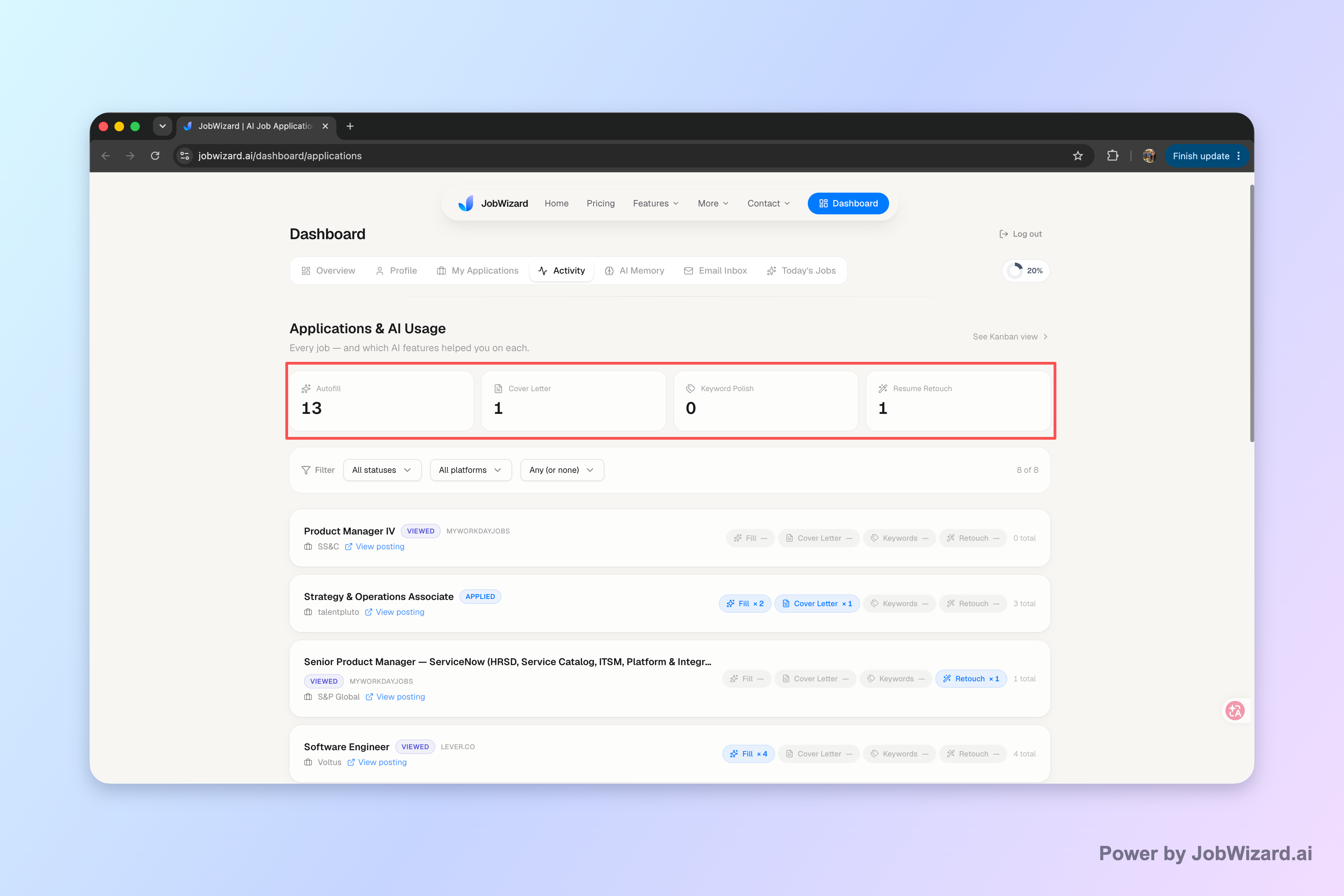
JobWizard’s Activity view shows application status and which JobWizard tools were used for each role—so you can see where each application stands and what happened along the way. This supports a disciplined follow-up cadence, where you send the right message at the right time and avoid duplicate or inconsistent check-ins.
Rather than treating follow-ups as random events, build a loop:
- Track: confirm the role status and the last email you sent.
- Decide: choose the next follow-up step (timeline check, status check, or “any additional info needed?”).
- Send: keep the email short and specific to the interview.
- Log: update the thread so you don’t repeat the same ask later.
To go deeper on building a system, review How to Track Job Applications: A Practical System (JobWizard + Beyond).
If you prefer an approach built around the “right message at the right time,” these guides help you tailor your check-ins:
- Interview Follow-Up Email After 2 Weeks: A Confident Check-In That Gets Replies
- Interview Follow Up Email: A Tracking-First System That Gets You Seen (and Responded To)
- Follow Up Email After Interview Status: What to Send for “Pending,” “In Review,” and More
Do this automatically with JobWizard
Skip the manual work — JobWizard's Application Tracker handles this for you.
FAQ: follow up thank you email after interview
When should I send a follow up thank you email after an interview?
Send your thank-you within 24 hours, then send your follow up thank you email only if you don’t hear back by the timeframe you expected (often about a week), and again using a clear, respectful check-in cadence if needed.
What should I include in a follow up thank you email after interview?
Include (1) a brief thank you, (2) one specific detail from the interview, (3) a short “why this role” link, and (4) a low-pressure line asking about next steps or the interview timeline.
Should I mention salary, sponsorship, or EEO in my follow up thank you email?
Keep the follow up thank you email focused on next steps and your fit. If salary/sponsorship/EEO questions were part of the process, it’s best to address them separately (or in the thread if the interviewer raised them), so your thank-you doesn’t become a checklist.
How do I follow up if the interviewer hasn’t responded?
Use a tracking-first approach: note what you’ve already sent, which interviewer you contacted, and the role’s current status. Then send a concise check-in that references your conversation and asks for the next step or expected timeline.
Can I use the same follow up thank you email for multiple interviews?
You can reuse the structure, but customize at least one concrete detail from each conversation and the exact role title. Generic messages that don’t reference your interview specifics usually get less attention.
Ready to make follow-ups easier to manage? Use JobWizard’s Activity view to keep each application’s status and next step in one place, then send a targeted follow up thank you email after interview that matches where you are in the process. Start tracking your interview pipeline today with JobWizard.
Frequently Asked Questions
Autofill your next job application
JobWizard is a free Chrome extension that fills applications, tracks statuses, and optimizes your resume.