Applyai: What “Bot Apply” Gets Wrong—and the Safer Autofill-Review Way with JobWizard
Searching for applyai tools that “apply for you”? Learn why bot-style submission can misread screening answers, and how JobWizard’s autofill + review-before-submit approach helps you apply accurately.
Free Chrome extension
Autofill your next job application
JobWizard is a free Chrome extension that fills applications, tracks statuses, and optimizes your resume.
Applyai is popular—but “bot apply” can damage your application before it even reaches a human.
If you searched for applyai because you want jobs fast, you’re not alone. The problem is that many “apply for me” or “bot apply” approaches optimize for volume, not accuracy—so you can end up giving employers answers that don’t match your background, your resume, or the specific job.
When a tool submits while you’re not actively reviewing, small mismatches become big problems: a screening question gets answered incorrectly, a custom prompt is left too generic, or a resume section doesn’t align with the role. And because submission is the final step, you can’t easily undo a bad first impression.
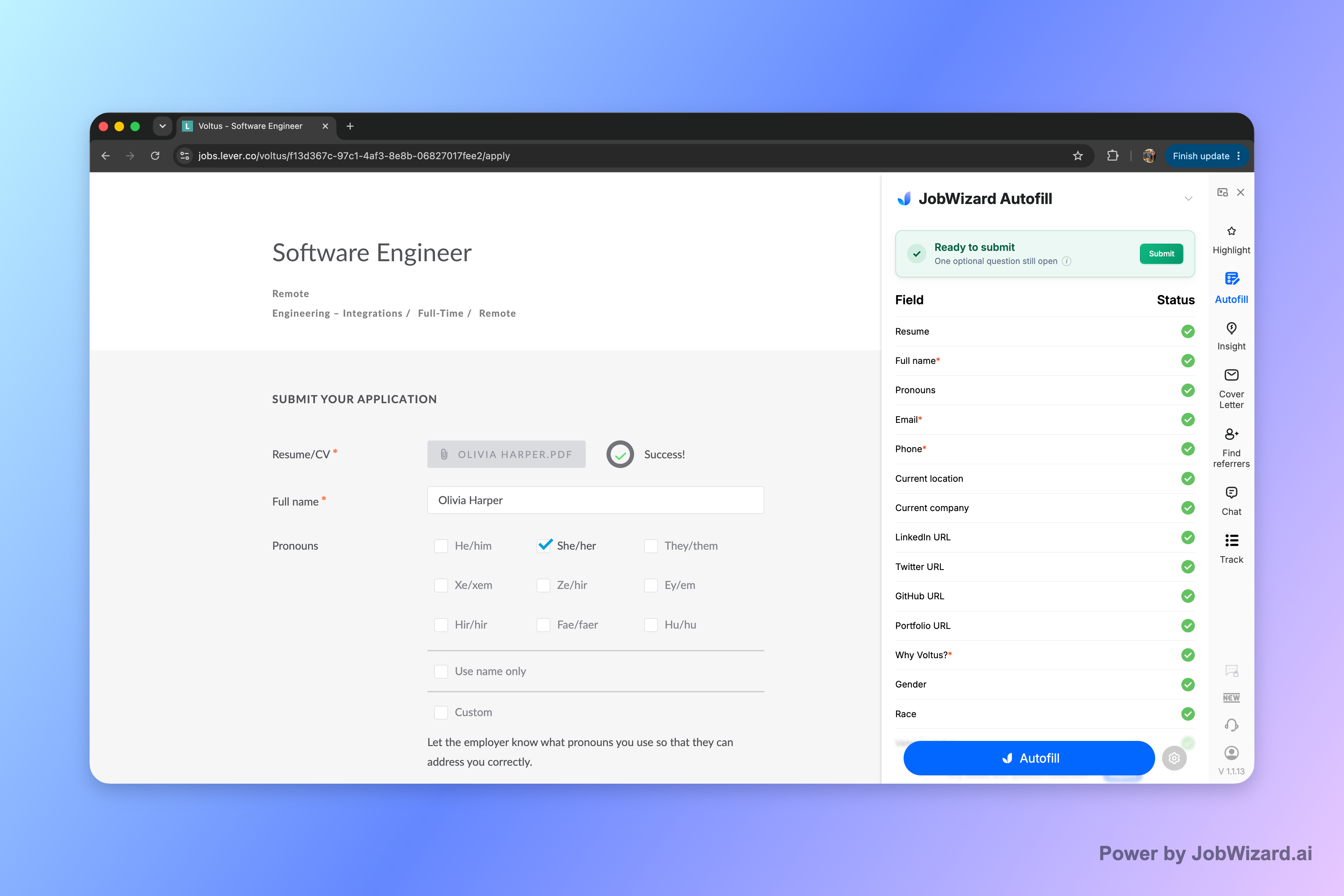
JobWizard’s approach is different: it’s built for autofill + review-before-submit, not blind auto-submission. That helps you move quickly through repetitive fields while keeping the final responsibility—your answers, your experience details, your decision to submit.
Why bot-style submission goes wrong: the exact failure modes that cost you interviews.
“Applyai”-style bot submission typically fails in the same predictable ways. Below are the issues that show up most often when the software controls the answers and hits “submit” without you verifying everything.
1) Wrong screening answers (the #1 silent killer)
Screening questions aren’t always obvious. They can be phrased indirectly (“Which of the following best describes…”) or include eligibility gates (work authorization, availability windows, years of experience, location requirements). A bot can guess wrong based on imperfect resume parsing or stale profile info.
- Example: You answered “Yes” to a tool’s inferred “have you done X” question, but your actual experience is limited—now you’re marked as qualified when you’re not, or excluded if the inverse happens.
- Example: A question requires a specific value (e.g., number of years, frequency). A bot might map your resume wording incorrectly and submit a mismatched numeric answer.
2) Resume mismatches and experience drift
Even when the right resume is attached, the “story” inside the application can drift. Job titles, dates, and project details in the form may not match what’s in your resume—or the resume may not match the role’s seniority.
- Example: The bot fills “current title” from a profile field, but your resume lists a different title or a blended role name.
- Example: The application asks about specific tools or domains; your resume mentions them, but not in the way the form expects (or the bot fills a different set of skills).
This is how you end up with employers thinking you didn’t read the posting—or worse, that your information is inconsistent.
3) Generic or off-target responses to custom questions
Many job applications include custom prompts: why you’re interested, a short writing response, or a targeted question about collaboration, leadership, or impact. A bot can produce bland answers that technically “fit” but don’t sound like you.
- Example: “Tell us about a project you’re proud of.” A generic response won’t reference the company’s domain, your relevant metrics, or the specific angle the role needs.
- Example: A tool “fills” a partially relevant answer but leaves out the one detail that would have made it credible—your ownership, scope, or constraints.
4) Employer-side spam or safety filtering (and wasted effort)
Even if your answers were mostly correct, repeated automated submission patterns can trigger employer systems designed to reduce low-quality traffic. This doesn’t mean “bots are bad” in general—it means job application environments often have guardrails against repetitive or suspicious behavior.
Result: applications can be slowed down, deprioritized, flagged for manual review, or discarded—making your effort less effective.
5) Reputation risk with companies you actually want
Job searching is competitive, but it’s also personal. If you apply to a dream company multiple times with submissions that don’t look accurate, you can create friction. If a recruiter later checks your history, they may notice patterns that reduce trust.
When your goal is long-term career fit, quality and consistency matter as much as speed.
Verified usage from our database shows JobWizard is used for autofill + review-before-submit—filling repetitive fields fast while you confirm the answers you’re sending.
The safer alternative: fill in seconds, check every screening question, then submit yourself.
If you want the upside of faster applications without the “bot submit” backfire, use a workflow designed for accuracy. The key idea is simple: autofill where it helps, review where it matters.
Step-by-step: “fill fast, check, submit”
- Open the application on the job site (you’re already there, so you’re in control).
- Autofill repetitive fields (contact info, standard form items, repeated sections).
- Verify screening answers one by one, especially eligibility, years, and yes/no gates.
- Confirm resume/experience alignment with the role’s seniority and key responsibilities.
- Review custom questions so the final text sounds like you and matches the posting.
- Submit yourself only after every high-impact field is correct.
What you should not skip checking
Even with autofill, certain sections deserve extra attention because mistakes are costly:
- Screening questions (work authorization, availability, experience thresholds)
- Compensation / location / EEO-related questions where applicable
- Custom prompts (why this job, project examples, collaboration/leadership)
- Resume selection and experience sections for correct titles and timelines
Why this works better than “auto-apply”
Bot-style tools often replace your judgment with an assumption. A review-before-submit workflow preserves judgment at the last moment—exactly where errors become final.
With JobWizard, autofill is meant to remove repetitive typing—not to decide your eligibility or craft your final answers.
You can also compare approaches in related guides: How to Autofill Job Applications (Step-by-Step with JobWizard) and smartapplier.ai: Why “Bot Apply” Can Backfire (and the Safer Autofill-Review Way).
Where JobWizard fits for applyai searchers (and what it doesn’t do).
If you’re comparing tools because you want faster applications, make sure you understand the difference between autofill you confirm versus submission the tool controls.
JobWizard’s model: autofill on the page you’re on
JobWizard autofills an application the user is already on, then the user reviews and submits. It never submits by itself, never mass-applies, and never applies while the user is away.
That design matters for applyai searchers because it prevents the most common “bot submit” failure modes: incorrect screening answers, misaligned experience entries, and generic custom text slipping through.
How much is autofilled (so you can decide what to check)
In our database usage, JobWizard autofills an average of ~18 repetitive fields per application (typically 11–23). This helps reduce the time spent on repetitive inputs, while you stay responsible for the questions that affect eligibility and fit.
Platform reality: why Workday is where it saves the most time
Of applications submitted through JobWizard, ~65% are on Workday, ~19% Greenhouse, ~12% Ashby, ~4% Lever. Workday is where it saves the most time, which aligns with how many repetitive form steps exist in those flows.
That’s useful when you’re trying to apply efficiently without trading accuracy for speed.
More context: similar “auto-apply” risks, different guardrails
If you’ve read about other tools that promise auto-apply, it’s worth reviewing the risk framing and safer alternatives:
- Lazyapply Risks: Why “Auto-Apply” Can Backfire (and the Safer Autofill-Then-Review Fix)
- LoopCV Review: What “Auto-Apply” Gets Wrong—And the Safer Way to Vet Fit
These comparisons keep the focus on the same core lesson: when the tool controls the final submission step, mistakes become harder to correct.
Applyai comparison table: how to choose between “bot submit” and autofill-review workflows.
Use this checklist to decide what kind of job-search automation you should rely on. The goal isn’t to label competitors as “good” or “bad”—it’s to choose the workflow that keeps you in charge of screening and custom answers.
| Decision point | Bot-style auto-submit approach (applyai-like) | Autofill + review-before-submit approach (JobWizard) |
|---|---|---|
| Who decides your final answers? | The tool may submit based on inferred or generated inputs. | You review autofilled fields and decide what to submit. |
| Screening question accuracy risk | Higher risk if screening responses aren’t verified field-by-field. | Lower risk because you can confirm eligibility and yes/no gates before submitting. |
| Custom prompt quality | May be generic or mismatched if you don’t edit after generation. | You can tailor custom responses so they match the posting and sound like you. |
| Employer-side filtering risk | Potentially higher if submission behavior looks repetitive or automated. | Designed for autofill while you remain actively involved in submission. |
| Time savings style | Optimized for submission volume and minimal user input. | Optimized for repetitive field completion, then review and submit yourself. |
Do this automatically with JobWizard
Skip the manual work — JobWizard's Smart Autofill handles this for you.
FAQ: applyai questions job seekers ask before they try “bot apply.”
Is “applyai” just another auto-apply tool that submits applications automatically?
No. Many “bot apply” tools are built around auto-submission, which can create avoidable mistakes. JobWizard takes a different approach: it autofills the application you’re already on, then you review and submit so screening answers and key details stay in your control.
What are the most common problems when a bot submits for you?
Common issues include wrong answers to screening questions, mismatched resumes/experience sections, and incomplete or off-target responses to custom prompts. In some cases, repetitive automated submissions can also trigger employer-side spam or safety checks—so your application effort doesn’t help you.
How does JobWizard reduce mistakes without “bot applying”?
JobWizard autofills repetitive fields quickly while you remain responsible for the content that matters most. That means you can confirm job-specific details (like custom answers, salary/EEO-related questions, and anything unique to that role) before you click submit.
Will using autofill or review-before-submit still save time?
Yes. JobWizard focuses on repetitive fields so you spend less time retyping and more time checking. In our usage, JobWizard autofills an average of ~18 repetitive fields per application (typically 11–23), and you review before submitting.
What’s a practical workflow to avoid backfires when using applyai-style tools?
Use a “fill fast, check, submit” workflow: (1) open the application, (2) let autofill complete repetitive sections, (3) scan every screening/custom question for correctness, (4) confirm your resume/experience matches the role, and (5) only then submit yourself.
Ready to apply faster without letting a bot make the final call? Try JobWizard and use autofill to complete repetitive fields quickly—then review and submit yourself so your screening answers and custom responses stay accurate.
Frequently Asked Questions
Autofill your next job application
JobWizard is a free Chrome extension that fills applications, tracks statuses, and optimizes your resume.