AI Auto Apply: How Bots Get It Wrong—and Why Smart Autofill + Review Beats Blind Submission
AI auto apply tools can misread screening questions, mismatch your resume, and trip employer spam filters—hurting roles you actually want. Use smart autofill and review before you submit.

Free Chrome extension
Autofill your next job application
JobWizard is a free Chrome extension that fills applications, tracks statuses, and optimizes your resume.
AI auto apply sounds like a shortcut—until your application gets submitted with the wrong answers, the wrong resume details, or a set of inconsistencies that trigger employer screening filters. If you’re trying to move faster while keeping your candidacy strong, the real question is: how do you save time without handing the submission to a bot?
In this guide, we’ll break down what goes wrong with bot-style auto-apply and what to do instead: autofill to populate repetitive fields, then review and submit yourself—fast, accurate, and under your control.
What goes wrong with “ai auto apply” bots (and why it can cost you roles you want)
With ai auto apply, the core failure mode is simple: bots can’t reliably interpret every job’s intent and every screening question the way a human can.
Even when bots “fill everything,” they can still be wrong in ways that matter to hiring teams—especially when applications include conditional questions, custom requirements, or information that must match the exact role. The result isn’t just wasted effort; it can create a mismatch between what the employer asked for and what you actually submitted.
- Wrong answers to screening questions: Bots may misread wording like “required experience,” “eligibility,” or role-specific compliance prompts, resulting in answers that don’t fit the job.
- Resume/work history mismatches: If the tool pulls the wrong resume section or connects your experience to the wrong checkbox, you can look unqualified—even if you aren’t.
- Required fields left in an incorrect state: A field can be “filled” but still need your confirmation (or still require a different input than the one the bot assumed).
- Employer-side spam or fraud filters: Overly automated patterns (especially when submissions look identical across applications) can increase the odds that your application gets deprioritized or flagged for review.
- Reputation damage with companies you actually want: If you repeatedly submit inaccurate answers, a recruiter may infer you’re not paying attention—even when the error came from the automation.
Bottom line: blind automation trades control for speed. And in application screening, control is what protects accuracy.
Better than blind submission: smart autofill, then you review and submit
The safer workflow is autofill-then-review: use a job application tool to populate repetitive fields, then review every answer yourself before you submit.
JobWizard is built for that exact pattern. It fills the application fields on the job page using your saved profile and resume data, but the user reviews what was populated and submits the application themselves.
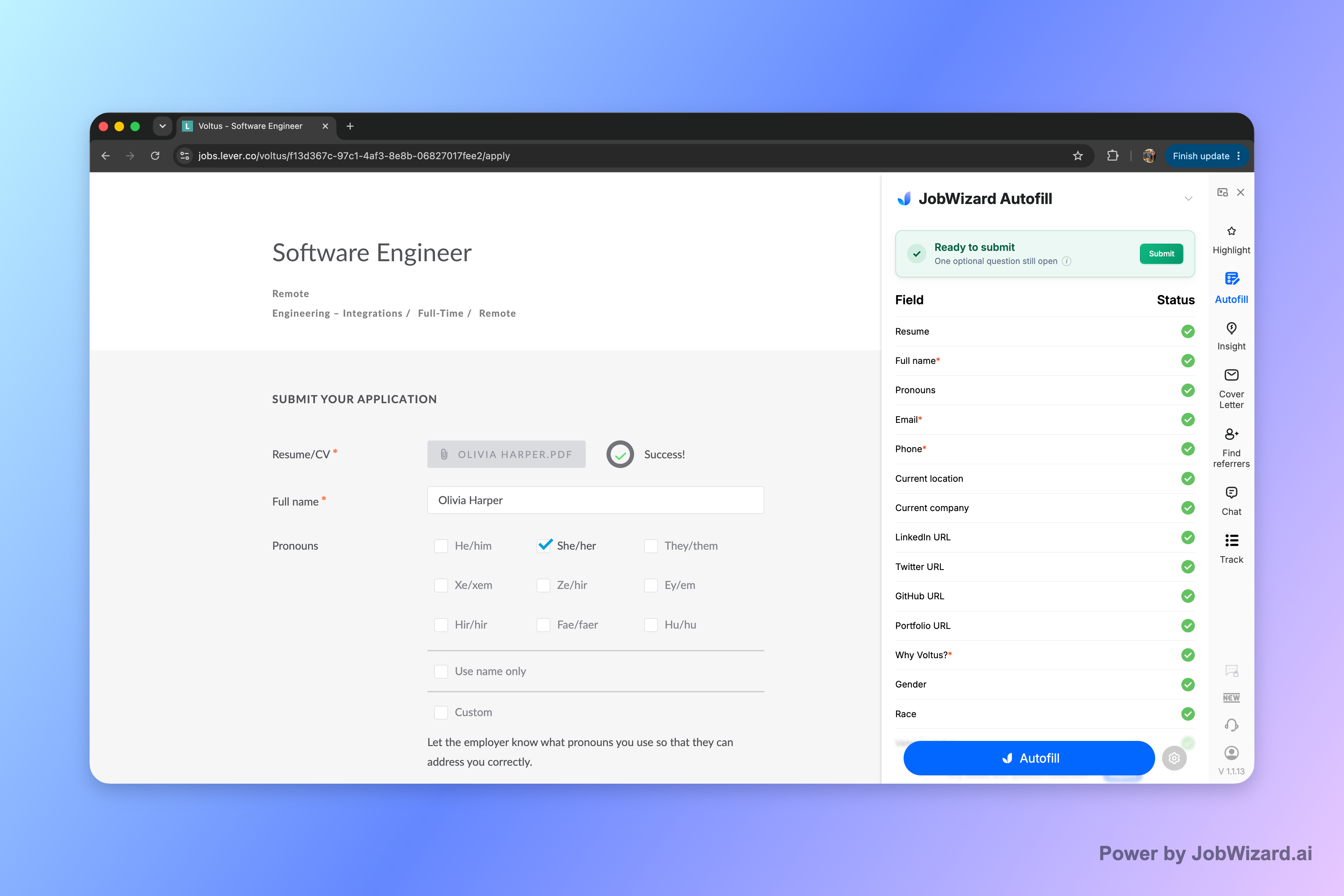
JobWizard fills the repetitive fields while keeping the final review and submission in the job seeker's hands.
When a required field still needs attention, JobWizard can identify it and let you jump to the matching question—so you can correct what matters most instead of blindly trusting what got populated.
How this helps with real-world job boards
If you’re applying across modern ATS platforms, the time sink is often the same: repeating forms, copying details, and re-entering consistent information. With autofill + review, you keep the speed benefits without the “set it and forget it” risk.
In verified usage across applications submitted through JobWizard, a large share happens on Workday, with additional flow through Greenhouse, Ashby, and Lever—so you’re optimizing for the sites where the repetitive form work is most common.
Verified usage context: JobWizard has helped power 720,000+ applications submitted and 600,000+ autofill sessions. Autofill typically fills ~18 repetitive fields per application (often 11–23), while leaving sponsorship / salary / EEO / custom questions for the user to review before submitting.
Key takeaway: the “AI” part should handle speed on routine fields—not replace your judgment on screening-critical answers.
Where JobWizard fits vs “ai auto apply” tools that push blind submission
If you’re deciding between bot-first “ai auto apply” approaches and an autofill-then-review workflow, the deciding factor is responsibility at the last mile.
JobWizard does not submit applications by itself, and it’s not designed for mass-applying while you’re away. It’s designed to autofill the application you’re already on, then you review and submit.
Here’s how that philosophical difference shows up in practice:
| Decision point | Bot-style “ai auto apply” | Autofill-then-review (JobWizard) |
|---|---|---|
| Who submits? | Typically automation submits (or proceeds) without you checking every answer. | You review the populated fields and submit the application yourself. |
| Screening-critical accuracy | Higher risk of wrong answers if the bot misreads conditional questions. | You keep control over sponsorship, salary, EEO, and custom questions before submit. |
| Required field handling | May look complete even when something still needs correction. | If a required field needs attention, JobWizard can identify it so you jump to the matching question. |
| Application consistency | Repeated “bot-like” patterns can contribute to employer-side deprioritization or flags. | Autofill speeds repetitive work, but your review keeps the final content aligned to the specific role. |
So what should you choose? If your priority is speed without sacrificing correctness, pick tools that help you fill faster on the page you’re viewing, then require a final review step from you.
For readers who want a deeper workflow, start with our pillar guide: How to Autofill Job Applications (Step-by-Step with JobWizard).
Try the autofill-then-review workflow next (and reduce bot-style risk immediately)
If you’re currently using or considering ai auto apply for volume, the fastest improvement you can make is changing how you submit.
Use a controlled autofill workflow on your next application:
- Open the job application and let the autofill tool populate the detected repetitive fields.
- Review every screening question and confirm that your answers reflect the role—not just your general background.
- Check resume/work-history mapping to ensure details pulled into the form match what the employer is asking for.
- Confirm sponsor/salary/EEO/custom prompts (these are typically where precision matters most).
- Submit yourself once you’re satisfied every important field is correct.
If you want more “speed without bot mistakes” guidance, read Speedyapply Without the Bot Mistakes: Autofill-Then-Review That You Control and compare it to what can happen when automation goes too far.
And if you’ve heard about specific auto-apply tools in the market, it’s worth understanding the broader failure pattern: Spotly Jobs: Why Bot Auto-Apply Can Cost You Interviews (and the Safer Autofill-Then-Review Way).
For a checklist-style perspective on “auto-apply” purchases and decisions, also see JobCopilot Review What to Check Before Paying for Auto-Apply (Do the Right Kind of Autofill).
Ready to try it on your next application? Use JobWizard’s Smart Autofill to fill repetitive fields quickly, then review every answer before you submit—so you get speed and accuracy.
Do this automatically with JobWizard
Skip the manual work — JobWizard's Smart Autofill handles this for you.
FAQ about ai auto apply and the safer autofill approach
Is “ai auto apply” the same as letting an autofill tool populate fields for review?
No. The safer workflow is autofill to populate the repetitive parts, then you personally review and submit the application. That way you control the answers to screening and custom questions, instead of trusting a bot to guess.
What’s the most common way AI auto apply bots hurt your applications?
They can answer screening questions incorrectly, leave required fields wrong or incomplete, or select the wrong resume/work history mapping. Even small mismatches can cause you to be rejected before a human ever reviews you.
Can an autofill tool still save time if I’m required to review before submitting?
Yes. You can still fill repetitive fields quickly while reserving your attention for anything that must be accurate—like sponsorship, salary, EEO, and custom questions. JobWizard is designed for that autofill-then-review flow.
How do you avoid submitting a mismatched resume or incorrect work history?
Before submission, confirm the resume/work history pulled into the application matches the role you’re applying to, then carefully review every screening question and anything that looks prefilled with your prior details. If a required field needs attention, JobWizard can identify it so you can jump to the matching question.
Is it better to try one AI auto apply tool or stick with a controlled autofill workflow like JobWizard?
If your goal is more applications without losing accuracy, prioritize a controlled autofill workflow: autofill the repetitive fields, then review every answer before you submit. That gives you speed where it’s safe and accountability where it matters.
Frequently Asked Questions
Autofill your next job application
JobWizard is a free Chrome extension that fills applications, tracks statuses, and optimizes your resume.