auto apply: what goes wrong with bots—and how JobWizard autofill keeps you in control
auto apply tools can fill the wrong details into screening questions and trigger employer spam filters. JobWizard autofills repetitive fields while you review and submit.
Free Chrome extension
Autofill your next job application
JobWizard is a free Chrome extension that fills applications, tracks statuses, and optimizes your resume.
auto apply feels like the quickest path to more interviews—but when a bot submits for you, small mistakes can become big problems: wrong answers to screening questions, mismatched resume details, and even employer-side spam filters that cost you a chance with a company you actually want.
This guide is about the trade-off. We’ll cover what typically goes wrong with auto-apply tools, then show a safer alternative: autofill repetitive fields fast, review everything, and submit yourself.
auto apply bots fail in predictable ways (and why employers notice)
Auto-apply breaks down most often when “fast” becomes “unchecked.” The issue isn’t just accuracy—it’s ownership. If you don’t control what’s submitted, you can’t reliably correct it before it’s sent.
Here are the most common failure modes job seekers run into with auto apply tools:
- Wrong or incomplete screening answers: Screening questions are where bots tend to guess, skip, or use stale information.
- Mismatched resume-to-role details: A tool may fill employment dates, titles, or skills from the wrong version of your experience.
- Missing “final mile” fields: Even if a form looks filled, required fields can still need attention—especially custom questions that vary by posting.
- Employer-side spam filters: If applications are sent in a bot-like pattern or with inconsistent data, automated filtering systems can flag them.
- Reputation damage: If the application contains inaccuracies or generic answers, you may create a negative first impression with a real recruiter or hiring team.
One more practical reality: many “easy apply” workflows still include questions that must match your real situation. If you want to be considered for roles where the details matter, you need a review step—not just speed.
Where the risk spikes: screening questions, custom fields, and resume mismatch
Screening questions and custom fields are the highest-risk areas because they’re designed to filter for fit. If an auto apply bot answers incorrectly, it can remove you from consideration before a human ever reviews your profile.
Common examples of what can go wrong:
- Availability and authorization nuances: Bots may apply broadly without reflecting your current constraints.
- Work authorization or sponsorship-related answers: If your status changes, autopopulated responses can be outdated.
- EEO and eligibility prompts: These often require careful selection, not approximations.
- Skills and experience mapping: If your resume includes multiple roles, an auto-apply tool can select the wrong match to fill a form.
Even when an auto-apply tool “fills,” it may not reflect what the posting actually asks in that moment. That’s why the safer approach is to treat autofill as drafting—then you decide what gets submitted.
If you’ve been searching for “AI job application bot” solutions, you’ve probably seen the promise of “apply faster.” The better question is: faster to what? Faster to submit unchecked answers is rarely faster to interviews.
Why review-before-submit beats blind auto-submit (a workflow you can trust)
Review-before-submit is the difference between “automation” and “control.” The goal is to reduce repetitive typing without relinquishing accountability for what goes into the application.
Think of the process like this:
- Start the application: Open the job posting and move to the form in your browser.
- Autofill repetitive fields: Use JobWizard to populate the standard profile information it can detect on that page.
- Check the important answers: Read every screening/custom question and confirm accuracy based on your real background.
- Submit yourself: Send the application only after you verify what will be reviewed by the employer.
JobWizard is designed for this exact pattern: it autofills while you keep the final review and submission in your hands. Your time is saved on repetitive data entry; your judgment is applied to the decisions that affect fit.
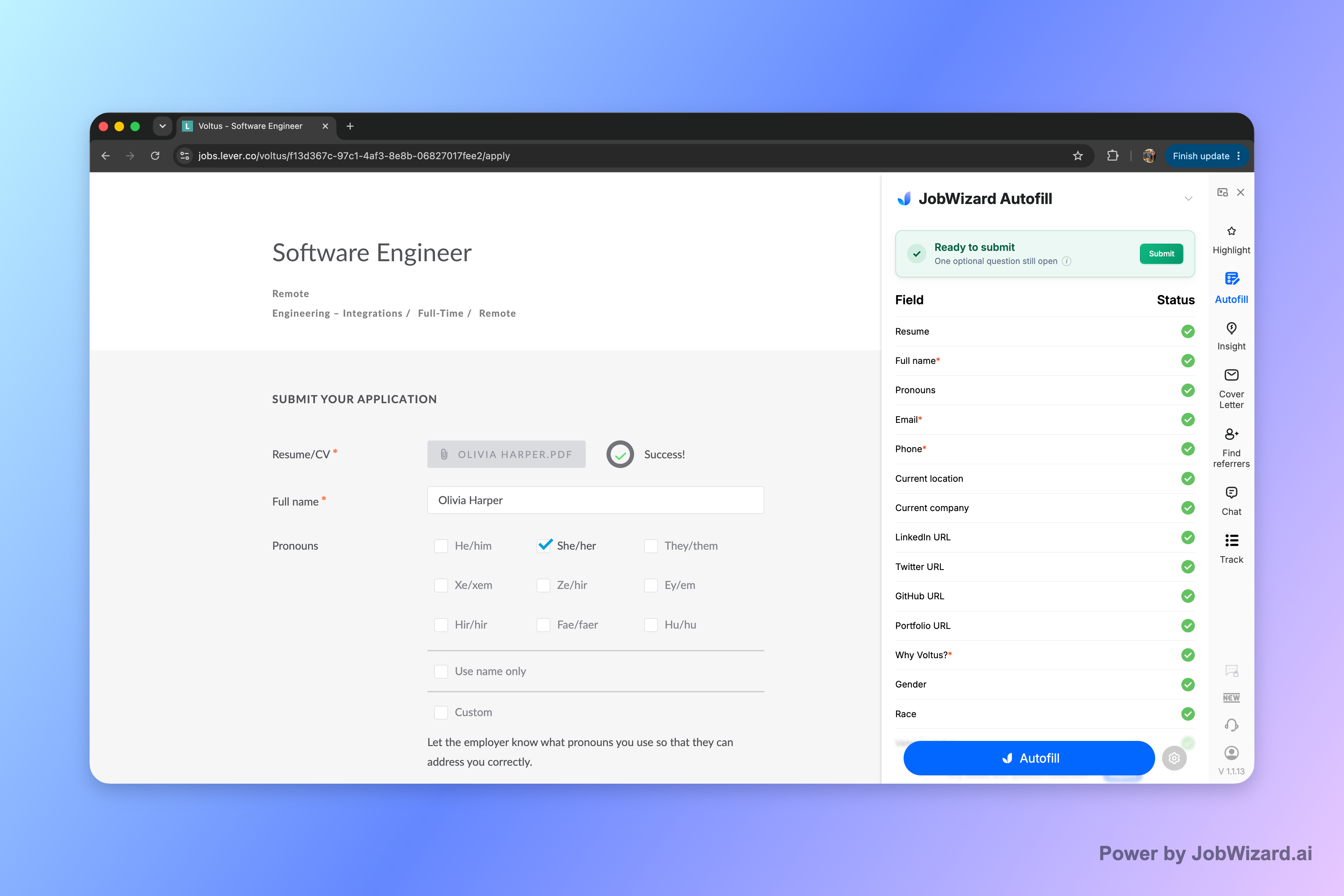
JobWizard fills the repetitive fields while keeping the final review and submission in the job seeker's hands.
How JobWizard supports “apply faster” without becoming an auto apply bot
JobWizard autofill helps you move quickly through forms by filling detected fields, then guiding you to verify anything that still needs attention.
JobWizard’s approach is explicitly review-first:
- It autofills fields on supported application pages using saved profile and resume data.
- You review the populated fields and submit the application yourself.
- If something required needs attention, JobWizard can identify it and let you jump to the matching question.
That means the tool supports the part of job searching that’s repetitive (form filling), while avoiding the biggest downside of auto apply tools: sending incorrect or mismatched answers before you can correct them.
For broader context, many applicants use platforms like Workday, Greenhouse, Ashby, and Lever. In our usage data, the majority of autofill activity is on Workday, with smaller portions on Greenhouse, Ashby, and Lever—so the workflow is most relevant where employers commonly standardize certain form fields.
Reality check: Autofill saves time on the repetitive fields you still need to confirm. In aggregate usage, JobWizard runs autofill + review-before-submit for hundreds of thousands of applications, and it typically fills ~18 repetitive fields per application—while leaving the final screening/custom decisions for you to review.
That’s the right balance for auto apply intent: speed where it’s safe, accuracy where it matters.
If you want a deeper walkthrough of the process, start with How to Autofill Job Applications (Step-by-Step with JobWizard).
Do this automatically with JobWizard
Skip the manual work — JobWizard's Smart Autofill handles this for you.
Choose the right tool for speed: autofill-then-check vs auto apply strategies
Not every “apply faster” tool is the same. The practical difference is whether you’re in control of the final content that gets submitted.
Here’s a fair way to decide what fits your workflow:
| Approach | What it’s good at | Main risk to watch |
|---|---|---|
| auto apply bots (blind submission) | Trying to increase submission volume | Wrong answers to screening questions, resume mismatch, and employer-side spam filtering from bot-like behavior |
| Autofill-then-review tools (you submit) | Filling repetitive fields quickly | You must still verify screening/custom answers before submitting |
If you’re using job platforms with established application tracking, pairing autofill with a review-first tracking habit can help you stay consistent. For example, review-focused guidance on Workday workflows is here: Workday Application Tracking System: A Review-First Autofill Workflow to Apply Faster (and Stay in Control).
And if you’ve been searching specifically for bot-style behavior (like the “copilot ai job” concept), use this as a safety reference: “copilot ai job” search: stop bot submissions and use autofill-then-review to apply safely.
Finally, if your goal is “easy apply” speed, review-first matters there too. This comparison-oriented guide can help you pick tactics without drifting into risky auto-submit behavior: Top Rated Job Search Apps With Easy Apply: A Review-First Guide to Faster Applications (Without Risky Auto-Submit).
Is auto apply ever a good idea?
It can seem fast, but auto apply bots often mis-answer screening questions, use the wrong resume/experience details, or behave like spam. A review-first workflow (autofill repetitive fields, then submit yourself) reduces those risks.
What are the most common ways auto apply tools fail?
They can insert mismatched resume info, pick the wrong work history for the role, overlook or guess at screening questions, and sometimes trip employer-side spam filters—especially if applications are sent too broadly or without tailoring.
How does JobWizard differ from an auto-apply bot?
JobWizard autofills an application you’re already on using saved profile and resume data, then you review the populated fields and submit yourself. It also helps identify fields that still need attention so you can jump to the matching question.
Will autofill write every answer for me automatically?
No—autofill is not automatic submission, and it’s not guaranteed to fill every field perfectly. You’re expected to review each answer, especially anything involving sponsorship, salary, EEO, and custom questions.
What’s the fastest safe workflow to use instead of auto apply?
Use a review-first autofill flow: (1) start the application in your browser, (2) let JobWizard fill repetitive fields, (3) quickly check each screening/custom answer, and (4) submit only after you confirm everything is correct.
Ready to apply faster without going blind? Try JobWizard on your next application to autofill repetitive fields in seconds, then review every answer before submitting.
Frequently Asked Questions
Autofill your next job application
JobWizard is a free Chrome extension that fills applications, tracks statuses, and optimizes your resume.