auto apply for jobs: how bot-style submissions go wrong (and smart autofill fixes the damage)
Thinking about auto apply for jobs with a bot? Learn why wrong screening answers and resume mismatches happen—and how smart autofill + review gets applications ready without submission risk.
Free Chrome extension
Autofill your next job application
JobWizard is a free Chrome extension that fills applications, tracks statuses, and optimizes your resume.
Auto apply for jobs feels fast—until a bot guesses, and you pay for it later.
Most auto apply for jobs tools promise speed, but the moment a bot submits your application automatically, it has to “decide” what to answer—based on whatever data it can infer. That’s where things go wrong: screening questions get the wrong response, your resume doesn’t match the role details, and an employer’s system may treat the submission as spam or low-quality.
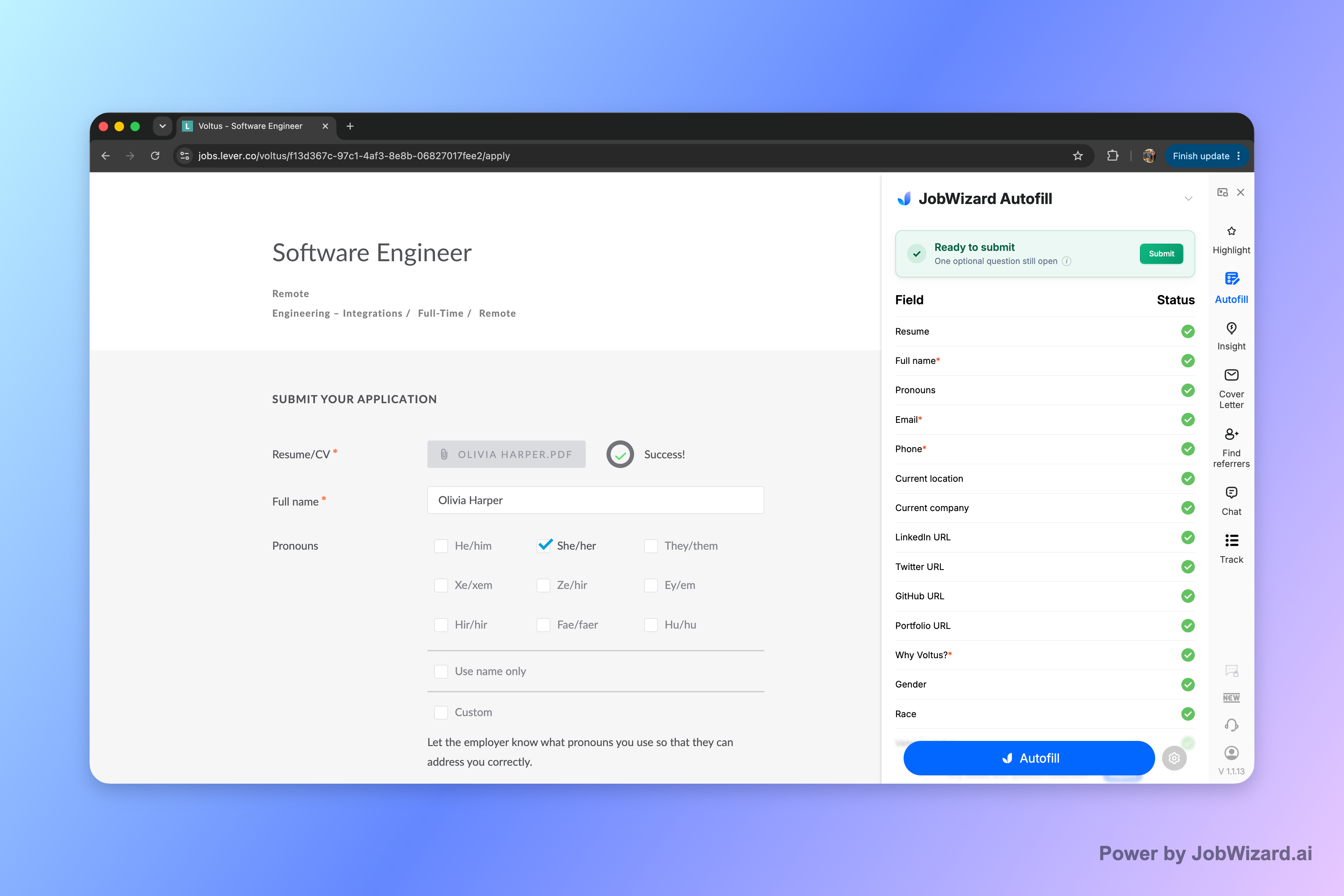
JobWizard’s approach is different: it helps you move quickly by autofilling the repetitive parts on the application page, while you keep control of the accuracy-critical fields and you submit yourself. In other words, it’s autofill + review-before-submit, not blind auto-apply.
What goes wrong with bot submissions when you auto apply for jobs
When you let an automation fire-and-forget, the application stops being a careful match between your experience and a specific job—and becomes a best-effort guess. Even small inconsistencies can trigger automatic rejection, and some damage isn’t obvious until you hear back (or don’t).
1) Screening questions get the wrong answers
Many job postings include questions where wording matters: eligibility, availability, work authorization details, relocation preferences, or “yes/no” filters tied to the role. If a bot fills those fields from an old profile note or an imperfect inference, you can end up answering opposite to your real status—without noticing.
- Example: The job asks whether you have “3+ years of hands-on experience with X.” Your resume mentions X once in a project, but you don’t meet the exact threshold the screening is using.
- Example: The form asks about start date flexibility. A bot may assume “immediately” when you actually need a two-week notice.
2) Resume/profile mismatches look “inconsistent” to the employer
Even if the bot is filling correctly from your data, it can mismatch what the form asks versus what your resume supports. Employers often rely on the specific fields they request (tooling, tenure, titles, location, salary expectations, EEO answers, custom questions). If those are off, your application can be flagged as incomplete or not truly aligned.
- Example: The application requests your most recent title and dates; your profile may have a different wording than your resume, or you may have updated responsibilities that the form doesn’t “understand.”
- Example: The form asks for salary/compensation expectations tied to location; a bot may reuse a generic number instead of your role-specific target.
3) Employer-side spam filters may treat automation as low quality
Some employers use anti-spam and application quality signals. If your submissions look repetitive, missing context, or inconsistent across fields, they can be deprioritized or blocked. You don’t want your “real interest” job to become the one where the system lumps you into an automated or low-effort bucket.
Key takeaway: incorrect answers aren’t just “a small mistake”—they can change how the employer routes your application.
4) You can’t catch context issues before submission
In most bot-style flows, you don’t get a chance to confirm every question that matters. That means you might submit before noticing that a required field is asking for something different than you assumed, or that a text area needs a tailored response for this employer.
JobWizard’s verified usage shows that autofill + review-before-submit is how applicants keep speed without surrendering accuracy-critical checks—720,000+ applications submitted and 600,000+ autofill sessions run through JobWizard.
JobWizard’s autofill + review workflow: fast forms, you in charge of the answers
The practical alternative to auto apply for jobs “bot submission” is to speed up the typing without removing your judgment. JobWizard fills the repetitive fields on the application page, then you review the populated fields and submit the application yourself.
How it works on the application page
JobWizard’s smart autofill uses saved profile and resume data to fill detected fields on supported application pages. If a required field still needs attention, it can identify it and help you jump to the matching question.
- Detect: JobWizard recognizes fields on the application form (where supported).
- Autofill: Repetitive inputs get filled based on your saved profile/resume data.
- Review: You verify every answer—especially screening and custom questions.
- Submit: You press submit with the final truth in your hands.
Why this reduces the exact bot failures
- Less screening trouble: You confirm eligibility/start date/threshold questions before they go in.
- Fewer mismatches: You catch when the form needs a nuance your resume didn’t phrase exactly.
- Cleaner intent: Your application reflects your decisions, not an automation guess.
Platforms you’ll see in the real world
In real usage, a majority of autofills occur on Workday (~65%), with additional activity on Greenhouse (~19%), Ashby (~12%), and Lever (~4%). Workday is where it saves the most time, because many of the repetitive fields are structured in a way that’s easy to autofill and review.
Auto apply for jobs vs smarter autofill tools: choose the workflow that protects accuracy
Not every “auto” job tool behaves the same way, and you shouldn’t treat all options as interchangeable. The right choice depends on whether you’re okay with a tool deciding the accuracy-critical parts—or whether you want speed with review.
| Approach | What it typically does | Best for | Watch-outs |
|---|---|---|---|
| Auto-apply / bot-style submission | May submit applications automatically after filling (exact behavior varies by tool). | Time-crunched volume when you accept higher uncertainty. | Higher chance of wrong screening answers, resume/profile mismatches, and employer quality filtering—because final context may not be verified. |
| Autofill + review-before-submit (JobWizard) | Autofills repetitive fields on the application page; you review and submit. | Applicants who want faster forms without losing control of accuracy-critical answers. | You still need to review. Speed comes from reducing typing, not eliminating responsibility. |
| Other application assistants (e.g., Simplify, Teal, Huntr) | Often help with autofill and/or job tracking; capabilities vary by product and site. | People who want a different combination of autofill, tracking, or matching. | Always verify what happens right before submission—especially screening questions and custom fields—regardless of vendor. |
If you want a more detailed walkthrough for getting consistent results using autofill, start with How to Autofill Job Applications (Step-by-Step with JobWizard). If you’re focused specifically on the risk side of auto apply for jobs, read Auto Applying for Jobs Is Risky—Here’s What to Do Instead (Autofill-Then-Review) and Best Auto Apply for Jobs: Why “Bot” Submissions Backfire and What to Use Instead. For real-world anecdotes and failure modes, see ai auto apply for jobs reddit: what goes wrong with bot-style submissions (and the safer autofill review workflow).
Do this automatically with JobWizard
Skip the manual work — JobWizard's Smart Autofill handles this for you.
FAQ: auto apply for jobs questions people ask before they hit submit
Is auto apply for jobs ever safe if a tool “submits” automatically?
It’s safer to avoid fully automatic submission. Even well-intentioned tools can miss context in screening questions, mismatch resume content to specific roles, or trigger employer spam filters. A workflow like autofill + review keeps repetitive fields fast while you control the final, accuracy-critical answers.
What kinds of mistakes happen with bot-style submissions?
Common failure points include incorrect or incomplete answers to screening questions, profile/resume mismatches (e.g., dates, titles, or tools you truly don’t have), and inconsistent information across forms. Those errors can cause your application to be rejected automatically or reviewed as low-quality.
How does JobWizard’s smart autofill reduce those risks?
JobWizard autofills detected fields on the application page using saved profile and resume data, then you review everything and submit yourself. If a required field still needs attention, it can identify where the user should jump to the matching question—so you don’t blindly ship incorrect answers.
Will auto apply for jobs tools protect me from employer screening?
No tool can guarantee what an employer’s screening logic will do. If a bot answers screening questions inaccurately, you may be filtered out even when you’re qualified. The practical protection is to keep the “final truth” in your hands: fill repetitive fields quickly, then review every screening and custom question before you submit.
Ready to apply faster without letting a bot decide? Try JobWizard’s Autofill on your next application: let it populate the repetitive fields, then review every answer and submit yourself.
Frequently Asked Questions
Autofill your next job application
JobWizard is a free Chrome extension that fills applications, tracks statuses, and optimizes your resume.