Auto Applying for Jobs Is Risky—Here’s What to Do Instead (Autofill-Then-Review)
Auto applying for jobs can backfire when bots guess at answers, mismatch your resume, or trigger spam filters. Use JobWizard’s autofill, then review every field before you submit.
Free Chrome extension
Autofill your next job application
JobWizard is a free Chrome extension that fills applications, tracks statuses, and optimizes your resume.
When you’re searching for faster ways to auto applying for jobs, it’s tempting to rely on “bot” tools that fill forms and submit for you. But the downside is real: screening answers can be wrong, your resume context can mismatch, and your submission can look inconsistent to employers. The result isn’t just “less effective”—it’s avoidable damage to jobs you actually want.
JobWizard fills repetitive fields while keeping control with you.
Why auto applying for jobs backfires when a bot submits
Bot submission turns your application into a high-risk guessing game—because the tool has to infer details you’d normally choose carefully.
When someone else presses the submit button (or when automation runs without your direct review), problems tend to cluster around the same failure points. Here’s what commonly goes wrong.
- Wrong answers to screening questions: Eligibility, location, work authorization, availability, and “yes/no with nuance” questions are easy to misread or mis-enter.
- Resume mismatches and missing context: Even if a resume is attached, the form fields may not align with the resume’s most relevant experience or dates—especially for roles with specific requirements.
- Inconsistent profiles across the application: If one field is auto-filled from a saved profile and another is manually edited differently, your answers can conflict in subtle ways.
- Employer-side spam or quality filters: Many ATS and hiring workflows use signals to detect low-quality or repetitive submissions. Inconsistent or clearly template-driven responses can increase the chance your application gets deprioritized.
The bigger issue is reputational: a “fast apply” approach can cause you to look careless to a company you might target again—especially when you genuinely match the role but your answers don’t reflect that match.
The safer alternative: autofill, review, then submit yourself
Autofill-then-review keeps speed without losing accuracy—you still decide what goes into the final submission.
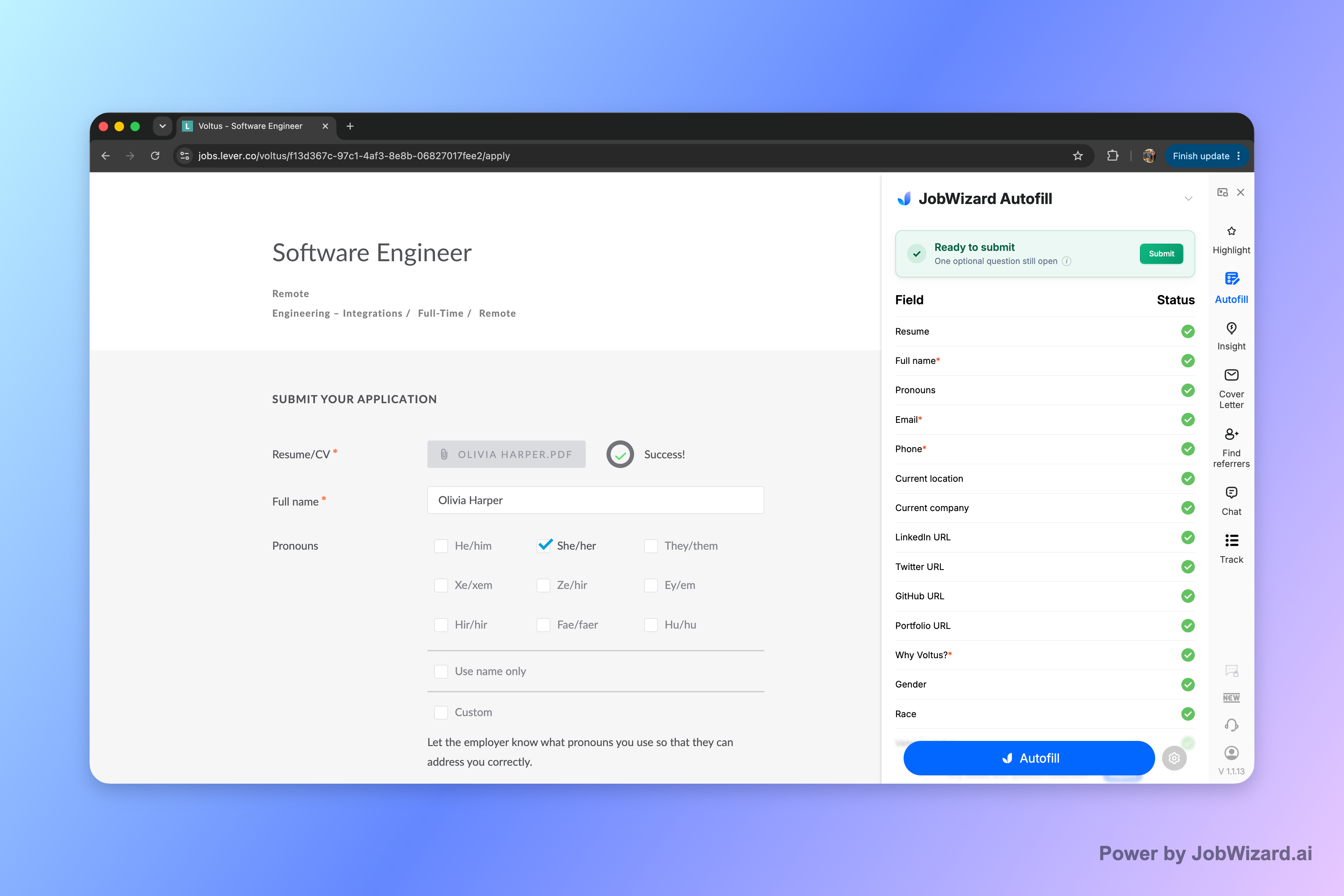
JobWizard’s Smart Autofill is designed for the part of the process that’s repetitive: the detected fields on the application form. Instead of submitting for you, it helps you move quickly to the stage where you can verify everything that matters.
- You review every filled field before submitting, so screening questions and custom prompts stay accurate.
- It identifies required fields that need attention so you can jump to the matching question and confirm the right answer.
- It’s not “automatic submission”: the final click is yours, while you keep control of sponsorship/salary/EEO/custom questions and anything that demands your judgment.
In practice, this means you get the benefit of fast form completion while avoiding the core risk of bot-style “auto applying for jobs.” You fill seconds faster, but you still submit like you meant it.
Where JobWizard helps most (and what to expect)
JobWizard shines on the form-filling steps that waste time, especially inside common ATS workflows.
From our aggregated usage, JobWizard autofills an average of ~18 repetitive fields per application. That workload is the exact place where humans lose time—and where copy/paste errors can happen. If you’re aiming to apply faster, this “autofill + review-before-submit” workflow is the practical middle ground.
Usage context: 720,000+ applications submitted and 600,000+ autofill sessions run through JobWizard. Applications are ~65% on Workday, ~19% Greenhouse, ~12% Ashby, ~4% Lever.
Those platform shares matter because Workday is where it tends to save the most time. Still, the important product reality is the same everywhere: JobWizard autofills detected fields, and you review and submit yourself.
If you want to see how this shows up across workflows, start with the complete guide: How to Autofill Job Applications (Step-by-Step with JobWizard).
And if your main pain is doing this at scale across tabs, consider reading about the browser workflow: Best Chrome Extension for Applying to Many Jobs Fast: JobWizard’s Fast Autofill + Review Workflow.
Auto applying for jobs vs. autofill-then-review: a practical comparison
Choose the workflow that protects your answers, not the one that just speeds up the click.
| Approach | What it does | What can go wrong | Best for |
|---|---|---|---|
| Bot-style “auto apply” | Fills and may submit without your final, careful review | Wrong screening answers, resume/context mismatch, inconsistent responses, and increased chance of employer-side filtering | Situations where you can still fully control every answer before submission (rare) |
| Autofill-then-review (JobWizard) | Autofills detected fields, then you review and submit | You must still check accuracy for questions that require judgment or custom responses | Applying faster while keeping your final submission accurate and consistent |
If you’re weighing tools and want a deeper look at the “bot” trade-offs, you can compare perspectives in these related reads: Best Auto Apply for Jobs: Why “Bot” Submissions Backfire and What to Use Instead and ai auto apply for jobs reddit: what goes wrong with bot-style submissions (and the safer autofill review workflow).
Ultimately, auto applying for jobs can make you feel productive—until you realize the application you submitted didn’t represent you. Autofill helps you move fast; review helps you stay credible.
Do this automatically with JobWizard
Skip the manual work — JobWizard's Smart Autofill handles this for you.
FAQ: Auto applying for jobs
Is auto applying for jobs ever a good idea?
It can feel fast, but most “auto apply” setups turn critical screening fields into guesswork. Wrong answers, mismatched resume sections, and inconsistent profiles can hurt your chances—so the safer approach is autofill repetitive fields, then review and submit yourself.
What goes wrong when a bot submits for you?
Common issues include incorrect responses to screening questions, a resume or work history that doesn’t match what the employer expects, and answers that look inconsistent across fields—problems that can also increase the chance of employer-side filters flagging your submission.
How does autofill help without turning into a bot submission?
JobWizard autofills detected fields on the application page using your saved profile and resume data, then you review what was filled before submitting. If a required field still needs attention, it can guide you to the matching question so you can confirm accuracy.
Which platforms does autofill work well on?
JobWizard is used across common ATS experiences like Workday and Greenhouse (and others). Workday is where it tends to save the most time, and the key is that you still control the final review and submission.
What should I check before I click submit?
Double-check screening questions (especially eligibility, location, and role fit), confirm work history and dates, verify the resume section that’s most relevant to the role, and ensure any custom questions are answered in your own words before submitting.
Ready for faster applications without risky “auto applying for jobs” submissions? Try JobWizard Autofill on your next application, review every filled answer, and then submit yourself—so speed never comes at the cost of accuracy.
Frequently Asked Questions
Autofill your next job application
JobWizard is a free Chrome extension that fills applications, tracks statuses, and optimizes your resume.