auto apply jobs: why bot submissions backfire—and the review-first alternative with JobWizard
“auto apply jobs” sounds like a shortcut, but bot-style submissions can answer screening questions wrong and trigger spam filters. Use JobWizard to autofill repetitive fields, then review and submit yourself.
Free Chrome extension
Autofill your next job application
JobWizard is a free Chrome extension that fills applications, tracks statuses, and optimizes your resume.
If you’re searching for auto apply jobs, you probably want speed—but bot-style “auto-submit” can quietly damage your candidacy before anyone reads your resume.
The fix isn’t to submit less. It’s to submit right: autofill repetitive fields fast, then keep final control so you’re not sending the wrong screening answers or mismatched experience. That’s the review-first approach JobWizard is built for.
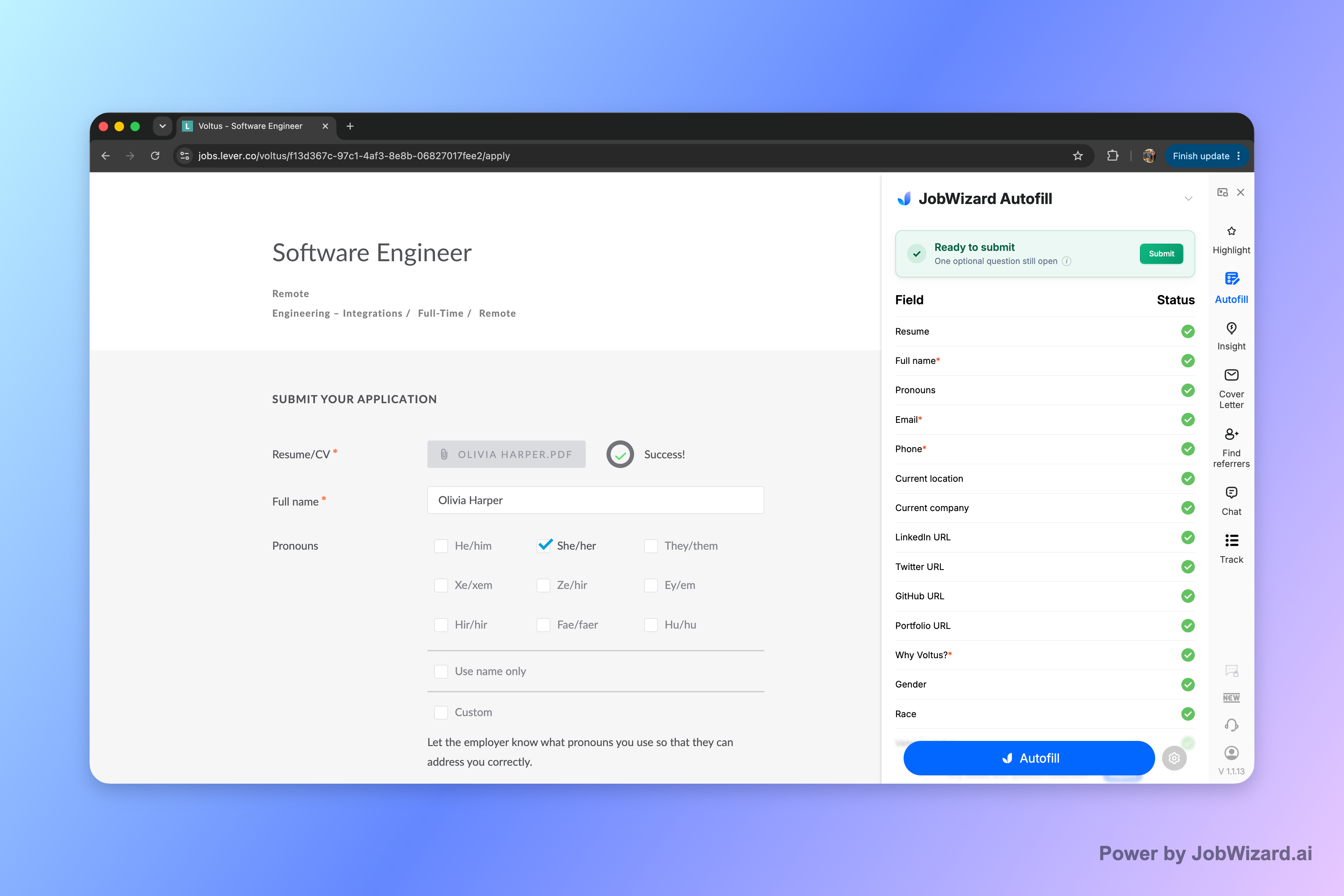
Why “auto apply jobs” bots often backfire
Auto-submit bots can introduce errors that screening and hiring teams actually notice. Even when an application form looks “filled,” automation can still choose the wrong option, skip a required prompt, or fail to match your resume to what the employer asked for.
Here are the most common failure modes job seekers run into when they chase “auto apply jobs” instead of review-before-submit.
- Wrong answers to screening questions: A bot may select an option that doesn’t reflect your real experience (for example, availability, eligibility, or role expectations).
- Mismatched resume or work history: Some employers collect overlapping details across multiple sections; an automated filler can produce inconsistencies that stand out.
- Employer-side spam or quality filters: Highly repetitive, robotic-looking applications can trigger anti-spam or quality checks—especially when patterns don’t align with how humans apply.
- Custom prompts get handled like “optional” fields: If a question changes by role, automation may treat it as generic and leave you with content you didn’t intend to submit.
The impact is simple: you may accidentally “apply” to the right job but still lose the opportunity because the application content doesn’t match what the employer is screening for.
The safer alternative: autofill first, submit yourself
You can apply faster without going fully hands-off. The review-first workflow is designed for a practical reality: most applications ask you to repeat the same core information, but you still need to confirm role-specific answers.
JobWizard focuses on the parts that are typically repetitive—filling detected fields on the application page—then handing you back control at the review stage. If a required field still needs attention, JobWizard can identify it so you can jump directly to the matching question.
That workflow matters for “auto apply jobs” searches because it prevents the biggest downside of bot-style tools: submitting while you haven’t confirmed the details that decide whether you pass screening.
Verified usage context: JobWizard autofills about ~18 repetitive fields per application on average (typically 11–23). You still review before submitting, and sponsorship/salary/EEO/custom prompts are left for you to confirm.
How to apply faster without triggering the common “bot” problems
Use a checklist so autofill becomes a draft you control. Instead of trying to automate submission, tighten your process around the moment that matters: the review.
- Start on the real application page: Make sure you’re filling the exact form the employer is using.
- Autofill repetitive fields, then pause: Treat autofill as time saved—not as “done.”
- Verify screening questions line-by-line: Confirm answers about eligibility, availability, location requirements, and any yes/no or select-all prompts.
- Check resume-to-form alignment: Ensure dates, job titles, and responsibilities match across sections so you don’t submit internal inconsistencies.
- Review custom questions last: Especially anything role-specific, since these are where bots are most likely to guess or generalize.
- Submit yourself: Final click is where you take responsibility—and where review-before-submit prevents bot-style mistakes.
If you want speed, this approach delivers it where it’s safe: you fill commonly repeated inputs quickly, but you still own the answers that get screened.
JobWizard vs. “auto apply” tools: choosing the right trade-off
The right choice depends on whether the tool submits by itself or helps you fill accurately. For “auto apply jobs” seekers, it’s worth understanding the core trade-off: auto-submit prioritizes volume, while review-first autofill prioritizes correctness at the moment screening happens.
| Approach | What it typically optimizes | Main risk | When it can fit |
|---|---|---|---|
| Bot-style auto-submit (“auto apply jobs” tools) | High throughput | Wrong screening answers, resume mismatch, or employer quality/spam checks reacting to repetitive patterns | When you don’t care about precision (but this can still hurt you at preferred employers) |
| Review-first autofill (JobWizard) | Speed on repetitive fields + accuracy on reviewed content | Still requires your review—so you must confirm role-specific questions before submitting | When you want to move quickly without sending “draft errors” to screening |
JobWizard is frequently used with major ATS workflows, and the time savings tend to be strongest on Workday. In aggregate usage, about ~65% of applications are on Workday, ~19% Greenhouse, ~12% Ashby, and ~4% Lever (review-before-submit is still part of the workflow).
If you’re trying to speed up applications the safe way, start with autofill—and keep the submission click under your control.
Next: learn the full review-first workflow with How to Autofill Job Applications (Step-by-Step with JobWizard). If you’re comparing approaches, also read Copilot Jobs: When “Bot Apply” Breaks Screening—and How Autofill-Then-Review Saves Your Candidacy and auto apply for jobs: how bot-style submissions go wrong (and smart autofill fixes the damage). For a broader comparison of the risk model, see Auto Applying for Jobs Is Risky—Here’s What to Do Instead (Autofill-Then-Review).
Do this automatically with JobWizard
Skip the manual work — JobWizard's Smart Autofill handles this for you.
FAQ
Is it safe to use auto apply tools that submit automatically?
It’s safer to assume automatic submission can mis-handle details. Even if fields get filled, bots can miss or misunderstand screening questions, mismatch your resume, or trip employer anti-spam checks—so you keep control by reviewing every answer before you submit.
What goes wrong with bot-style “auto apply jobs” submissions?
Common issues include wrong answers to screening questions, a resume or work history that doesn’t match what the employer asked for, and employer-side spam or quality filters reacting to suspiciously repetitive applications. That can cost you opportunities at companies you actually want.
How is JobWizard different from auto-submit bots?
JobWizard autofills an application you’re already on using your saved profile and resume data, then you review the populated fields and submit yourself. If a required field still needs attention, you can jump directly to the matching question.
How should I review before I submit when using autofill?
Treat the autofill as a draft: verify screening questions, dates, job titles, and any custom prompts; confirm your resume/work history align with the role; and double-check the final sections before clicking submit so you don’t accidentally send mismatched answers.
Which applicant platforms does JobWizard support best?
JobWizard is used across common ATS platforms, and Workday is where it tends to save the most time. Coverage depends on whether the relevant fields are detected on the application page.
Ready to apply faster without the bot mistakes? Try JobWizard on your next application: let it autofill the repetitive fields, then review every answer before you submit—so you control what the employer actually receives.
Frequently Asked Questions
Autofill your next job application
JobWizard is a free Chrome extension that fills applications, tracks statuses, and optimizes your resume.