Auto Apply AI: How “Bot Submits for You” Goes Wrong—and What to Do Instead
Auto apply ai tools promise speed, but the downside is often wrong answers, mismatched resumes, and screening friction. Learn the reviewed autofill approach instead.
Free Chrome extension
Autofill your next job application
JobWizard is a free Chrome extension that fills applications, tracks statuses, and optimizes your resume.
Auto apply ai sounds like a shortcut, but “bot submits for you” workflows often create avoidable damage—wrong screening answers, mismatched resumes, and employer-side spam friction. In this guide, we’ll break down what goes wrong with auto-apply bots and show a reviewed alternative: autofill the repetitive parts, then submit yourself.
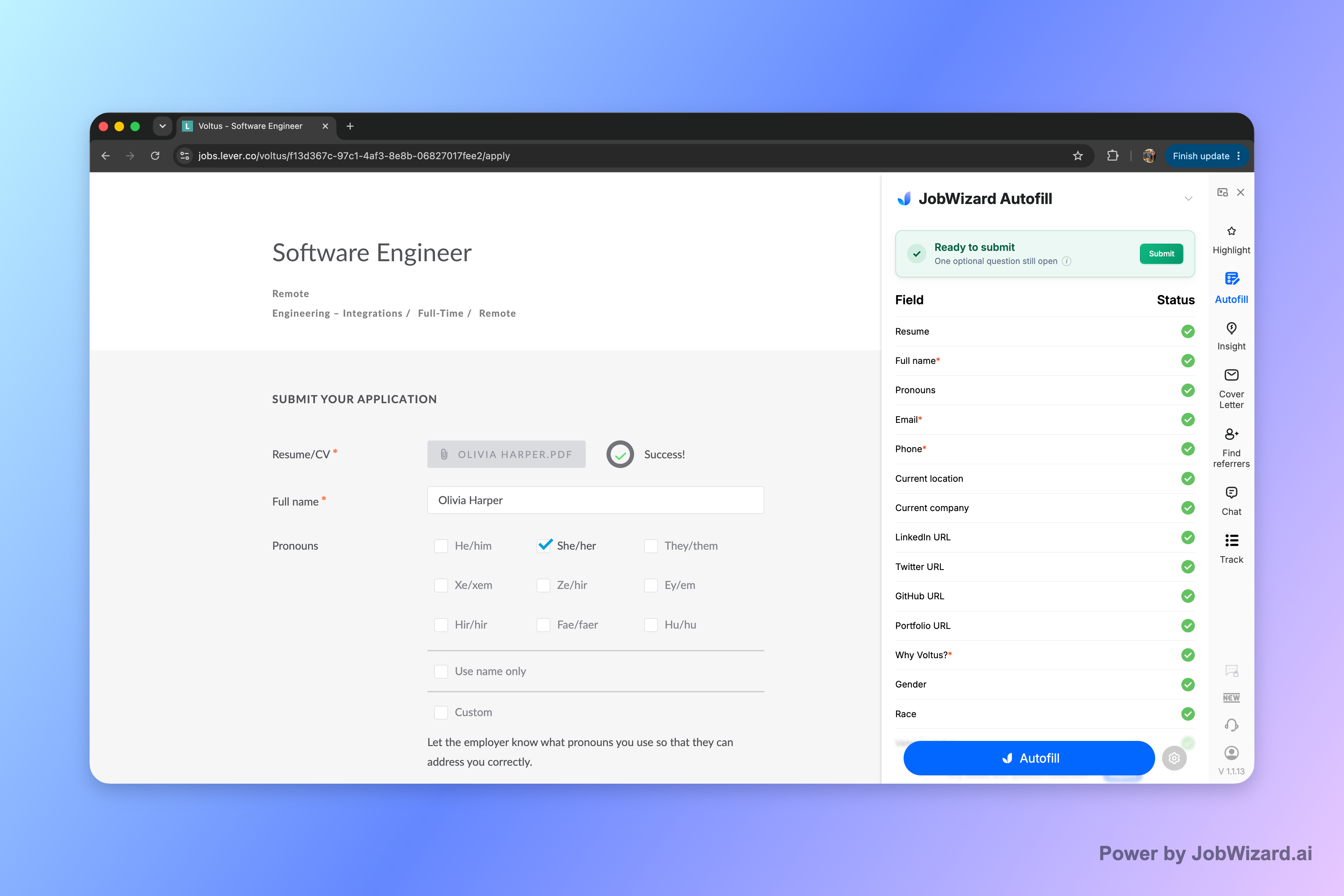
If you want faster applications without handing control away, start with a workflow that’s designed for autofill + review-before-submit rather than blind automation.
What auto apply ai tools get wrong when they submit on your behalf
Bot submission can turn a targeted application into a mismatched one, even when the tool “finds” a form.
Auto apply ai tools that submit for you usually optimize for volume, not correctness. That’s where problems start: the answers a screening flow requires (eligibility, dates, work authorization, location constraints, compensation expectations, EEO responses, and custom questions) are exactly the fields that must be accurate for the specific job.
The result is a set of common failure modes that hurt your chances and sometimes your reputation:
- Wrong answers to screening questions: A bot can fill fields with stale or generic responses that don’t match the job’s requirements.
- Resume mismatches: The wrong version of your resume can be attached (e.g., missing a recent project, incorrect role title, or missing a required credential).
- Form logic doesn’t translate: Some job portals change what questions appear based on earlier answers; an auto-filled flow can step into the wrong branch.
- Employer-side spam filters and reputation risk: When applications look repetitive, inconsistent, or automated, systems may flag them and hiring teams may deprioritize them.
Even if the text “looks” filled, the hiring process is highly sensitive to specifics. A single incorrect eligibility or availability response can cause an early rejection that would never happen with a quick manual review.
For a broader perspective on repeating forms safely, see Job Search Extension: The Practical Way to Speed Up Repetitive Applications (Without Blind Auto-Apply).
The safer alternative: autofill the repetitive parts, then review and submit yourself
You can move fast without losing accuracy by using an autofill workflow that stops short of auto-submission.
With JobWizard, you’re not “set and forget.” The core idea is: you’re brought to the job application page, repetitive fields are filled quickly, and then you review before you submit. That means you keep final responsibility for the answers that matter.
This approach is especially important because the “right” application is rarely one-size-fits-all. You want automation where it’s safe (repetitive fields) and human control where it’s not (screening answers, sponsorship/salary/EEO, and custom questions).
Across 720,000+ applications submitted and 600,000+ autofill sessions run through JobWizard, autofill typically fills ~18 repetitive fields per application (often 11–23). Sponsorship / salary / EEO / custom questions are left for the user to review before submitting.
That’s the key trade-off vs auto apply ai bots: you still get speed from drafting repetitive details, but you avoid “wrong by default” submission behavior.
If you want a detailed workflow comparison, read How to Autofill Job Applications (Step-by-Step with JobWizard).
Where auto apply ai breaks down: screening, attachments, and mismatch signals
Most bot failures happen in the high-stakes fields—the ones employers use to quickly filter candidates.
1) Screening questions: accuracy beats speed
Screening questions are often logic-driven and role-specific. Auto apply ai can guess, misinterpret, or overwrite your intended answers if you didn’t provide them in the exact way the screening form expects.
- Confirm eligibility and authorization details against your real situation.
- Check availability, location constraints, and willingness to relocate.
- Verify compensation/sponsorship/EEO responses for each posting.
2) Resume and document attachment: “a” resume isn’t “the” resume
Even when a tool attaches a resume, it may not be the resume version aligned to the job. That can create a mismatch between your claims in the application and your actual document.
Fast autopicking can cost you when the employer expects certain keywords, projects, or credentials to match the posting.
3) Mismatch signals that trigger friction
Employers don’t evaluate applications only by content; they also detect patterns. When applications appear repeatedly templated or inconsistent across fields, systems may flag them.
That can mean delays, rejections, or—worst case for candidates who care about specific companies—an impression of spammy behavior.
If you’re comparing tools, it’s helpful to see how different approaches handle autofill vs submission. Start with JobWizard vs LazyApply: A Practical Autofill-and-Review Showdown for Applications.
How to build an “autofill + review” workflow that’s actually reliable
A repeatable checklist prevents the exact mistakes auto apply ai bots make.
Use the steps below every time you’re ready to apply. The goal is simple: let automation handle repetitive data, and let your review handle accuracy.
- Start on the job page so the correct fields and logic appear for that specific posting.
- Autofill the repetitive sections (contact basics, prior company details, standard employment fields, and similar items).
- Review every screening answer line-by-line—especially eligibility, availability, compensation, and EEO-related items.
- Verify the resume match to the role (title, scope, recency, and the keywords that matter).
- Check custom questions that ask for specifics about projects, tools, leadership, or domain experience.
- Submit yourself only after the entire application reflects the job.
This workflow directly addresses the failure modes of auto apply ai submission tools: the “guessing” risk drops because you’re the final decision-maker before the submit action.
For teams worried about ATS mismatches and how to think about compatibility, explore Jobscan Alternatives for Job Seekers: ATS Matching + Application Workflow Options (Without Blind Auto-Apply).
Auto apply ai vs autofill-and-review: a practical comparison
Choose the workflow that keeps you in control of screening and customization.
| Approach | What it tends to optimize for | Main risk | Best fit when… |
|---|---|---|---|
| Auto apply ai that submits for you | Speed and quantity | Wrong answers to screening questions, resume mismatch, and possible employer-side spam friction | You’re okay reviewing nothing and accept higher false-positive rejections |
| Autofill + review-before-submit (recommended) | Speed on repetitive fields, accuracy on role-specific details | Lower than submission-by-bot because you confirm answers before submit | You want faster applications without losing control of high-stakes fields |
JobWizard fits the second category. The repetitive fields are autofilled to reduce typing time, while the parts that require judgment remain for you to review—then you submit yourself.
As you apply more roles, this is how you protect quality while staying efficient.
Do this automatically with JobWizard
Skip the manual work — JobWizard's Smart Autofill handles this for you.
FAQ about auto apply ai
Is auto apply ai actually “auto-submitting” your applications?
Some auto apply ai tools are designed to submit on your behalf, which can fill in screening fields incorrectly or out of sync with what the job needs. With JobWizard, you’re autofilled on the job page and you review before submitting—so nothing is submitted while you’re away.
What are the most common problems when a bot submits for you?
Bots can give wrong or outdated answers to screening questions, attach the wrong resume, and cause mismatches that employers (or their systems) treat as spam. The fix is to fill repetitive sections quickly, then review the application yourself before you hit submit.
Will reviewed autofill still save time compared with typing everything manually?
Yes—autofill is made for repetitive fields, so you can complete applications faster and then focus your attention on the parts that must be accurate (like sponsorship, salary, EEO, and custom questions). You submit yourself after a quick review.
How do I avoid screening-question mistakes when using autofill?
Treat autofill as a draft: scan every screening question answer, confirm dates, locations, and eligibility details, and verify any custom responses. If a question is unclear, pause and adjust rather than letting an auto-submission tool guess.
If employers see “spammy” applications, can that hurt me?
It can. When automated submissions look repetitive or mismatched, employers may block or downgrade them, and it can also harm your reputation with companies you actually want. The safer approach is autofill + review-before-submit, so your content matches the role.
Ready to apply faster without the “bot submitted the wrong thing” risk? Try JobWizard’s autofill-and-review workflow: fill repetitive fields quickly, verify screening answers, then submit yourself with confidence.
Frequently Asked Questions
Autofill your next job application
JobWizard is a free Chrome extension that fills applications, tracks statuses, and optimizes your resume.