aiapply: Why “Bot Submits for You” Backfires—and the Safer Way to Submit Fast
aiapply tools can speed up filling forms, but “bot submits for you” workflows often create wrong answers, resume mismatches, and spam-filter issues. Use autofill + review instead.
Free Chrome extension
Autofill your next job application
JobWizard is a free Chrome extension that fills applications, tracks statuses, and optimizes your resume.
aiapply usually fails when the bot submits for you—here’s why
The keyword aiapply gets used to describe a spectrum of automation, but the parts that go wrong are often the ones where an AI “submits for you” while you’re not actively checking the answers. That’s how a fast-looking application can still become a wrong or inconsistent application.
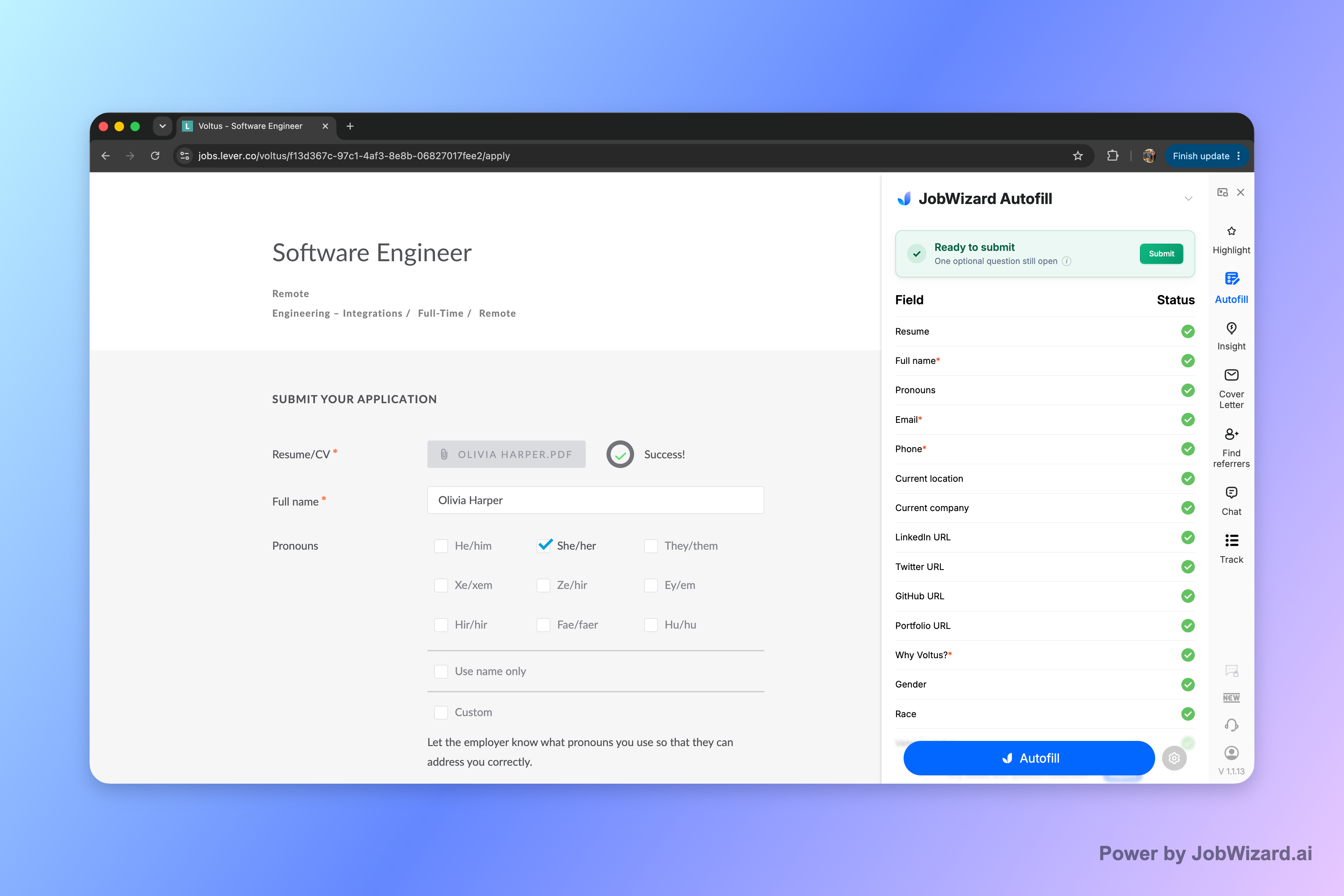
In practice, many hiring systems rely on screening question accuracy, matching resume details to form fields, and consistent identity/profile signals. When automation fills or submits without your final read, the application may be syntactically complete but semantically off—which is exactly what filters and recruiters catch.
JobWizard’s approach fits the safer middle: autofill the repetitive fields on the application page you’re already working in, then you review and submit. It’s designed to reduce typing burden while keeping the final decision in your hands.
What goes wrong with bot-style “aiapply” submissions (real risk scenarios)
When an AI bot submits, you lose control over the final content—and that’s where the problems cluster. Here are the most common failure modes that can quietly cost you interviews.
1) Wrong screening answers (or answers that look right but aren’t)
Screening questions are frequently the highest-impact part of an application. A bot-style workflow may attempt to auto-answer from limited cues, but screening questions often require exact, individualized information (eligibility, availability, required years, location constraints, or nuanced experience).
- Example: A role asks whether you’ve used a specific tool “in the last 12 months,” and the bot answers “yes” based on older experience.
- Example: A question about work authorization is answered inconsistently across the resume and form—either from mismatched data sources or stale info.
Even if the form is submitted, an inconsistent answer can trigger automated rejection or move you to the bottom of a ranked pool.
2) Resume mismatches and identity/version problems
Many bots don’t just fill forms—they can attach the wrong version of your resume or populate fields that don’t match the resume you meant to send. A recruiter reading your application may notice the disconnect quickly, especially when the job description is specific.
- Example: The application form lists a recent job title that doesn’t appear on the attached resume, or the dates conflict.
- Example: You intended to submit a targeted resume, but the automation attaches a more general one because it used the wrong file.
This isn’t “AI magic gone wrong”—it’s a boring but decisive mismatch: your application materials must agree with each other.
3) Employer-side spam filters and “repetitive pattern” flags
Some employers use defenses against low-quality or repetitive application behavior. If a bot submits many applications with similar content patterns, repeated fields, or inconsistent answers across roles, it can increase your chance of being flagged—even if your intent is legitimate.
Example: If custom questions are answered in a generic way for every company, you may trip “insufficient tailoring” heuristics. If answers vary unpredictably across submissions, you may also look unreliable.
Also, if you’re not reviewing while it happens, you can’t correct mistakes that would have been easy to catch in seconds.
4) Reputation damage with companies you actually want
One of the most overlooked risks is reputational. When a bot submits while you’re away, you can end up sending an application that contains an error you would never have allowed if you’d seen it.
- Example: A “preferred locations” or “salary expectation” field is auto-filled with an outdated number.
- Example: A short “tell us about yourself” response is filled too generically, making you look uninterested.
If that’s a company where you’d genuinely like to work, you don’t just reduce your odds—you create a negative first impression you may not be able to undo.
5) The “you didn’t mean to submit that” problem
Automation doesn’t understand what you wanted to do—you’re the only one who can confirm the details. With a bot-style apply flow, it’s easy to end up submitting to the wrong posting, the wrong role family, or a posting you were only skimming.
Example: You clicked “apply” for a job opening, but the bot submitted before you noticed it was the wrong location or a less relevant team.
If you’ve been searching for aiapply because you want speed, the key is to keep the speed where it’s safe: repetitive fields. The key is to keep the final quality where it matters: your review.
Real usage signal: Across JobWizard, more than 720,000 applications have been submitted and 600,000+ autofill sessions have run, with the autofill averaging ~18 repetitive fields per application—while users review before they submit.
The safer workflow: autofill fast, then review-before-submit
The best alternative to bot submission is a workflow that treats automation as a drafting assistant, not an autopilot. Here’s how to think about it when using autofill tools like JobWizard.
Use autofill for the repetitive fields you’d otherwise retype
JobWizard autofills many of the standardized inputs that repeat across postings. This typically includes the kinds of entries that are time-consuming to retype but not usually where the “value” of a tailored application lives.
- Contact + basic profile fields: name, email, phone, and standard entries.
- Employment basics: role titles and dates when they match your source information.
- Form logistics: fields that are straightforward and consistent from application to application.
Review the high-stakes sections every time
To avoid the bot-style failure modes, your review should focus on anything where context matters or where a wrong answer has outsized consequences.
- Screening questions: eligibility, authorization, availability, tool usage windows.
- Custom questions: “why this role,” job-specific experience, and nuanced summaries.
- Attachments and identity: verify the resume and any profile details match.
- Compensation/EEO/special fields: confirm the values are current and correct.
Submit only after you confirm it matches the job
This is the core trade-off: you get the time savings of autofill, but you keep control of the final submission. JobWizard is built for “fill, then you submit,” not blind auto-submit.
If you want to reduce risk and still move quickly, this is the workflow to prioritize—especially when applying through systems that have long forms and many custom questions.
Where this matters most: platform-heavy application pages
JobWizard’s autofill usage is heavily represented in common enterprise platforms. In our aggregated data, approximately 65% of autofill-enabled applications are on Workday, with about 19% on Greenhouse, 12% on Ashby, and 4% on Lever. Because these platforms often have extensive fields, autofill + review is especially useful.
That doesn’t replace tailoring. It just prevents the drudgery from becoming a reason you submit something you didn’t mean to.
If you’re comparing approaches, you may also find these reads helpful:
- How to Autofill Job Applications (Step-by-Step with JobWizard)
- Auto Apply AI: How “Bot Submits for You” Goes Wrong—and What to Do Instead
How to choose between “aiapply bots” and autofill-review tools
Choosing the right tool for aiapply comes down to one question: who controls the final answers and the final submission?
| Approach | What it typically does | Where it can go wrong | Best fit |
|---|---|---|---|
| Bot-style “auto-apply/auto-submit” | Attempts to apply without you reviewing everything | Wrong screening answers, resume mismatches, repetitive pattern flags, and reputation risk if mistakes slip through | Hard to recommend if accuracy matters for screening and you care about target employers |
| Autofill + review-before-submit (JobWizard-style workflow) | Fills repetitive fields while you review, then you submit | Less risk of incorrect content—still requires you to verify high-stakes answers and attachments | Best when you want speed but need correct screening responses and alignment with your resume |
| Manual-only | No automation; you type everything | More fatigue and higher odds you’ll miss details under time pressure | Best for a small number of highly tailored applications where you can dedicate full attention |
That table isn’t about dunking on other tools—it’s about risk trade-offs. If a workflow reduces your involvement too much, the chances of a “looks fine but is wrong” submission rise.
If you’re deciding what to trust, it’s worth reading perspectives from the community and other applications strategies too:
- ai auto apply for jobs reddit: what goes wrong with bot-style submissions (and the safer autofill review workflow)
- Loopcv Reviews: Why “Auto-Apply” Can Backfire (and the Better Way to Apply)
Quick checklist: use “aiapply” speed without bot-submit risk
If you want fast output without the downsides of “bot submits for you,” use this checklist every time you reach the final review screen.
- Verify resume alignment: confirm the resume attached matches the job and the dates/titles in the form.
- Read every screening question: ensure answers are current, truthful, and consistent with your resume.
- Check custom prompts: confirm the “why this role” response actually reflects your experience and priorities.
- Confirm any high-stakes details: work authorization, location constraints, availability, salary/EEO fields, and any eligibility items.
- Double-check the posting: make sure you’re applying to the correct role and location—not a near-match.
Done right, you’ll still get the biggest time savings from aiapply use cases: reducing repetitive data entry. But you keep control over what a recruiter and screening system will ultimately receive.
Do this automatically with JobWizard
Skip the manual work — JobWizard's Smart Autofill handles this for you. On these platforms: JobWizard vs AIApply.
FAQ: aiapply and the “bot submits for you” problem
What exactly is “aiapply,” and does it mean the bot submits my applications?
In most bot-style “aiapply” marketing, the automation is framed as doing the submission for you. A safer workflow is autofill-first: the AI helps fill repetitive fields while you review and submit the application yourself.
Why can a bot submit the “wrong” answers on screening questions?
Screening questions often require context—specific dates, eligibility details, or nuanced experience. When automation fills without that context (or pulls the wrong profile/resume content), answers can be incorrect or inconsistent, which can lower your chances even if the form looks complete.
How does a bot-style apply trigger employer spam filters or reputational risk?
Employers may flag repetitive patterns, mismatched content, or abnormal application behavior (for example, many similar submissions with inconsistent answers). If a bot submits while you’re away or you don’t control the final content, you increase the likelihood of tripping those checks and damaging how you’re perceived by companies you actually want.
What’s the safer alternative to fast “aiapply” that still saves time?
Use autofill for the repetitive parts, then review each section that matters (screening answers, work authorization, salary/EEO fields, and any custom questions) before you submit yourself. That keeps speed without sacrificing accuracy.
How do I decide when to use autofill versus retyping everything?
Autofill is ideal for fields you’d otherwise repeat the same way (contact info, employment dates that match your source, standard form entries). Re-type or verify anything high-stakes or subjective—eligibility, specific accomplishments, “why you” prompts, and anything you wouldn’t be confident about without reading it carefully.
Ready for fast applications that you control? Try JobWizard to autofill the repetitive fields on the job application page you’re already on—then review everything and submit yourself. If you want, start with How to Autofill Job Applications (Step-by-Step with JobWizard).
Frequently Asked Questions
Autofill your next job application
JobWizard is a free Chrome extension that fills applications, tracks statuses, and optimizes your resume.