Loopcv Reviews: Why “Auto-Apply” Can Backfire (and the Better Way to Apply)
Loopcv reviews often circle back to one question: what happens when a bot submits for you? Here’s what can go wrong—and how to review-ready your application fast instead.
Free Chrome extension
See your resume's match score for any job
JobWizard compares your resume to each job description and shows the exact keywords to add — free.
When people search loopcv reviews, they’re usually trying to answer one hard question: is an “auto-apply” style tool actually helping—or silently damaging the application you worked to prepare? The uncomfortable truth is that bots can create avoidable failures, especially around screening questions, resume mismatches, and employer-side spam filtering.
In this guide, I’ll walk through the most common “what went wrong” patterns behind loopcv reviews, then show the safer alternative: a review-before-submit workflow where repetitive fields get filled fast, but you confirm accuracy and submit yourself.
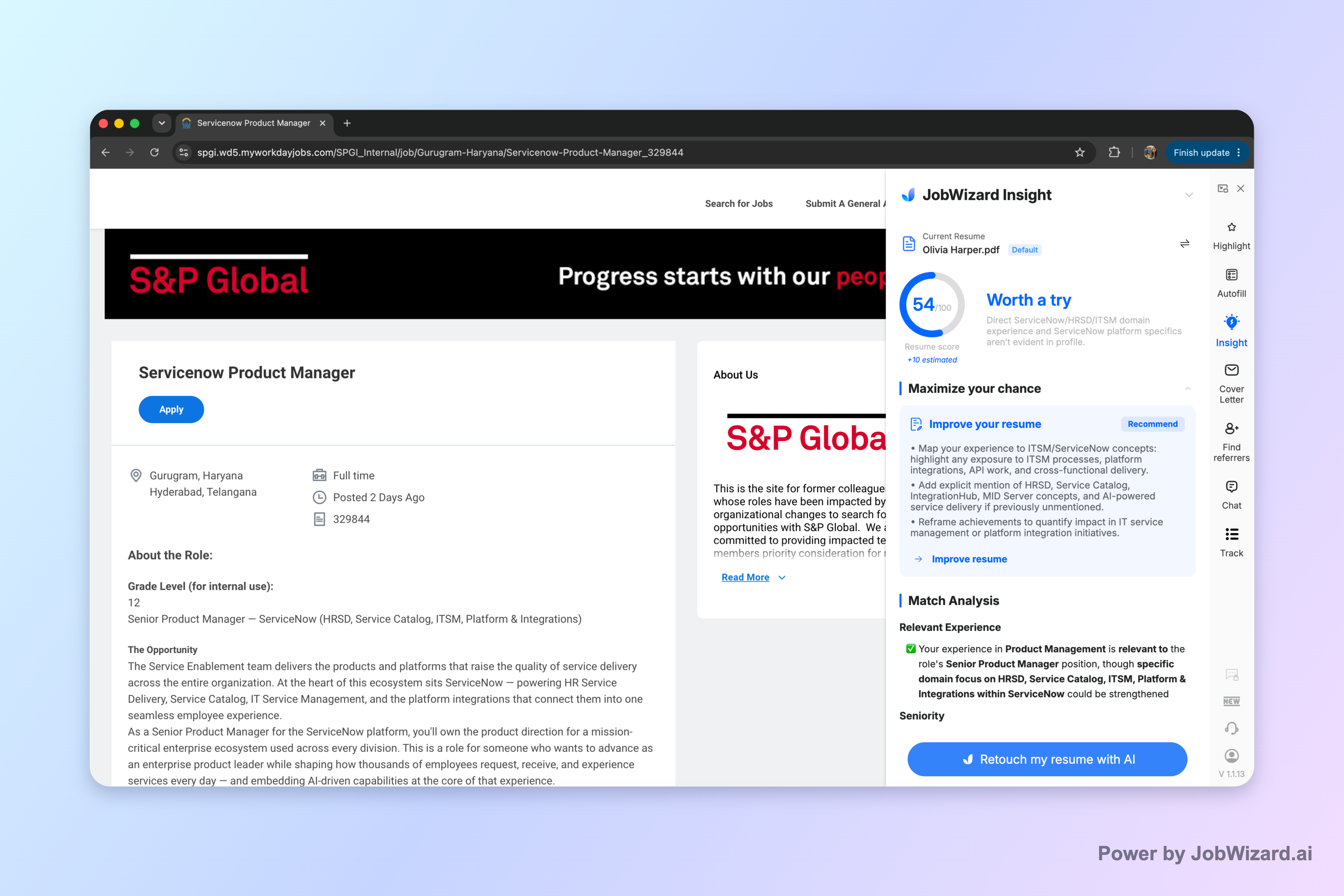
To make that review step faster (and more targeted), JobWizard includes an Insight / Match Score that compares your selected resume with the current job description, surfaces an overall assessment, and suggests improvements.
Why loopcv reviews keep warning about auto-submit risk
Loopcv reviews tend to come up when applicants try to speed up applications—and discover the bottleneck isn’t clicking “apply,” it’s whether your answers and resume details are actually correct for each specific posting.
When a bot submits for you (or effectively submits while you’re not actively reviewing), errors aren’t just annoying—they can be visible to both systems and humans. Below are the most common ways that automation can backfire.
Wrong answers to screening questions
Screening questions are where automation most often breaks. Even small inaccuracies can trigger an automatic rejection or create doubt about your fit.
- Mismatch between what the question asks and what the tool filled (years, tools, location, eligibility, or availability).
- Overgeneralized responses that don’t match the job’s exact requirements or phrasing.
- Inconsistency with the resume details you intended to send (dates, titles, scope, or specific accomplishments).
Resume mismatches that look “off” to employers
Even if your resume is strong, a bot that drafts a one-size-fits-most version can create a mismatch between the job description and your actual experience. Employers often look for specificity.
- ATS keyword gaps can remain if the resume wasn’t properly aligned to the job’s language.
- Expression gaps happen when your experience is relevant, but your resume doesn’t describe it in a way the employer expects to see for that posting.
- Editing risk increases when the tool suggests changes you didn’t explicitly verify.
Employer-side spam filters and “low-effort” signals
Automation can also trip employer-side controls. When a submission pattern looks mass-produced, employers may treat it as lower quality—even if parts of it are accurate.
- Repetitive or template-like answers that don’t vary by role
- Incomplete or generic responses in sections that should be tailored
- Submission volume patterns that can resemble bot activity (even when the applicant’s intent is legitimate)
Key takeaway: The problem isn’t “applying quickly”—it’s submitting inaccurate or mismatched content on autopilot.
What a safer loopcv alternative looks like (fast + verified)
The better approach is not “no automation,” it’s “automation that supports your review.” The goal is to reduce repetitive work while protecting the parts of the application that must be exact.
JobWizard is built around a autofill + review-before-submit workflow. It can autofill repetitive fields on the application page you’re currently on, but you review everything and submit yourself—so accuracy stays in your control.
Speed where it matters: repetitive fields, not final judgment
Applicants don’t get rejected because they lack the ability to click “submit.” They get rejected because the application content doesn’t match the role. That’s why the safest workflow targets the time sinks that don’t change the substance of your candidacy.
- Autofill repetitiveness reduces the boring typing: consistent personal/contact info and other repeated items.
- Human verification protects the decisions that must be role-specific: screening answers, custom questions, and resume accuracy.
Why “fill fast, then check” beats true blind auto-submit
With blind auto-submit, you can’t catch problems like an eligibility mismatch, a missing skill, or a question that required a nuanced “yes/no” with supporting detail. With a review step, you can catch issues while they’re still easy to fix.
This matters because the score or suggestions are not guarantees. For example, JobWizard’s Insight compares your resume to the job description and generates an overall assessment and improvement suggestions, but you must verify every change and keep only accurate experience.
How to interpret a match score so you don’t blindly trust it
A match score can be useful, but only if you treat it as a “diagnosis” to review—not a hiring prediction.
JobWizard’s Insight compares the selected resume with the current job description and presents a match score, overall assessment, and improvement suggestions. The diagnosis can identify resume expression gaps (including ATS keyword gaps) and turn them into an editable resume revision draft you can verify.
Use the match score to find gaps (not to assume ATS passage)
Match scores help you focus on what to improve, but they do not guarantee hiring results or ATS passage.
- Not a probability: the score is not a hiring probability.
- Not a guarantee: it doesn’t ensure ATS passage or an interview.
- Do verify: you must confirm every suggested resume change and ensure your experience stays accurate.
Turn suggestions into “accurate tailoring”
Tailoring works when it stays honest. Your resume already contains relevant experience—your job is translating it into the job’s language without inventing details.
- Identify the expression gaps between the job description and your resume wording.
- Map skills to your real experience (titles, tools, scope, and outcomes you can stand behind).
- Revise only what’s accurate—then keep the rest of your resume consistent.
- Re-check screening answers after you review the resume edits, so both sections match.
Loopcv reviews vs. a review-before-submit workflow: the practical trade-off
Loopcv reviews are often really about trade-offs: speed vs. control, automation vs. accuracy, and volume vs. quality.
Below is a fair way to compare common “auto-apply” approaches in the context of what can go wrong—without assuming any single tool is the same as another. The consistent risk comes from the same root: submissions that happen without careful verification.
| Workflow choice | What can go wrong | What to do instead |
|---|---|---|
| Blind auto-submit (you’re away while answers/resume go out) | Wrong screening answers, resume mismatch, inconsistent details, and employer “low-effort” signals | Fill repetitiveness quickly, then review every screening/custom question and verify resume accuracy before submitting |
| Fill + review (you control the final submission) | Fewer issues if your verification catches gaps; remaining risk is mostly human error during review | Use job-description-based diagnosis to spot expression/keyword gaps, then verify suggested changes reflect your real experience |
| AI-assisted tailoring (suggests edits, you decide) | Over-trusting suggestions or keeping inaccurate details | Treat suggestions as drafts; verify and keep only accurate experience, then double-check screening responses |
So the real question behind loopcv reviews isn’t whether automation exists—it’s whether the final decision remains with you.
Checklist: how to protect your application before you hit submit
Before submitting, use a quick checklist that targets the failure points that show up in loopcv reviews: screening answers, resume alignment, and consistency.
- Screening questions: confirm each answer matches your actual experience, eligibility, and timeline.
- Resume accuracy: verify suggested edits reflect what you can truthfully claim.
- Job-description alignment: look for expression/ATS keyword gaps so your resume mirrors the job’s requirements.
- Consistency pass: ensure the resume and form answers agree on tools, dates, titles, and scope.
If you’re applying while juggling interviews, your biggest advantage is not speed for its own sake—it’s a repeatable verification workflow. JobWizard is designed to support that with autofill on the application page you’re already on, plus Insight to compare resume vs. the current job description.
Ready to apply with more confidence? Try JobWizard’s review-first approach: use Insight to identify resume gaps against the specific job description, then review the autofilled application fields and submit yourself.
Do this automatically with JobWizard
Skip the manual work — JobWizard's Smart Autofill handles this for you. On these platforms: JobWizard vs LoopCV.
FAQ about loopcv reviews and “auto-apply” outcomes
Are loopcv reviews mostly about auto-apply bots or resume quality?
Most “Loopcv reviews” discussions focus on automation—especially what happens when an auto-apply tool submits on your behalf—while resume tailoring is what ultimately determines whether your application content matches the job.
What are the most common problems when a bot answers screening questions for you?
Common issues include wrong or incomplete answers to screening questions, mismatches between what you truly did and what the system filled in, and inconsistent details that can look like low-effort submissions to employers.
Will an auto-apply tool help me pass ATS?
No tool can guarantee ATS passage. A “match” score or AI suggestions can help you spot gaps, but you still need to verify the resume and every answer for accuracy.
What should I do instead of relying on auto-submit?
Use a workflow that fills repetitive fields quickly while you review everything that matters—especially screening questions, employment details, salary/EEO/custom questions, and any resume changes—then submit yourself.
How can I review whether my resume is aligned to the job description?
Compare your resume to the specific job description, look for expression gaps (including ATS keyword gaps), and revise only what’s accurate to your experience—then double-check before submitting.
Frequently Asked Questions
See your resume's match score for any job
JobWizard compares your resume to each job description and shows the exact keywords to add — free.