Loopcv Pricing: What You Pay for—and What Can Go Wrong With Auto-Apply Bots
Loopcv pricing is only part of the story. Learn what automated auto-apply tools can break—then use a resume/CV + job description comparison workflow to apply accurately instead.

Free Chrome extension
See your resume's match score for any job
JobWizard compares your resume to each job description and shows the exact keywords to add — free.
“loopcv pricing” is often searched by job seekers trying to spend less time applying. But before you focus on cost, understand the real trade-off: many auto-apply tools optimize for volume, and when they submit for you, mistakes become hard to catch—wrong answers, mismatched resumes, and screening friction can land you in the wrong pile.
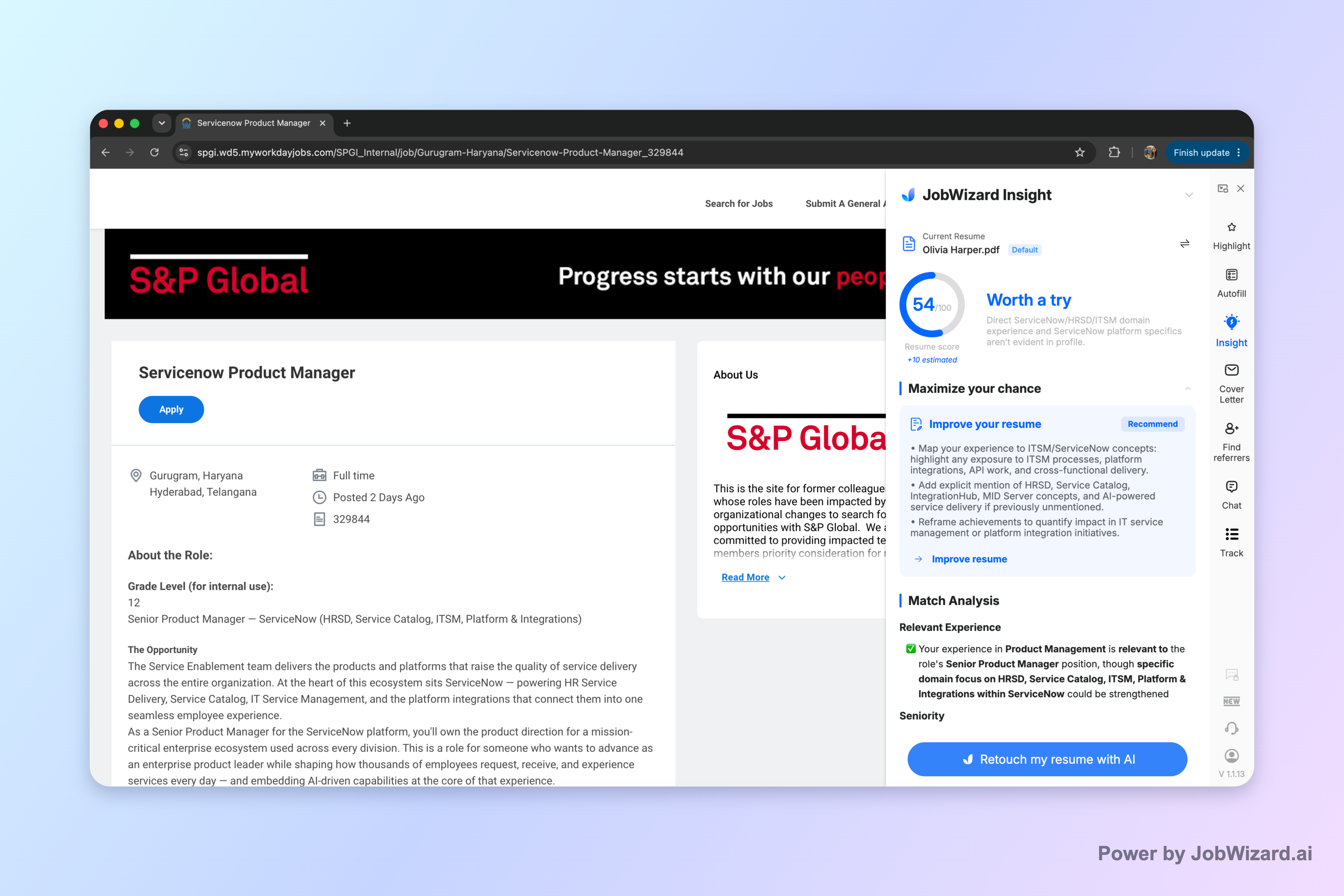
With JobWizard, you can compare your selected resume against the specific job description and get an actionable match score plus improvement suggestions—then review everything before you submit yourself.
Why “loopcv pricing” isn’t the whole decision
Loopcv pricing can help you compare budgets, but it doesn’t answer the bigger question: what happens when the tool has to translate your background into the employer’s exact questions and fields?
Auto-apply approaches generally aim to reduce friction—filling fields fast or attempting to submit without the careful, job-specific checks humans do. That’s where things can break. Even small mismatches (employment dates expressed differently, a missing keyword phrase, or an incorrect response to a screening question) can cause you to lose momentum with a role you’d genuinely want.
Job hunting isn’t just “apply and wait.” Many roles use screening questionnaires and structured inputs to filter applicants. If those answers are wrong or generic, you may be filtered out before a human ever sees your resume. The cost of getting it wrong is often higher than the cost of the tool.
What goes wrong when a bot submits for you
Auto-submit bots can create errors you won’t notice until after you’re already filtered out.
Here are the most common failure modes when an auto-apply tool takes the wheel:
- Wrong answers to screening questions: A tool may misread requirements or apply a one-size-fits-all response. Even if you’re qualified, an incorrect “yes/no” can stop your application.
- Mismatched resume content: The resume you used may not reflect the current job description’s needs. If the job wants specific skills, tools, or responsibilities and your CV doesn’t match the phrasing closely, you can look unqualified.
- Employer-side spam filters and application flags: When many applications look similar—or when optional fields are filled inconsistently—employers may treat submissions as low-quality or automated, even if your profile is legitimate.
- Damaged reputation with a company you actually want: If you submit incorrect or obviously templated information, you might hurt trust with recruiters or hiring teams. That matters more when you’re targeting competitive roles and recurring postings.
None of these outcomes are guaranteed, but the risk profile is real: when you’re not reviewing every field and every customized response, mistakes can slip through.
Fair trade-off: automation vs. accuracy (and why “review-before-submit” wins)
The right workflow reduces repetitive typing but keeps you accountable for the final submission.
Here’s the principle: you want speed where it’s safe (repetitive form fields), and you want judgment where it matters (screening questions, any custom or role-specific inputs, and truthfully tailoring your resume to the job description).
Reality check: JobWizard autofills repetitive fields and you review everything before you submit. It never submits by itself, never mass-applies, and doesn’t apply while you’re away.
That “review-before-submit” step is where accuracy is preserved. Instead of sending whatever the tool guessed, you verify the details you personally own: your work history, your eligibility, and how you answer screening questions.
And you can still reduce time spent on repetitive data entry. Across all applications submitted through JobWizard, 720,000+ applications were submitted and 600,000+ autofill sessions were run. JobWizard also autofills an average of ~18 repetitive fields per application (typically 11–23). Importantly, the sponsorship / salary / EEO / custom questions remain for your review before submitting—because those are exactly where small errors have outsized consequences.
How to use a resume-to-job-description comparison to apply smarter
Use the job description as the source of truth, then confirm your resume and answers match what the employer is asking for.
JobWizard’s Insight feature is built for this moment: it compares the selected resume with the current job description and presents a match score, an overall assessment, and improvement suggestions. It can also identify resume expression gaps and turn them into an editable resume revision draft.
That matters for the exact failure modes above. Instead of guessing whether your resume “sounds right,” you get a diagnostic you can verify. And because you must review every suggested resume change and keep only accurate experience, you avoid the classic risk of bot-driven or hallucinated edits.
Quick workflow (10-minute version)
- Select the job description: Use the exact posting you’re applying to, not a generic “similar role” version.
- Run a resume comparison: Review the match score and the improvement suggestions for expression gaps.
- Edit only what’s true: Keep your experience accurate—use the draft as a starting point, then confirm details.
- Answer screening questions carefully: Don’t rely on assumptions; use your real history and preferences.
- Submit yourself: Once everything checks out, submit through the employer portal.
loopcv pricing and alternatives: what to evaluate beyond the sticker
If you’re shopping for “loopcv pricing,” evaluate the risk surface, not just the cost.
Because search intent is “Loopcv pricing,” it’s tempting to compare features and ignore outcomes. But for auto-apply tools, the most important comparisons are the ones that affect whether your application is accurate when it hits the employer workflow.
| Evaluation area | What to look for | Why it matters |
|---|---|---|
| Screening question handling | Do you review answers before submission? | Wrong yes/no answers can filter you out even if you’re qualified. |
| Resume tailoring accuracy | Does the tool help identify job-description gaps and you verify edits? | Mismatched resume content reduces perceived fit. |
| Submission control | Does the system avoid auto-submit and keep you in control? | Employer-side concerns grow when submissions look automated or error-prone. |
| Trust and reputation | Can you prevent obviously templated or inconsistent fields? | Reputation matters with companies you truly want. |
If you want a faster path without taking on “bot submission” risk, build your process around: (1) comparing your resume to the job description, (2) reviewing suggested improvements, and (3) submitting yourself after confirming every important field.
JobWizard CTA: If you’re applying to a specific role today, paste that job into your workflow and use JobWizard Insight to compare your resume to the job description, spot the expression gaps, and then review and submit yourself with confidence.
Do this automatically with JobWizard
Skip the manual work — JobWizard's Smart Autofill handles this for you.
FAQ
Is loopcv pricing the only thing I should compare before using an auto-apply tool?
No. Pricing matters, but you also need to compare how the tool handles screening questions and resume accuracy—because bot-submitted answers or mismatched CV details can cause rejections or employer-side filtering.
What can go wrong when an auto-apply bot submits for me?
Common problems include incorrect or generic screening-question answers, a resume that doesn’t reflect the specific job description, and content mismatches that can trigger employer-side spam or applicant review issues—hurting your chances with roles you actually want.
What’s the safer alternative to auto-submit automation?
Use a workflow where your resume/CV is compared to the specific job description, you review the identified gaps, and you submit yourself after correcting anything inaccurate. Autofill helps reduce repetitive typing, but you stay in control of the final answers.
Does a match score guarantee I’ll pass ATS screening or get an interview?
No. A match score is a helpful diagnostic, not a hiring probability. You still need to verify every suggested resume change and keep only accurate, truthful experience.
How do I use a resume-to-job-description comparison without wasting time?
Start with the current job description, run an insight that highlights expression gaps, review the suggested edits, then do a quick final pass on screening questions and any custom fields before you submit yourself.
Frequently Asked Questions
See your resume's match score for any job
JobWizard compares your resume to each job description and shows the exact keywords to add — free.