Loopcv pricing 2026: what you pay for (and why bot apply can backfire)
Searching “loopcv pricing 2026” is smart—but price alone won’t tell you whether an auto-apply workflow creates screening mistakes. Compare the trade-off: fast autofill with review vs. bot apply that can mismatch answers.

Free Chrome extension
See your resume's match score for any job
JobWizard compares your resume to each job description and shows the exact keywords to add — free.
Searching loopcv pricing 2026 is natural: you want to know what you’re paying for before you commit to any auto-apply workflow. But the bigger question is what happens after the button gets pressed—because the wrong details in screening questions, mismatched resume sections, or bot-like submission patterns can work against you.
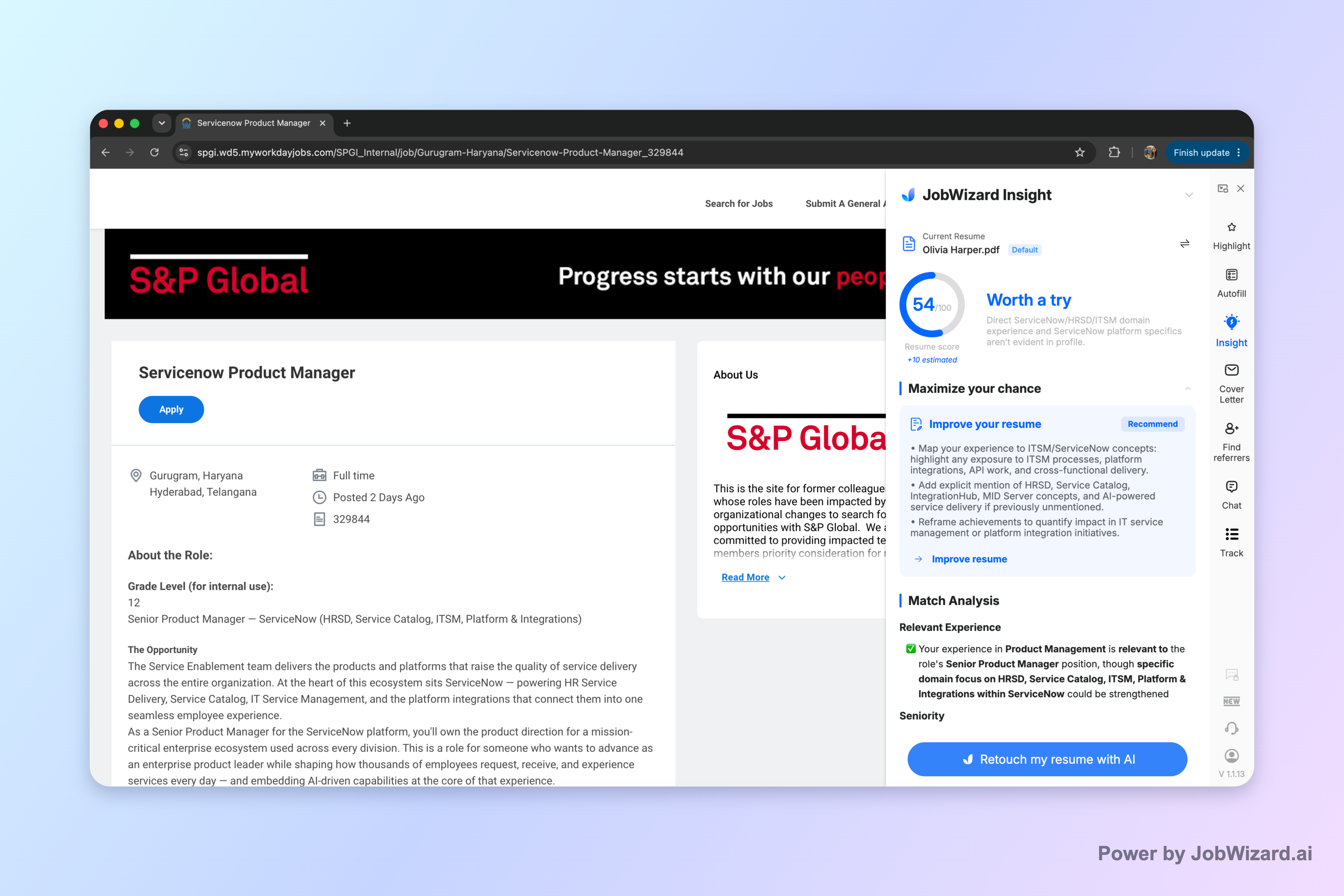
One of the smartest ways to protect your application is to compare your resume against the exact job description and then only submit after you review the gaps and edits. JobWizard Insight does this by comparing a selected resume with the current job description, showing a match score plus improvement suggestions you can edit—then you decide what’s accurate and ready to send.
What “loopcv pricing 2026” won’t tell you: the real risk of bot apply
Bot apply may look efficient, but it can cause avoidable damage when the information doesn’t truly fit the specific employer’s screening logic. When tools submit automatically (or while you’re away), there’s no reliable “last-mile” check to catch mismatches.
Here are the most common failure modes that make bot-style applications underperform—even if the resume attachment looks “close enough” at first glance.
- Wrong answers to screening questions: Employment dates, eligibility, preferences, and role-specific requirements often differ by job posting. If answers are generic or guessed, employers may reject you quickly.
- Resume mismatch: Even when a tool selects a resume, the job might require a very specific skill set or wording. A mismatch can cause your application to read like you didn’t apply to the right role.
- Broken context from stale data: If your work authorization status, location, or title history changed since your last update, automated fills can quietly send outdated information.
- Employer-side spam filtering signals: Many employers use systems that look for submission patterns and content similarity. Highly repetitive form-filling or mass submission behavior can increase the chance of review delays or filtering.
- Reputation cost with a company you actually want: If you submit something that doesn’t match, you may get marked down by a recruiter or hiring team who later sees your profile as “low effort,” even if you’re a strong fit.
The key point: speed is only an advantage if the content is correct. “Loopcv pricing 2026” may help you compare payment models, but it can’t prevent these quality failures by itself.
How to evaluate loopcv pricing 2026 without getting trapped by “auto” claims
Price comparisons are easiest when you translate them into one question: what exactly is the workflow doing to your application data? Instead of focusing only on cost, map the workflow to how decisions happen inside job applications.
Use this checklist to evaluate any auto-apply tool you’re considering in the context of “loopcv pricing 2026.”
- Who submits the application? If submissions happen without your review, you lose the safety net that catches mismatched answers and incorrect uploads.
- What fields are filled automatically? Repetitive fields are less risky than screening answers that determine eligibility or fit.
- What review steps exist before submission? You want a workflow where you verify custom questions and the exact resume details before pressing submit.
- How are resume tailoring decisions handled? Look for JD-based feedback that identifies expression gaps (and lets you edit), rather than one-size-fits-all attachment swapping.
In other words: the “right fit” is the workflow that reduces the tedious parts of applying while keeping you in control of correctness. That’s also why review-before-submit approaches typically avoid the worst failure modes of bot apply.
What “good” looks like: autofill + review-before-submit (and why it works better)
Autofill + review-before-submit is a practical compromise: you move faster on repetitive fields while keeping accountability for screening questions and job-specific details.
At JobWizard, the workflow is designed around a simple principle: you’re the one who reviews the filled-in content and submits the application. The autofill step is meant to reduce repeated typing, not to replace your judgment.
- Less typing, same responsibility: JobWizard autofills repetitive fields while you review and submit yourself.
- Fewer avoidable mismatches: Because you review before submission, you can confirm that eligibility, preferences, and job-specific answers are accurate.
- Better tailoring feedback: With Insight, you can compare your resume to the job description and then edit only what’s true for your background.
Real usage signals (for context, not guarantees): JobWizard has helped run 720,000+ applications submitted and 600,000+ autofill sessions. On average, ~18 repetitive fields are autofilled per application (typically 11–23), with a heavy share on Workday—where autofill tends to save the most time. These are autofill + review-before-submit figures, not blind auto-apply/auto-submit.
Those numbers matter because they describe an approach people use repeatedly: autofill to reduce friction, then review to protect accuracy. This is exactly the opposite of what goes wrong when a bot submits for you.
Use JD-based match insights to reduce “skills gap” rejection—without pretending it’s magic
JD-based match insights help you fix the problem employers care about: whether your resume wording actually matches the job description you’re applying to. However, it’s important not to treat match scoring as a guarantee.
JobWizard Insight compares your selected resume with the current job description and presents a match score, an overall assessment, and improvement suggestions. It can diagnose “resume expression gaps” and turn them into an editable resume revision draft.
Here’s how to use that effectively—so you don’t fall back into bot-style submission habits.
- Review every suggested change: Keep only edits that are accurate. A match score can’t know your full story or guarantee that every suggested phrasing is honest.
- Translate gaps into reality: If the job asks for a skill you used, rewrite your experience to reflect it clearly. If you didn’t do it, don’t “borrow” it.
- Check screening alignment: Even perfect resume wording won’t fix incorrect eligibility or availability answers—those must be correct before submission.
That’s the workflow that protects you from the downside of bot apply: you don’t outsource correctness to automation.
Do this automatically with JobWizard
Skip the manual work — JobWizard's Smart Autofill handles this for you.
FAQ: loopcv pricing 2026 and the bot apply trade-off
Loopcv pricing 2026 is one part of the decision—these questions cover the rest: quality control, screening accuracy, and what helps most on real applications.
Does “bot apply” always increase my chances?
No. “Bot apply” can fill forms with the wrong details—especially screening questions, resume attachments, or employment history—creating mismatches that hurt your chances with employers who review applications.
What should I check before I submit an application?
Before submitting, review every autofilled or AI-generated field, confirm that the right resume and dates are used, and double-check custom screening answers (EEO, work authorization, and role-specific questions).
How does a JD-based resume match check help?
A job-description-based match check compares your selected resume with the current job posting and identifies expression gaps, then suggests editable improvements. It’s not a hiring guarantee—you still verify accuracy.
Is it safer to use a tool that only fills and I submit manually?
That’s usually safer than fully automated submission. Filling repetitive fields quickly while you review and submit helps prevent wrong answers, mismatched resumes, and avoidable employer-side spam-filter triggers.
Will a match score guarantee ATS passage?
No. A match score is an assessment tool, not a guarantee of ATS passage or an interview. Use it to guide edits you then verify against your real experience.
Final takeaway: choose the workflow that keeps you in control
Loopcv pricing 2026 might help you compare costs, but the best return comes from protecting application quality. When a bot submits for you, the risk isn’t theoretical—it shows up as wrong screening answers, mismatched resumes, and employer-side filtering or rejection.
If you want speed without the downside, go for a fill-fast, review-before-submit workflow and pair it with JD-based resume gap checks so you tailor what’s editable—and keep what’s accurate. Then you submit yourself with confidence.
Ready to reduce repetitive typing and still review like it matters? Try JobWizard and use Insight to compare your resume to the exact job description before you submit.
Frequently Asked Questions
See your resume's match score for any job
JobWizard compares your resume to each job description and shows the exact keywords to add — free.