LoopCV Review: What “Auto-Apply” Gets Wrong—And the Safer Way to Vet Fit
This loopcv review breaks down what can go wrong with auto-apply bots (wrong screening answers, resume mismatches, spam filters) and how to review before you submit yourself.
Free Chrome extension
See your resume's match score for any job
JobWizard compares your resume to each job description and shows the exact keywords to add — free.
LoopCV review is often driven by one big promise: applying faster with “auto-apply.” The problem is that speed can quietly turn into mismatches—especially when screening questions and resume tailoring are not reviewed by you. In this guide, we’ll focus on what goes wrong when a bot submits for you, and the safer alternative: fill in seconds, check, and submit yourself.
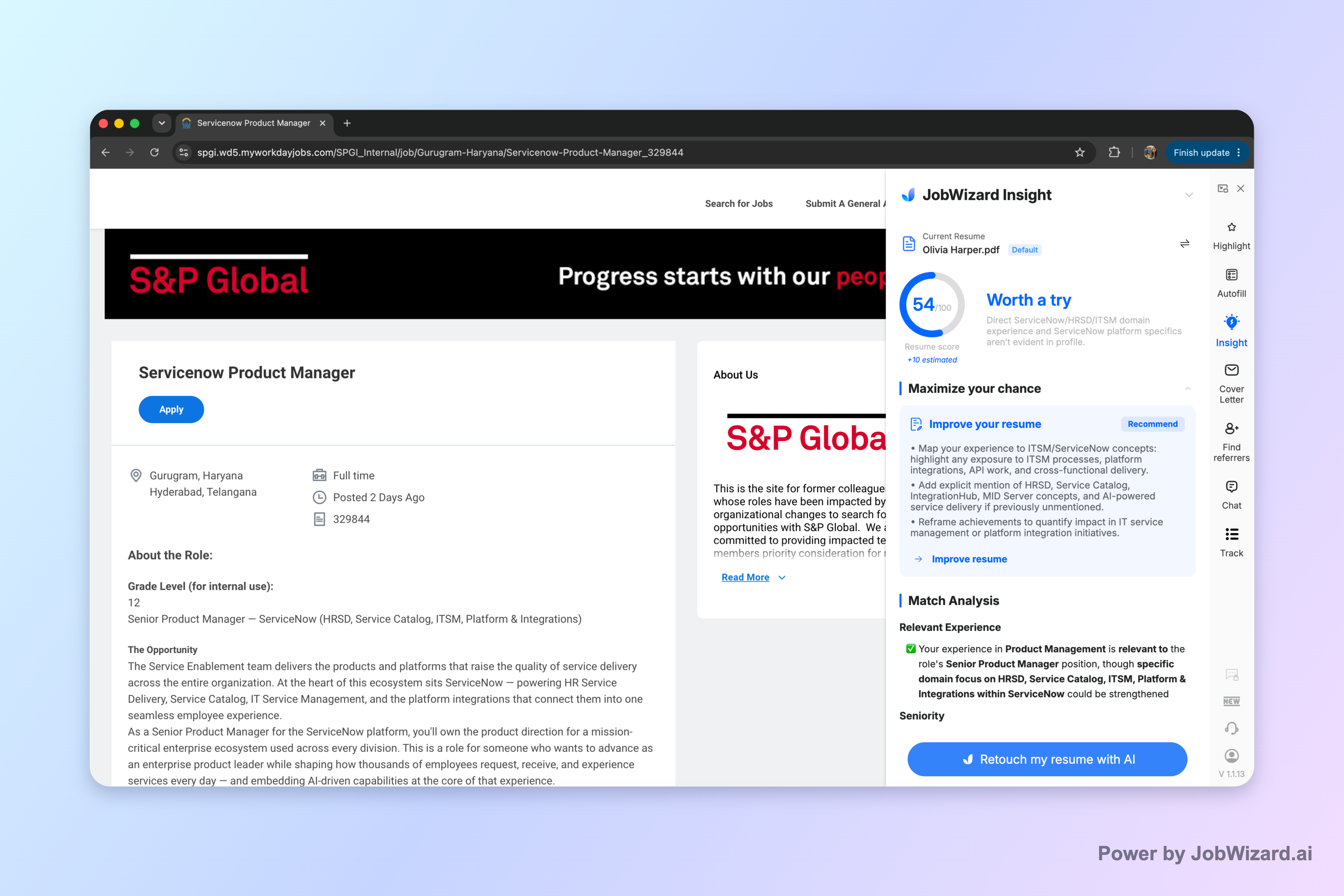
If you want fewer mismatches, start with job description–based diagnosis—compare your resume against the specific JD and review the match score and improvement suggestions before submitting.
Why “auto-apply” can backfire (even if it looks correct)
Auto-apply bots are built to reduce friction. But application quality depends on details that are easy for an algorithm to get wrong: screening questions, employment dates, job titles, and custom requirements that reflect your real background.
Here are the most common failure modes that show up in real hiring workflows—what goes wrong when submission happens without you verifying each answer.
- Wrong answers to screening questions: Many forms include multi-part questions (eligibility, availability, legal authorization, location flexibility, specific experience). Autofilled responses can be incomplete or slightly off, and that’s often enough to fail a filter.
- Resume mismatches that dilute your best evidence: If your resume isn’t truly aligned to the JD, you can end up “technically qualified” on paper but missing the exact phrasing that ATS-based screening looks for (or missing a required skill area you don’t keyword-match).
- Employer-side spam or low-quality filtering: Repeated submissions with inconsistent fields (or content that doesn’t track your experience) can trigger internal review rules that deprioritize applications.
- Damaged reputation with a company you actually want: Submitting inaccurate or inconsistent information to a specific employer can create a credibility gap that’s harder to fix later—especially when your future application depends on trust and accuracy.
The takeaway of this loopcv review angle is simple: if you care about matching quality (not just quantity), you don’t want submissions happening while you’re away from the details.
What to look for in any tool before you trust it
Vetting fit in minutes means checking how a tool handles two things: accuracy controls and job-specific tailoring. If a product blurs those lines, you’ll feel it later in screening outcomes.
When evaluating any “apply faster” assistant, use this checklist before you rely on it with real applications.
- Does it compare your resume to the current job description? A JD-based check can surface skills gaps and keyword expression gaps so you know what to fix.
- Are suggestions editable and verifiable? You should be able to review every change and keep only what’s accurate.
- Does it tell you what the score does (and doesn’t) mean? A match score is guidance—not a guarantee of ATS passage or an interview.
- Will you review the answers right before submitting? For best results, focus on filling repetitive fields quickly while you still control final submission.
This is also why the safest workflow is “autofill + review-before-submit,” not blind submission. Repetitive fields can be filled fast; the risk is leaving screening answers, eligibility, or custom questions unverified.
Safer workflow: fill repetitive fields, then review the risky parts
The reviewed-before-submit approach keeps the speed benefit without betting your application on unchecked assumptions. Instead of “submit while I’m away,” you aim for “prepare faster, confirm yourself, then submit.”
Here’s a practical sequence you can use with any assistant that helps with form completion (and with your own review process).
- Confirm the job details: Re-read the job posting, especially location rules, eligibility wording, and “must-have” experience.
- Verify screening answers: Compare each screening field to your real background. Don’t accept autopopulated answers you didn’t personally verify.
- Check resume alignment to the JD: Look for skills overlap and ATS keyword coverage you can honestly support.
- Review custom questions: These are where many bots struggle (short answers about motivation, availability, or specific examples).
- Submit yourself: Once everything is accurate and consistent, submit—so you can stand behind what you sent.
Accuracy beats automation: The goal is to fill repetitive fields quickly, then review and submit yourself.
JobWizard’s model is consistent with this philosophy: it autofills repetitive fields so you can move fast, but it’s designed for you to review before submitting. Across applications submitted through it, an estimated ~65% are on Workday, where it tends to save the most time—again, paired with your review before submission. (In addition, JobWizard autofills an average of ~18 repetitive fields per application—typically 11–23—so the “time saved” comes from speed on form filling, not unattended submission.)
LoopCV review takeaway: use a match score to fix gaps, not to “trust the bot”
Resume match scoring can be useful—if you treat it as a diagnosis tool, not as proof you’ll get an interview.
For example, JobWizard Insight compares your selected resume with the job description and presents a match score, overall assessment, and improvement suggestions. It can also diagnose expression gaps in the resume and turn them into an editable resume revision draft.
Important limitation: the match score is not a hiring probability and doesn’t guarantee ATS passage or an interview. You must verify every suggested resume change and keep only accurate experience.
- Use the score to decide what to edit: If the diagnosis highlights missing skill phrasing, focus your tailoring on the smallest set of accurate updates.
- Don’t “overfit” to keywords: Replace wording only when it reflects real experience—otherwise you risk misrepresentation and inconsistency.
- Validate with the JD: The JD is the source of truth. Treat suggestions as a starting draft, not final content.
That’s the heart of a high-quality loopcv review: the best workflow uses automation for preparation and speed, while you remain the final accuracy layer before submission.
Do this automatically with JobWizard
Skip the manual work — JobWizard's Smart Autofill handles this for you. On these platforms: JobWizard vs LoopCV.
FAQ: LoopCV review questions people ask before they apply
Is LoopCV an “auto-apply” tool that submits applications for you?
In this loopcv review, the key issue is the risk of submission happening without you carefully reviewing every screening field and resume detail. Even when tools autofill, you should still verify answers, resume alignment, and any custom questions before you submit.
What are the most common problems with auto-apply bots?
Common problems include wrong answers to screening questions, mismatched resumes (or missing relevant ATS keywords), and employer-side filtering that can treat repeated or inconsistent submissions as low-quality. A damaged reputation with an employer you actually want is also a real risk when content is inaccurate.
How do I know if my resume is a good match for the specific job?
Use job description–based diagnosis: compare your chosen resume against the current job description, review the provided match score, overall assessment, and improvement suggestions, then keep only changes that are accurate reflections of your experience.
If I use an assistant, what should I review before submitting?
Review every autofilled screening answer and any custom questions, confirm your work history and dates match what the job asks for, and validate any AI-suggested resume changes. The goal is to fill repetitive fields quickly, then submit only after you verify the details yourself.
Does a match score guarantee ATS passage or an interview?
No. In this loopcv review, a match score is a helpful signal, not a hiring probability. It does not guarantee ATS passage or an interview—your accuracy and job-specific fit still matter.
Ready to apply faster—with fewer avoidable mistakes?
JobWizard helps you move quickly by autofilling repetitive application fields while keeping the final step under your control: you review and submit. Pair that with JD-based diagnosis (match score, assessment, and editable improvement suggestions) so you’re not guessing whether your resume actually fits the job before you send it.
Start your next application with JobWizard—autofill what’s repetitive, review the screening answers and resume changes, and submit with confidence.
Frequently Asked Questions
See your resume's match score for any job
JobWizard compares your resume to each job description and shows the exact keywords to add — free.