JobCopilot Review What to Check Before Paying for Auto-Apply (Do the Right Kind of Autofill)
A JobCopilot review for people planning to pay for auto-apply: here’s what can go wrong with bot-style submissions, and what to check before you pay. Use a review-first autofill workflow instead—fill repetitive fields fast, then submit yourself.

Free Chrome extension
Autofill your next job application
JobWizard is a free Chrome extension that fills applications, tracks statuses, and optimizes your resume.
If you’re searching for a JobCopilot Review What to Check Before Paying for Auto-Apply, you’re probably trying to apply faster—without ruining your chances. The hard truth: bot-style “auto-apply” can send the wrong answers, the wrong resume, or incomplete responses, and that can backfire with screening systems and real hiring teams.
Instead of paying for hands-off submission, use a review-before-submit approach: autofill repetitive fields quickly, then you review everything that matters and submit yourself. JobWizard is built for that exact workflow.
JobCopilot Review What to Check Before Paying for Auto-Apply: start with the real failure modes
Before you pay, understand what usually goes wrong with auto-apply bots: they prioritize speed and automation over accuracy. That means your “submit” can contain answers you never intended.
Here are the most common ways bot-style applications fail—so you know what to look for in any product marketing promises.
- Wrong screening answers when questions require job-specific details (not generic profile info).
- Resume mismatches where the autofill chooses a version that doesn’t reflect the employer’s keywords, your dates, or your most relevant experience.
- Incomplete custom fields where required questions are overlooked, truncated, or left for the user but the tool still pushes toward submission.
- Employer-side spam/compliance flags when submissions look templated, repeated, or inconsistent across fields.
- Reputation damage with companies you genuinely want—because incorrect answers don’t just get rejected; they can also color future evaluation.
This is why “auto-apply” can feel like progress but quietly reduce your long-term success rate. In many cases, the fastest path to improvement is not more automation—it’s fewer mistakes.
What to check in any JobCopilot-style auto-apply promise (and what should worry you)
When you read a JobCopilot review, focus on how the tool handles the parts that are hardest to automate correctly: screening, eligibility, and custom employer questions. If those pieces aren’t handled carefully, the application can fail for reasons that have nothing to do with your actual fit.
Use this checklist as you evaluate whether paying for auto-apply makes sense—or whether you should switch to review-first autofill.
| What to check | Why it matters | Red flag to watch for |
|---|---|---|
| Who submits the application | You want control at the final step so you can confirm correctness. | A product that implies hands-off submission without a real review step from you. |
| How screening questions are answered | Small wording differences (dates, locations, eligibility) can change outcomes. | General profile text being treated as “final” for every employer. |
| How required fields are handled | Some forms have required custom fields that vary by company or role. | Any claim that you’ll never miss a required question. |
| Resume selection and matching | A mismatched resume can contradict your answers. | Automation that picks the wrong resume version for the specific posting. |
| Consistency across fields | Inconsistencies look templated and can trigger filtering. | Apps that can generate inconsistent “hybrid” profiles across sections. |
| What you can review before submit | You should be able to spot and correct issues quickly. | “Set it and forget it” workflows where you only see the result after submission. |
If a tool keeps you from reviewing the highest-risk parts before you submit, that’s the moment to pause. Speed is only useful when the answers are correct.
Why bot-style auto-apply can backfire—especially for the questions you can’t afford to get wrong
Hiring flows include details that are simple to fill incorrectly and difficult to fix afterward. When bot-style auto-apply tools push submissions without a human check, the mistakes are more likely to go out at scale.
Here’s what “backfire” typically looks like in practice for applicants—broken down into the kinds of fields that cause the most trouble.
1) Screening questions that demand exactness
Many employers use structured screening questions to filter candidates. If an auto-apply bot guesses wrong—about authorization, work location, dates, or preferences—you may get rejected instantly, without a human review.
2) Resume/experience alignment that doesn’t match the posting
Even when a resume is uploaded, autofill can still misalign dates, titles, or “summary” details with the employer’s expectations. That mismatch can look careless—even if your intent was strong.
3) Custom questions that aren’t part of your “default profile”
Job forms often include role- or company-specific questions. If the tool doesn’t accurately detect what’s required (or if it fills placeholders you wouldn’t choose), the application can be incomplete or inconsistent.
4) Employer systems that treat templated submissions as low-quality
Employer-side spam/compliance filters and applicant-tracking workflows may react to repeated patterns—especially if responses seem generic or inconsistent. The result is a rejection that doesn’t reflect your real fit.
Core principle: autofill speed matters only after you verify correctness for the questions that affect eligibility and screening.
That’s the reason this JobCopilot review focuses on what to check before paying: you’re not just buying speed; you’re buying the risk level of what gets submitted.
The safer alternative: review-first autofill that fills seconds worth of work, then you submit
A review-first autofill workflow keeps the best part of automation—filling repetitive fields quickly—while protecting the part where accuracy matters most: your final review.
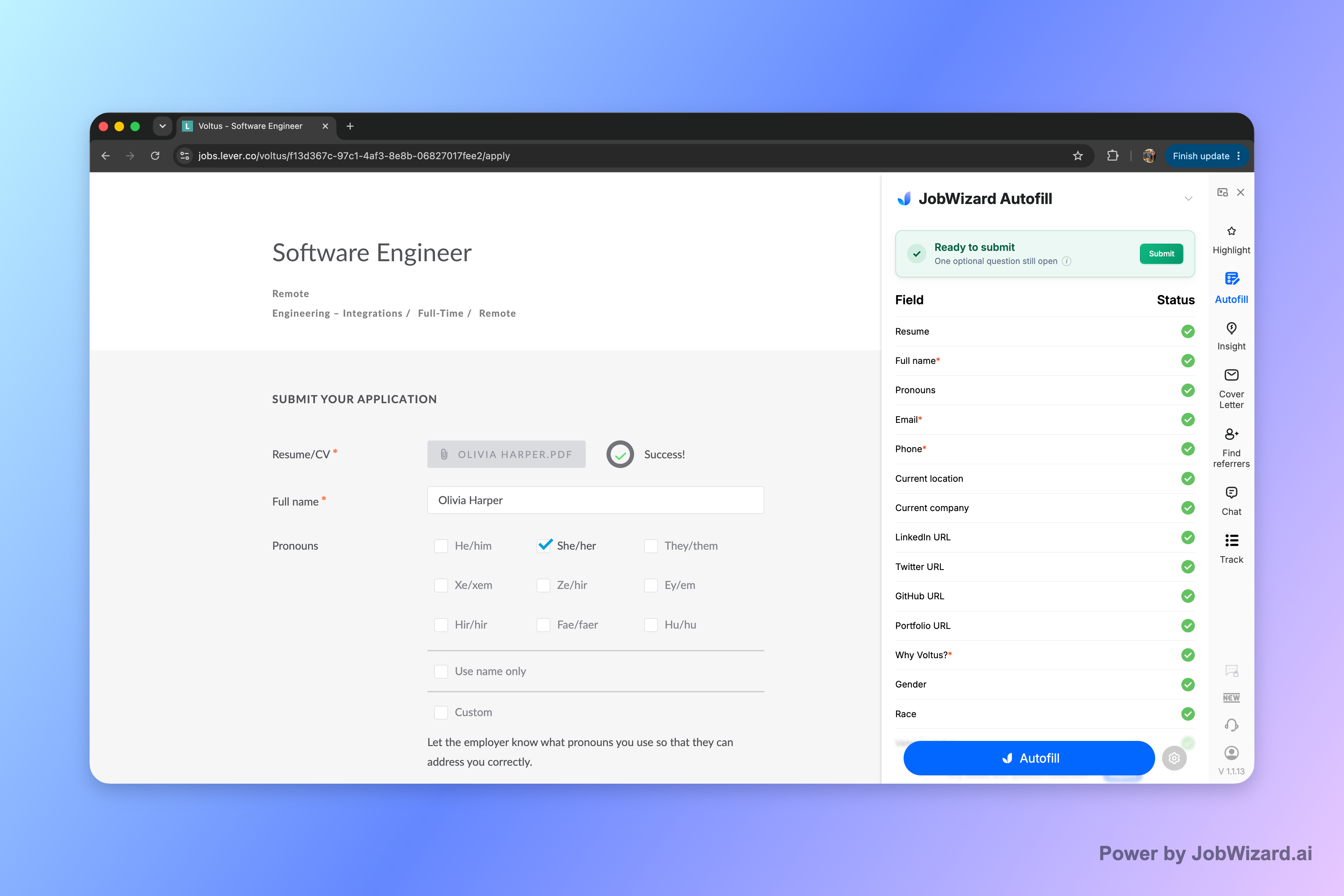
JobWizard is designed for that approach. It autofills application fields on supported pages using saved profile and resume data, and then you review the populated fields and submit the application yourself. It’s explicitly not a “set it and forget it” submission tool.
- Smart Autofill fills detected repetitive fields on supported application pages.
- Review before submitting keeps you in control of screening answers, custom employer questions, and any final details.
- Jump to what’s left when a required field still needs attention, helping you correct it before you submit.
If you’re deciding between paying for auto-apply vs using a review-first tool, this is the practical trade-off: bots optimize for volume; review-first autofill optimizes for reducing avoidable errors. For roles you truly want, reducing mistakes usually beats pushing more “maybe” applications.
It also helps to know that JobWizard has real usage at scale: 720,000+ applications submitted and 600,000+ autofill sessions run through the tool. Most of that value comes from fast autofill plus review-before-submit, not blind auto-submission. On average, autofill fills ~18 repetitive fields per application (typically 11–23), and a large share of that time-saving happens on Workday.
How to evaluate JobCopilot review claims vs a real workflow you can trust (quick comparisons)
Instead of asking “Which auto-apply tool is best?” ask “Which workflow gives me speed and correctness before I submit?” That framing keeps you safe from marketing that blurs the difference between autofill and submission.
Below is a neutral comparison of the approaches people often mix up—so you can choose the right behavior for your applications.
| Approach | What it tends to do | What you should verify |
|---|---|---|
| Bot-style auto-apply | Attempts to apply automatically with minimal control from you. | Whether you can review and correct screening/custom questions before anything is submitted. |
| Review-first autofill | Autofills detected fields while you remain responsible for final answers and submission. | That required fields needing attention are surfaced clearly, and that you can confirm all answers yourself. |
If you want more context on the workflow difference, start with How to Autofill Job Applications (Step-by-Step with JobWizard). If you’re comparing browser extension behavior and review steps, use Autofill Job Applications Extension: A Chrome Workflow That Fills, Reviews, and Helps You Apply Faster.
And if you’re specifically looking at payment-related concerns for another tool name you’ve seen in search, read aiapply.co pricing: What to know before you use an auto-apply bot. There’s also a practical “what goes wrong” thread here: ai auto apply for jobs reddit: what goes wrong with bot-style submissions (and the safer autofill review workflow).
Verdict for your JobCopilot Review What to Check Before Paying for Auto-Apply search: prioritize any workflow that helps you fill repetitive fields fast, then forces a real review from you before submission. That’s how you keep speed without shipping avoidable mistakes.
Do this automatically with JobWizard
Skip the manual work — JobWizard's Smart Autofill handles this for you. On these platforms: JobWizard vs JobCopilot.
FAQ: JobCopilot Review What to Check Before Paying for Auto-Apply
Is JobCopilot an auto-apply bot that submits applications for me?
No—this article focuses on review-first autofill instead of hands-off submission. With JobWizard, the repetitive fields are filled and you review, then you submit yourself, which reduces the risk of wrong answers going out on your behalf.
What’s the biggest risk with paying for auto-apply tools?
The biggest risk is sending incorrect or mismatched answers—especially for screening questions, resume/experience alignment, and anything personalized to the employer. That can trigger employer-side spam or compliance filters and can damage your reputation with companies you actually want.
How do I avoid bot-style errors before I hit submit?
Treat every filled field like a draft: review screening questions carefully, confirm the resume/experience matches the role, and verify details like dates, locations, eligibility/EEO-type responses, and any custom employer questions.
If autofill is safer, what should I verify in the filled form?
Verify that the tool matched the right job context and that required questions are complete and correct. For remaining required fields needing attention, jump directly to the matching question and fix it before submitting.
What should I look for in a “review-before-submit” autofill workflow?
Look for a workflow that fills only detected repetitive fields, clearly shows you what was filled, and keeps you in control of the final submission. You want fast completion plus a deliberate review step—not blind auto-apply.
Ready to apply faster without gambling on accuracy? Try Autofill Job Applications with JobWizard and review every answer before submitting—so your time-saving doesn’t turn into a reputation problem.
Frequently Asked Questions
Autofill your next job application
JobWizard is a free Chrome extension that fills applications, tracks statuses, and optimizes your resume.