Jobcopilot: Why “Bot Apply” Can Backfire (and the Safer Autofill-Review Way with JobWizard)
jobcopilot promises speed, but bot-submitted applications can answer the wrong screening questions, trigger employer spam filters, and hurt your reputation. Use a safer autofill-review workflow instead—fast fields, then you review and submit with JobWizard.
Free Chrome extension
Autofill your next job application
JobWizard is a free Chrome extension that fills applications, tracks statuses, and optimizes your resume.
Jobcopilot type tools can feel like a shortcut—until you’re the one reading the rejection or, worse, wondering why a company you actually want didn’t even consider you. The core problem isn’t “automation” itself—it’s bot-style submission where your answers may be wrong, mismatched, or incomplete, and you don’t get a real chance to fix them.
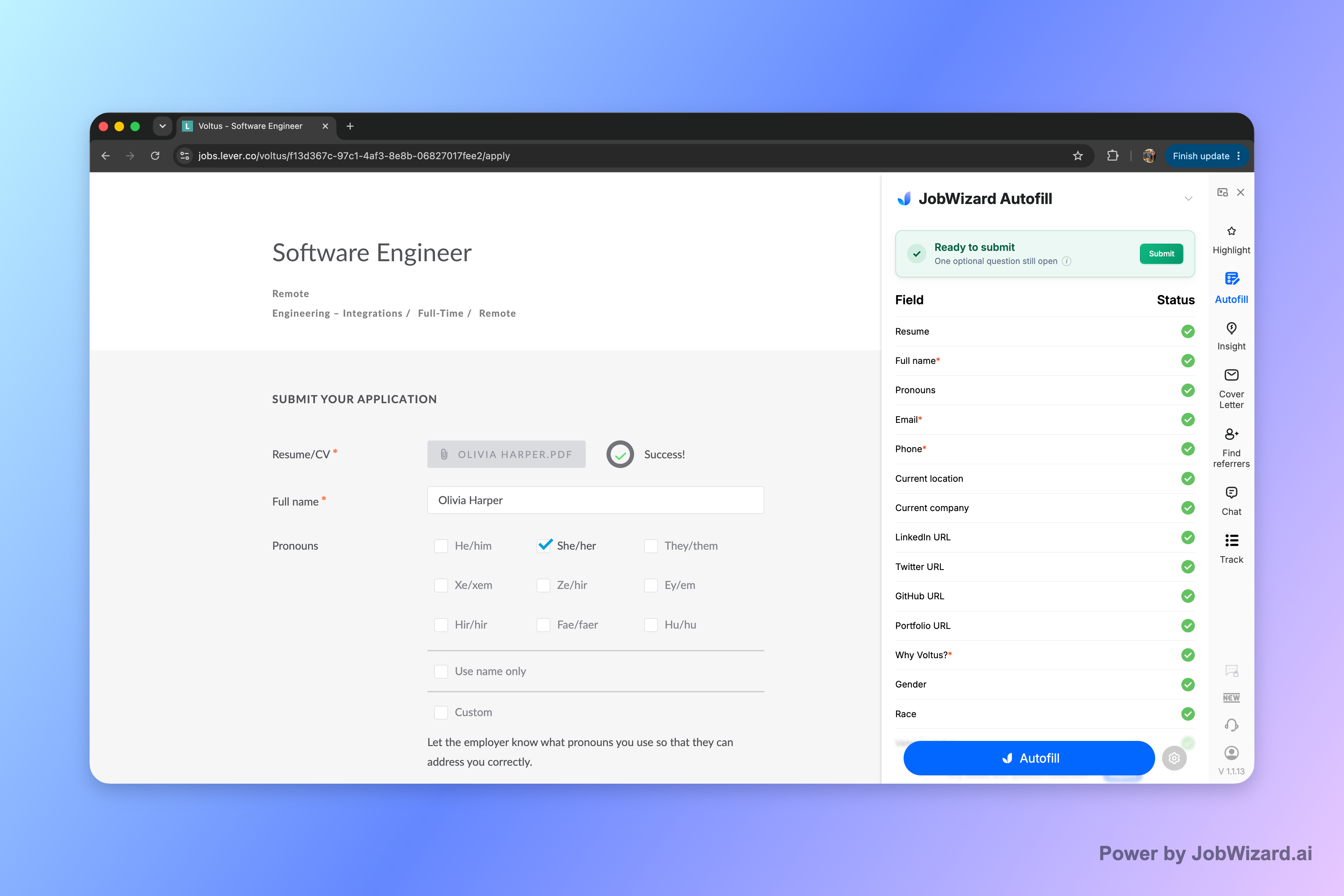
In this guide, you’ll learn what typically goes wrong with jobcopilot-style “apply for you” workflows (especially screening questions and resume mismatches), why employer-side spam filters can treat high-volume submissions suspiciously, and the better alternative: autofill the repetitive fields, then review and submit yourself with JobWizard.
Along the way, you’ll also see related real-world breakdowns of bot-reviewed applications and what to do instead.
How to Autofill Job Applications (Step-by-Step with JobWizard)
jobcopilot reviews: What can go wrong with bot-reviewed applications—and what to do instead
What “jobcopilot” usually means—and why bot submission is where things break
Most “jobcopilot” marketing centers on saving time by automating parts of applying. The danger comes when the tool goes beyond drafting and into submitting without your final review.
When you’re not actively checking every critical field, the application becomes a guess—sometimes a close one, sometimes not. And in job applications, “close” is often not enough because screening questions and custom prompts are the fastest way employers evaluate fit.
Bot submission turns “unknowns” into definitive answers
Even strong AI can misinterpret a question, or your current situation may have changed since the last time you applied. If a bot decides on the wrong response, it can lock you out immediately—before anyone reads your experience.
Example: An application asks about work authorization or start date. If the tool selects an answer that doesn’t match your current status, the rejection isn’t about your skills—it’s about eligibility or timing.
Mismatch errors look small, but they’re easy to flag
Employers don’t just compare your resume content; they also look for internal consistency. Bot-style submissions can produce subtle mismatches between what the form says and what your resume implies.
Example: The form lists a recent role start date that conflicts with your resume’s dates, or the resume you intended to use doesn’t match the application’s job family. Recruiters may not have time to diagnose what went wrong—they may treat it as low effort.
High-volume “apply for you” behavior can trigger employer filters
Many hiring systems include guardrails to reduce irrelevant or low-quality traffic. When submissions come in too fast, or with repetitive patterns, employer-side spam or quality filters may become more aggressive.
Important: This doesn’t mean all automated tools are malicious. It means that “bot-like” patterns can be treated as noise—especially if the application quality varies from one submission to the next.
What goes wrong with jobcopilot-style “bot apply” in real applications
The most common failures fall into a few buckets: wrong answers, missing context, resume mismatches, and quality signals that reduce your chances before review begins.
Here are the categories to watch for—so you can spot them quickly in your own workflow.
1) Wrong answers to screening questions
- Eligibility fields: work authorization, citizenship, location/remote eligibility, and availability.
- Experience filters: years of experience, specific tools, or industry requirements.
- Behavioral intent: scenario-based prompts that are hard to “infer” reliably.
If you don’t review those answers right before submitting, you can accidentally disqualify yourself—even if your resume is strong.
2) Mismatched resumes or inconsistent details
- Resume selection: using a resume version that’s close but not tailored to the role.
- Date alignment: conflicting start/end dates, job titles, or employment gaps.
- Content inconsistency: claiming experience in one area while the resume doesn’t clearly support it.
Recruiting teams may not always have the time to reconcile contradictions. The result can be automatic rejection or “not a match” labeling.
3) Missing custom questions (the parts that actually differentiate you)
Many application flows include custom questions that don’t map neatly to your resume. Bot-style approaches often leave them blank, reuse generic answers, or fill them with placeholders that don’t match the job.
Example: A question asks for a specific accomplishment with metrics. If the tool inserts a vague statement, your application can look unprepared.
4) Formatting issues that reduce readability
Even when content is correct, formatting can affect how easily a recruiter scans your info. Bots can generate truncated text, inconsistent punctuation, or fields that are hard to read in the ATS view.
Result: Your best points may be overlooked because the application looks messy.
How to get the speed of automation without the bot-submission risk
The safer alternative is not “do everything manually.” The safer alternative is autofill repetitive fields, then you review and submit.
This approach keeps your throughput high while protecting the high-stakes parts of the application—screening answers, custom questions, and anything that depends on your current details.
Use autofill for what it’s good at: repeatable form fields
JobWizard is designed to help with autofilling application fields on platforms where you’re already filling out the application. That matters because you’re present, you see the form, and you can confirm accuracy.
Verified aggregate usage data shows JobWizard has enabled 720,000+ applications submitted and 600,000+ autofill sessions, with autofill typically covering ~18 repetitive fields per application (often 11–23) while you review the remaining questions before submitting.
That workflow is the point: fast repetitive entry, paired with human review on what decides fit.
Auto Apply AI: How “Bot Submits for You” Goes Wrong—and What to Do Instead
Make “review-before-submit” your non-negotiable step
- Confirm screening answers: eligibility, experience level, and timing.
- Check resume alignment: role dates and titles match what the form implies.
- Rewrite custom prompts: make sure your answer matches the job and your achievements.
- Submit yourself: the final action stays under your control.
This is how you avoid bot-driven mistakes without losing momentum. You don’t need blind automation to increase your application volume—you need faster preparation and fewer typing bottlenecks.
Why this protects your reputation with companies you want
If you submit a low-quality or incorrect application to a company you genuinely want to work for, the damage can compound. You may not get a second look—not because you’re unqualified, but because your application signaled uncertainty or mismatch.
Reviewing before submission keeps you credible. It turns “automation” into a tool that helps you execute consistently, rather than a system that accidentally speaks for you.
Jobcopilot vs. autofill-review: a fair comparison of trade-offs
The right choice depends on whether you’re willing to personally verify every high-stakes field before submitting.
Below is a practical comparison focused on the jobcopilot-style “bot apply” risk areas described earlier.
| Approach | What it optimizes | Main risk to watch | Best for |
|---|---|---|---|
| Jobcopilot-style “apply for you” (bot submission) | Max time savings by reducing your interaction with the form | Wrong screening answers, resume mismatches, missing custom questions, and reduced quality signals | Situations where errors are acceptable and you’re not relying on accuracy |
| Autofill + review-before-submit (JobWizard workflow) | Speed for repetitive fields while keeping you in control | If you skip review, mistakes can still slip through—but you’re positioned to catch them | Applying consistently while protecting your accuracy and reputation |
| Tools that emphasize resume scanning/keyword matching | Fit analysis for job descriptions and resumes | They don’t automatically solve form accuracy (screening answers and custom questions still need your attention) | Improving your materials so each application is more tailored |
| Other auto-apply assist tools | Reducing manual time on forms | Auto-submission behavior may increase the odds of low-quality or mismatched entries if you don’t verify fields | Users who actively review every submission before taking the final step |
Takeaway: If the tool’s value depends on not checking details, you’re accepting a higher chance of the exact failure modes that hurt applications.
For more context from the same theme, see: ai auto apply for jobs reddit: what goes wrong with bot-style submissions (and the safer autofill review workflow).
Build your jobcopilot-proof process: faster forms, accurate answers, better outcomes
You can move quickly without sacrificing accuracy by pairing autofill speed with a deliberate pre-submit checklist.
Here’s a workflow you can reuse across applications.
A jobcopilot-proof checklist (10 minutes before you submit)
- Confirm “now” facts: location/remote availability, start date, and work eligibility.
- Scan screening questions: look for anything that sounds like a yes/no gate.
- Verify resume-role alignment: role titles, date ranges, and relevant skills.
- Answer custom prompts: keep them specific to the job and your real experience.
- Do a quick consistency pass: make sure your story doesn’t contradict itself.
Why this beats “more applies at any cost”
If your applications are riddled with avoidable errors, you can burn opportunity in two ways: you waste time and you reduce your credibility with employers. A bot that submits while you’re away maximizes speed—but it also increases the chance that you didn’t mean to submit that specific set of answers.
Autofill + review is the middle path: you still move fast, but your final content is yours.
Where JobWizard fits
JobWizard helps by autofilling the application fields while you’re actively on the application page, then you review and submit. That preserves the key safeguard: you catch mistakes before they become official submissions.
If you want to streamline your workflow without risking bot-style backfires, start with the step-by-step guide: How to Autofill Job Applications (Step-by-Step with JobWizard).
Ready to apply faster—with fewer form typos and fewer “oops” answers? Use JobWizard to autofill repetitive fields, then review and submit yourself for accuracy.
Do this automatically with JobWizard
Skip the manual work — JobWizard's Smart Autofill handles this for you. On these platforms: JobWizard vs JobCopilot.
FAQ: jobcopilot and bot-apply risks, answered
Is jobcopilot safe to use if it submits for you?
Not necessarily. When a tool submits without you carefully reviewing every field, it can mismatch your resume or leave incorrect answers in screening questions—plus it can increase the odds of triggering employer spam filters. A safer approach is to autofill repetitive fields quickly, then review and submit yourself.
What kinds of mistakes happen with bot-style “apply for you” tools?
Common issues include wrong screening answers (e.g., eligibility, location, work authorization, availability), mismatched resume details (title/company dates that don’t align), missing custom question responses, and inconsistent formatting. Any of these can cause your application to be rejected or—worse—flagged as low-quality by employer-side filters.
How does an autofill-and-review workflow help instead of full bot submission?
It reduces manual typing while keeping you in control. You can let the tool fill repetitive fields while you review the sponsorship/salary/EEO/custom questions and confirm everything is consistent. Then you submit yourself—so the final content is accurate and intentional.
If I want more applications, what should I do without using a “submit for me” bot?
Focus on faster preparation and cleaner inputs: reuse a strong master resume, keep work history and dates consistent, prepare a few targeted cover-note/answer variations, and use autofill for the repetitive sections. The goal is higher throughput without sacrificing accuracy on the questions that actually decide fit.
Which approach is better if I’m applying to companies I genuinely want to work for?
Choose the workflow that maximizes accuracy. For companies you care about, prioritize reviewing screening questions and custom prompts before submitting. Autofill can help you move quickly, but you should always be the one to confirm the final answers so you don’t accidentally harm your credibility with a bot-submitted mistake.
Frequently Asked Questions
Autofill your next job application
JobWizard is a free Chrome extension that fills applications, tracks statuses, and optimizes your resume.