smartapplier.ai: Why “Bot Apply” Can Backfire (and the Safer Autofill-Review Way)
Thinking about smartapplier.ai? Learn what goes wrong with bot submissions—wrong screening answers, resume mismatches, and spam-filter headaches—then use autofill + review-before-submit for fast, accurate applications.
Free Chrome extension
Autofill your next job application
JobWizard is a free Chrome extension that fills applications, tracks statuses, and optimizes your resume.
Trying to decide whether smartapplier.ai (or similar “bot apply” tools) is the fastest way to land interviews? The uncomfortable truth is that speed can trade off for accuracy—and when the wrong details get submitted, it can cost you with the very companies you’re trying to impress.
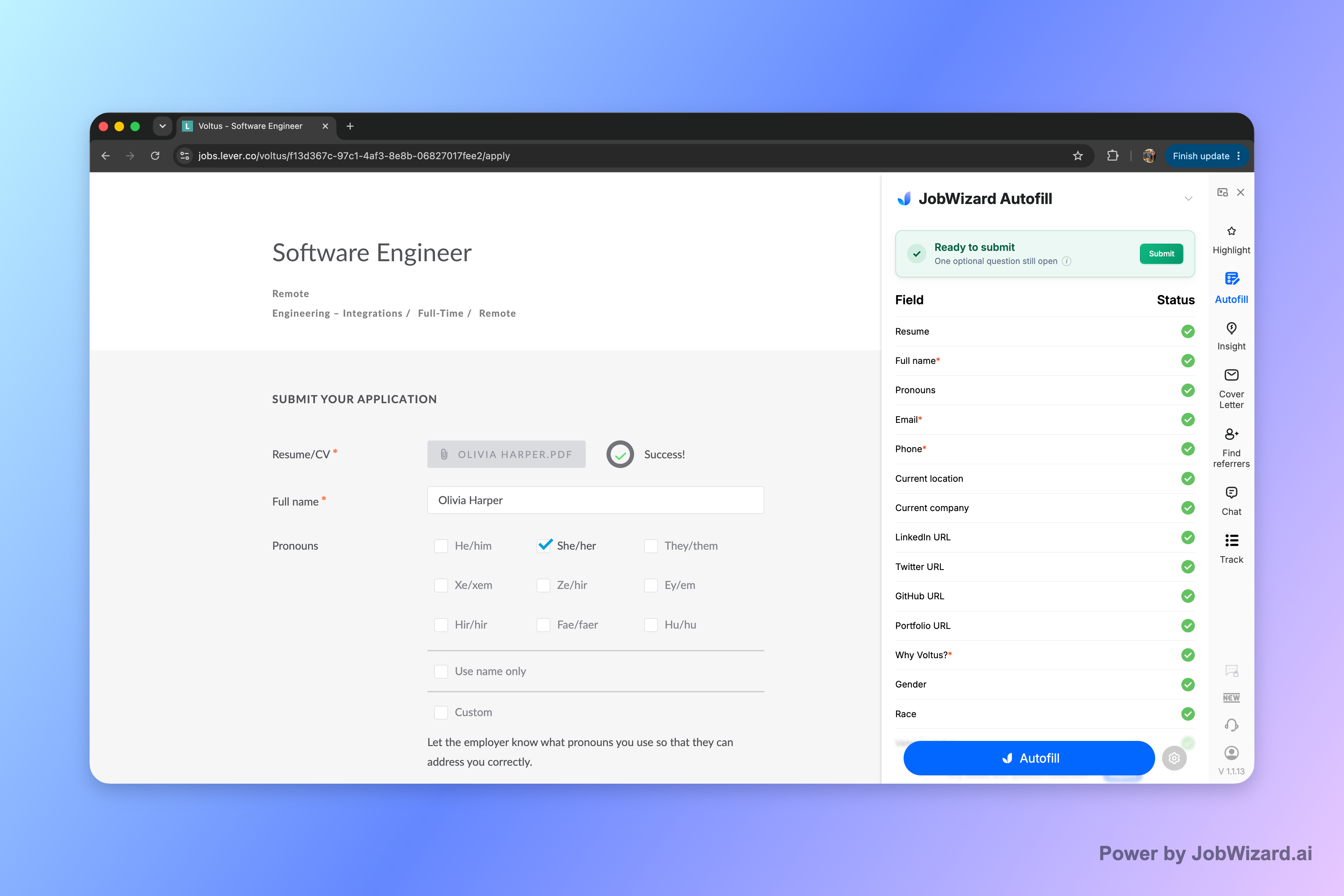
In this guide, you’ll see what typically goes wrong with bot-submitted applications, why that matters for screening and reputation, and what to do instead: use an autofill workflow you control—fill in seconds, check carefully, and submit yourself.
Why “smartapplier.ai” style bot submissions often backfire
Bot-submitted applications usually fail on the details that hiring teams rely on—screening questions, tailored responses, and resume-content alignment.
Most job funnels aren’t just looking for “a resume.” They’re collecting structured answers and matching them to the role. When an automation tool submits on your behalf, it’s easy for those answers to be wrong, outdated, or inconsistent with the resume you meant to send. And because you’re not actively reviewing each form field in the moment, you may not notice until after the fact.
1) Wrong answers to screening questions
Screening questions are where bot apply tools most often stumble, because the form language can be nuanced. A tool can misread what a prompt is asking, or reuse a generic answer that doesn’t match the job’s specific requirements.
- You might be filtered out automatically because your answer doesn’t match the employer’s criteria.
- You could also land in “manual review” with inconsistent or contradictory responses—which can still end with rejection.
2) Resume mismatches (wrong file, wrong content, formatting damage)
Resume mismatches happen when the submitted content doesn’t match the resume you intended to use. That can be as simple as uploading the wrong document, or as subtle as formatting changes that cause parsers to read your experience incorrectly.
- If the bot submits while you’re not actively confirming the document, you lose the chance to catch mistakes.
- If a field is auto-populated from the wrong source, your application can look “off” even to a human reviewer.
3) Employer-side spam or automation filters
Automation patterns can trigger friction. Even when a submission is technically correct, employer systems may respond to behavior that looks bot-like or repetitive—leading to throttling, additional checks, or outright suppression.
And if you submit incorrectly across multiple jobs, it can compound. The risk isn’t just wasting time—it’s creating a record that looks like low-quality automation to the employer.
4) Reputation damage with companies you actually want
Reputation isn’t only about your resume. It’s also about the signals you send through your application. If answers don’t match your actual background—or if the tone/details clearly look templated or careless—some employers will remember (or at least route you differently the next time you apply).
Even for well-meaning applicants, bot apply can send the wrong message: “this was thrown together by a machine.” For competitive roles, that’s a problem.
The safer alternative: autofill on the page you’re already viewing
Autofill + review-before-submit gives you the best of both worlds: fewer manual keystrokes, without surrendering control of the answers that matter.
Here’s the key distinction: tools in this safer category autofill applications you are already on, then you review and submit yourself. That workflow reduces the chance that wrong screening answers, mismatched resume details, or garbled text get sent without your approval.
What you gain (without giving up accuracy)
- Faster form completion for repetitive fields—so you don’t burn time retyping the same information over and over.
- Human accountability for the parts that can change meaning: screening questions, role-specific prompts, and any free-text sections.
- Submission control so you can confirm the final application looks right in the employer’s form before you click submit.
Verified usage data shows JobWizard is used at scale: 720,000+ applications submitted and 600,000+ autofill sessions run through the tool. On average, JobWizard autofills ~18 repetitive fields per application. Autofill + review-before-submit is the workflow—sponsorship/salary/EEO/custom questions are left for the user to review before submitting.
To see the workflow details end-to-end, start with How to Autofill Job Applications (Step-by-Step with JobWizard).
smartapplier.ai vs. the autofill-review approach: what’s the real trade-off?
Bot apply and autofill-review optimize for different risks: one reduces your effort by handling submission, while the other protects you by keeping you in the review loop.
| Workflow | What’s handled | Where mistakes happen most | Best for |
|---|---|---|---|
| Bot-submitted “apply for me” tools (e.g., smartapplier.ai style positioning) | Submission can happen without your real-time checks | Screening question accuracy, resume-document alignment, and employer filtering patterns | Situations where you can accept higher risk of mismatch (and you’re okay with fewer chances to correct) |
| Autofill + review-before-submit (JobWizard workflow) | Repetitive fields are autofilled while you review and submit | Lower risk, because you can catch wrong answers and misalignment before submission | Applicants who want speed but won’t compromise accuracy for screening questions and custom prompts |
If you’re deciding between a “bot apply” workflow and a safer alternative, these reads are directly relevant:
- Jobcopilot: Why “Bot Apply” Can Backfire (and the Safer Autofill-Review Way with JobWizard)
- aiapply: Why “Bot Submits for You” Backfires—and the Safer Way to Submit Fast
- AIapply Pricing: What You Pay for (and Why “Bot Apply” Costs More Than Money)
How to submit fast without letting bots answer for you
Fast doesn’t have to mean careless—the fastest applicants keep a tight “fill, verify, submit” loop.
Use an autofill workflow to reduce repetitive typing, then run a quick final check specifically aimed at the failure points bot apply tools create: screening answers, resume alignment, and custom questions.
A practical pre-submit checklist (30–60 seconds)
- Confirm the resume document shown in the application upload/selection area is the one you want.
- Verify every screening question answer matches the job’s phrasing and your actual experience.
- Check custom/free-text prompts for role fit, clarity, and any wording that could trigger rejection.
- Scan for formatting/truncation (especially dates, titles, and tool names) so parsers read what you intend.
- Review the final preview for inconsistencies before you submit yourself.
What to do when you catch a mismatch
Fixing before submit is where you protect your odds. If something looks wrong—an answer doesn’t match the resume, a prompt is misread, or formatting broke—update it immediately while you’re still on the employer page.
That’s the core difference between bot apply and autofill-review: you’re the final author of what gets sent.
Do this automatically with JobWizard
Skip the manual work — JobWizard's Smart Autofill handles this for you. On these platforms: JobWizard vs SmartApplier.
FAQ: smartapplier.ai and bot apply vs. autofill-review
Is smartapplier.ai an autopilot that submits applications for me?
Tools like smartapplier.ai that position themselves as “bot apply” often handle submission without the careful, moment-by-moment checks a human reviewer would do. JobWizard instead autofills fields on the page you’re already on, and you review and submit yourself—so you can correct screening answers, confirm resume details, and avoid accidental misrepresentation.
What are the most common problems caused by bot-submitted applications?
Bot submissions commonly fail in four ways: (1) wrong answers to screening questions, (2) resume mismatches (the wrong document, formatting issues, or outdated content), (3) employer-side spam or automation filters reacting to patterns, and (4) reputational damage with companies you actually want—especially when the answers are inconsistent with your real experience or intent.
How does the “autofill + review-before-submit” approach reduce those risks?
With autofill + review-before-submit, the repetitive fields are filled quickly, but you remain in control of the parts that must be accurate—like screening questions, role-specific details, EEO/work authorization questions, and any custom prompts. You can verify everything reads correctly on the employer’s form before submitting.
Will autofill replace my judgment when answering screening questions?
No. Autofill should not replace your judgment for screening questions and any content that can change the meaning of your application. Treat autofilled responses as drafts you must verify, then submit only after you confirm the wording and details match your actual background and the job you want.
What should I check right before I click submit on a job application?
Before submitting, scan for the resume document shown, confirm that every screening question answer is correct, verify that any custom questions or free-text sections match the role, check that contact and location details are current, and make sure nothing looks misformatted or truncated. Then submit yourself after those checks pass.
Ready to apply faster without letting bots make the calls? Try JobWizard to autofill the repetitive fields while you review and submit yourself—so your screening answers and resume details stay accurate. Start with How to Autofill Job Applications (Step-by-Step with JobWizard) and build your fill, check, submit routine.
Frequently Asked Questions
Autofill your next job application
JobWizard is a free Chrome extension that fills applications, tracks statuses, and optimizes your resume.