AIapply Pricing: What You Pay for (and Why “Bot Apply” Costs More Than Money)
Searching for “aiapply pricing” is really about the trade-off: cheaper auto-submission can mean wrong screening answers, spam-filter flags, and reputational damage. Learn how to avoid those pitfalls and still submit quickly—without giving up control.

Free Chrome extension
Autofill your next job application
JobWizard is a free Chrome extension that fills applications, tracks statuses, and optimizes your resume.
AIapply pricing is more than a checkout page—it’s the cost of how your applications get handled. If the workflow relies on a bot submitting while you’re not actively checking details, the “cheap” option can quietly turn into expensive mistakes: wrong screening answers, mismatched resumes, spam-filter flags, and reputational damage with employers you genuinely want.
In this guide, we’ll break down what you’re really paying for when you compare aiapply pricing and auto-apply tools—and what to do instead if your goal is speed without surrendering accuracy.
AIapply pricing isn’t just a number—it’s a risk decision
AIapply pricing typically bundles three things: how much help you get, how automated the process is, and how much responsibility you keep. When automation includes submission without your active review, the tool may optimize for throughput rather than correctness.
That difference matters because job applications are not “one form.” They’re a set of high-stakes, structured answers employers use to screen candidates. If those answers are wrong—especially for screening questions—the outcome can be immediate and irreversible.
- Wrong screening answers can disqualify you before a human ever sees your profile.
- Mismatched resumes (or outdated details) can make you look unqualified for the exact role.
- Employer-side spam filters can penalize patterns that look automated or low-quality.
- Reputational risk happens when a company receives repeated submissions that don’t match what they asked for.
Bottom line: the cheapest “aiapply” path is often the one that submits on your behalf without catching mistakes in screening, eligibility, and custom questions.
What goes wrong when bots submit for you (and why it’s not obvious at checkout)
AIapply pricing comparisons can hide the most important variable: whether a tool submits while you’re away. When it does, you lose the chance to validate details that screening systems and recruiters treat as truth.
1) Screening questions: small errors with big consequences
Screening questions often determine eligibility quickly. Bots can infer answers incorrectly, guess based on incomplete data, or map your experience to the wrong level. Even a minor discrepancy—like start/end dates, role scope, years of experience, or eligibility—can trigger an automatic “no.”
2) Resume mismatches: the job you applied for doesn’t match what you sent
If your document doesn’t align with the role, it can look like you applied without reading. That can happen when an auto-fill workflow pulls the wrong resume version or outdated content, especially if you’re applying to multiple roles in a short time window.
- You may send a resume tailored to a different title or seniority level.
- You may include projects that don’t match the “must-have” requirements.
- You may miss recent updates you meant to include.
3) Employer spam filters: not every submission is treated equally
Employers can apply filtering rules to manage volume. Auto-apply patterns—especially those that submit quickly or in large batches—can increase the chance your application is deprioritized or flagged. Even if you’re a qualified candidate, inconsistent or low-signal submissions can reduce the chance your application reaches a reviewer.
Note: spam-filter behavior varies by company and system. The key point is that automation that bypasses your review increases the likelihood of sending content that looks repetitive, mismatched, or low quality.
4) Reputation damage: applying “wrong” to a company you want
If you’re targeting a specific employer for the long term, reputation matters. When the process is bot-driven, you can accidentally submit answers that don’t reflect your true background or that contradict your profile. That can create a negative impression even if you later apply again with corrected details.
The irony is that aiapply pricing can look better upfront while the downstream cost shows up as fewer responses, fewer interviews, and extra time spent reapplying or correcting your approach.
The reviewed-submit alternative: speed with accountability
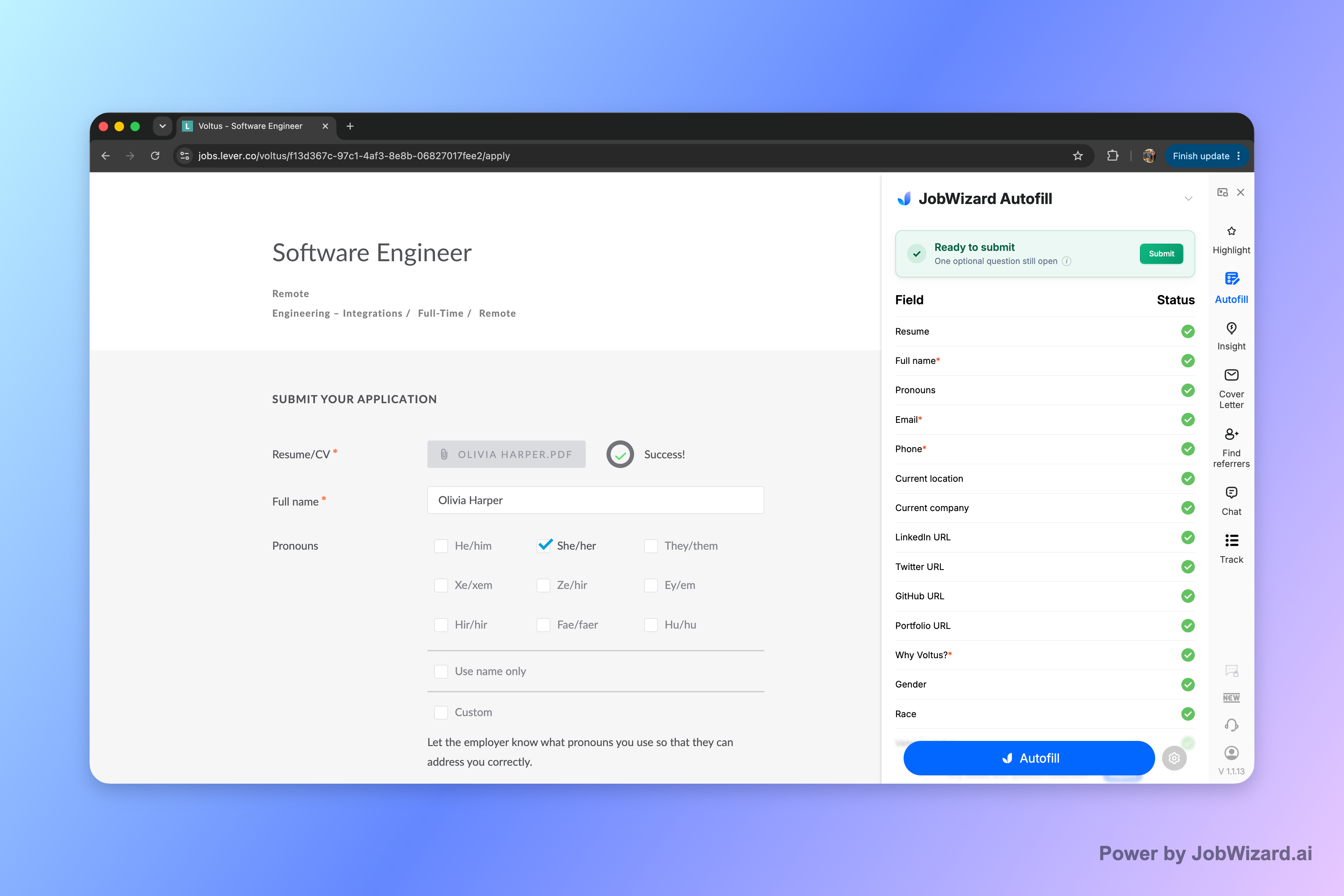
Reviewed-submit is the middle path that keeps momentum without letting automation decide what’s true. Instead of submitting while you’re away, you use the tool to fill repetitive fields fast and then verify everything before you press submit.
This approach is designed for the real-world structure of job applications: you can move quickly on standard fields (like basic contact and repeating form sections) while still taking ownership of screening answers, custom questions, and any details that need a human check.
- Autofill + review-before-submit keeps you in control of correctness.
- You confirm sensitive or role-specific answers yourself.
- You select the right resume version for the job you’re actually applying to.
- You prevent “almost right” submissions that screening systems can interpret as wrong.
With JobWizard, the workflow is built around this premise: it autofills applications you’re already on, and you review before submitting. In aggregate usage, JobWizard has supported 720,000+ applications submitted and 600,000+ autofill sessions, with an average of about ~18 repetitive fields autofilled per application (typically 11–23). Of those submissions, a majority are on Workday (~65%), followed by Greenhouse (~19%), Ashby (~12%), and Lever (~4%)—with Workday being where it saves the most time.
Why this matters for “aiapply pricing” decisions: if a tool’s value proposition includes submitting on your behalf, you’re paying to outsource judgment. If a tool’s value proposition is autofill with your review, you’re paying to reduce manual typing while preserving accuracy.
How to evaluate any “aiapply pricing” offer without getting misled
AIapply pricing can be confusing because features are often described in terms of automation, not responsibility. Use this checklist to compare tools fairly—especially if you’re considering anything that could submit while you’re away.
Use these criteria (and ask the same questions every time)
- Does it submit automatically? If yes, confirm you understand what it does while you’re not actively reviewing.
- Can you review the filled fields before submission? You want a final “human sign-off” step.
- How does it handle screening and custom questions? You should expect to verify those answers personally.
- Does it help you choose the right resume? Misalignment can happen fast when volume increases.
- What happens if something is uncertain? You should be able to correct it before sending.
A fair way to think about the trade-off
Some tools prioritize speed by automating more steps. That can feel attractive when you’re applying to many roles. The trade-off is that you also increase the chance that answers are inaccurate or mismatched—problems that are hard to undo once sent.
So instead of “Which is cheapest?” try: “Which workflow makes it easiest for me to submit accurate, job-matched applications quickly?” That framing usually leads to better outcomes than chasing the lowest “aiapply pricing.”
| Feature to compare | What you want | Why it matters |
|---|---|---|
| Submission control | You review before submitting | Prevents wrong answers and mismatched content from leaving your account |
| Screening question accuracy | You verify role- and eligibility-specific fields | Screening errors can disqualify you automatically |
| Resume alignment | You confirm the correct document for the job | Reduces “applied to the wrong role” signals |
| Employer-side filtering risk | Quality and consistency over bulk submission | Bot-like patterns can reduce visibility |
| Workflow speed | Fast autofill for repetitive fields | Cuts typing time without surrendering judgment |
Practical next steps: get faster without letting a bot take the wheel
AIapply pricing is only useful if it helps you make better applications faster. Here’s a workflow you can use right away—whether you’re using a tool or doing it manually.
- Target deliberately: Apply to roles where your experience genuinely matches the screening criteria.
- Use autofill for the repetitive parts: Let the tool reduce typing on standard fields.
- Verify screening + custom questions: Read every question and confirm the answer is correct for this specific employer.
- Confirm resume alignment: Make sure the document reflects the role’s requirements and your most recent details.
- Submit with confidence: You’re the final decision-maker—so only submit when it’s accurate.
If you want a tool that supports this reviewed-submit workflow, JobWizard is built for it: it autofills applications you’re already on, then you review and submit yourself (no blind “auto-submit” while you’re away). That’s the difference between paying for speed and paying for accuracy.
CTA: Try JobWizard to autofill repetitive application fields and keep control of your screening answers—then review and submit with confidence.
Do this automatically with JobWizard
Skip the manual work — JobWizard's Smart Autofill handles this for you.
FAQ: AIapply pricing and the automation trade-off
Is “aiapply pricing” just about the monthly cost, or are there hidden costs?
It’s rarely just monthly cost. Auto-apply workflows can create hidden costs like rework (fixing wrong answers), lost opportunities (because your submission doesn’t match the role), and reputational risk if a company receives low-quality or mismatched applications.
What goes wrong when a bot answers screening questions for you?
Bots can fill screening responses incorrectly or based on incomplete signals, which can disqualify you early. Even small mismatches—location, eligibility, experience level, or dates—can send you to a “no” without a human review.
How does a reviewed-and-submitted workflow avoid the biggest auto-apply problems?
Instead of submitting while you’re away, you review the filled fields before you hit submit. That lets you correct screening questions, confirm the right resume and work history, and ensure any custom/sensitive answers are accurate.
Will employer spam filters really matter for application success?
They can. Large-volume or bot-like submissions may trigger filtering rules on the employer side. Even if you’re applying legitimately, low-quality or inconsistent packets can reduce the chance your application is seen by the hiring team.
If I want speed, what should I prioritize over “aiapply pricing” alone?
Prioritize control and accuracy: whether the tool helps you complete repetitive fields quickly, whether you must review before submitting, and whether you can ensure screening and resume details match the job you’re actually targeting.
Frequently Asked Questions
Autofill your next job application
JobWizard is a free Chrome extension that fills applications, tracks statuses, and optimizes your resume.