AIapply cost isn’t the real issue—what bot submissions get wrong (and the autofill cost that helps)
AIapply cost comparisons miss the bigger problem: bot apply tools can mismatch answers, trip screening filters, and hurt your reputation. JobWizard’s autofill + review-before-submit approach helps you fill repetitive fields fast and submit yourself.
Free Chrome extension
Autofill your next job application
JobWizard is a free Chrome extension that fills applications, tracks statuses, and optimizes your resume.
If you’re searching for aiapply cost, you’re probably trying to figure out what “AI job application” automation will set you back. But the bigger question is what it can cost you when an auto-submit bot sends the wrong answers, mixes up your documents, or gets you flagged—then you’re stuck with the submission.
JobWizard is built around a different workflow: autofill + review-before-submit. It helps you complete the repetitive parts faster while you stay responsible for the final answers and the submission decision.
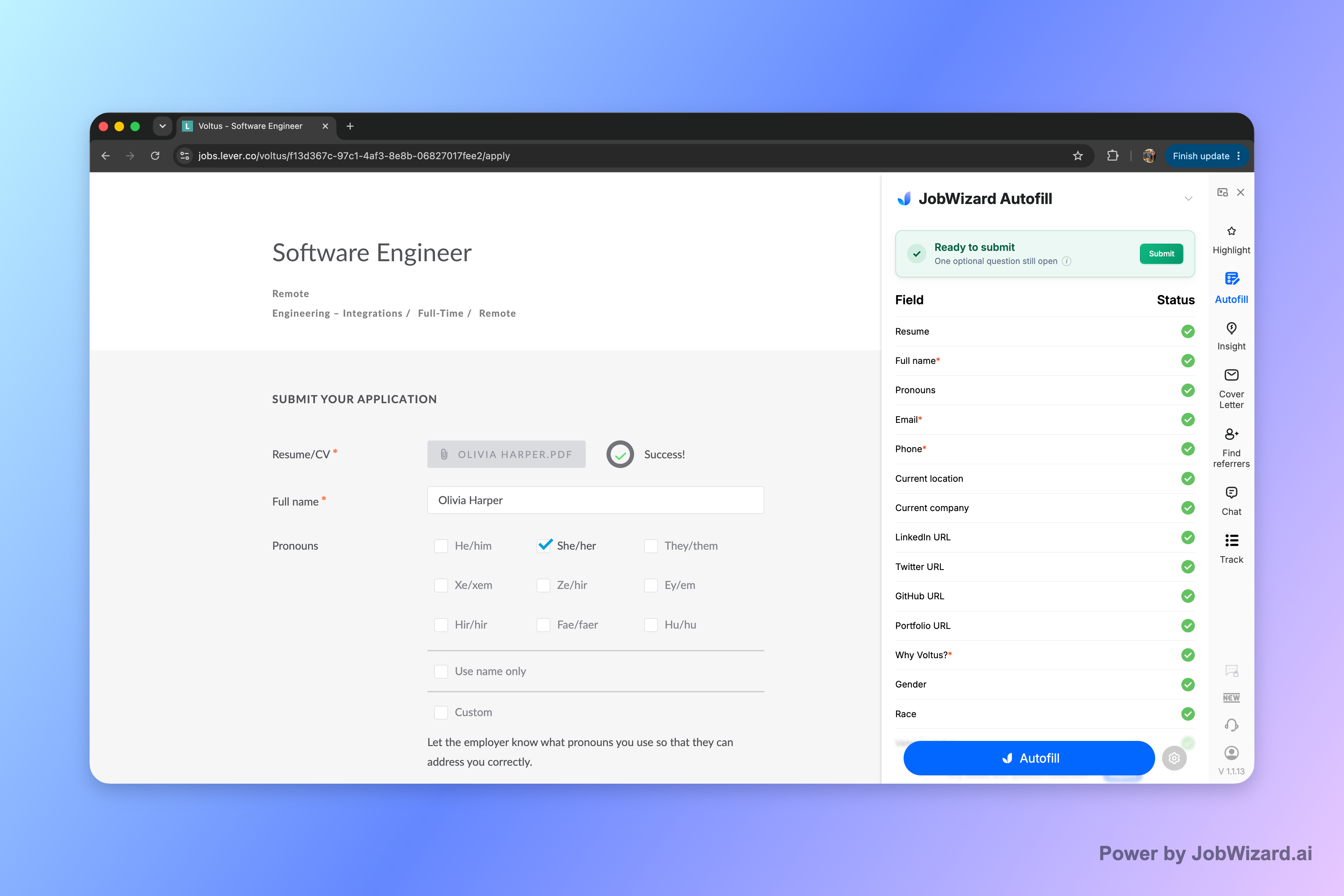
AIapply cost comparisons miss the downstream risk: bot submissions can be wrong in ways money can’t fix
When people talk about aiapply cost, they often focus on the sticker price or what a tool “does.” Auto-submit tools can be fast, but speed can introduce failure modes that are invisible until after you’ve already sent the application.
Here are the most common ways bot apply approaches go wrong—and why it matters to real hiring teams:
- Wrong answers to screening questions: If the bot guesses or misreads what a question is asking, you may submit an answer that doesn’t match your actual background.
- Resume mismatch and field confusion: Parsed data can map to the wrong fields (for example, mixing experience details or using the wrong summary), which creates inconsistencies employers can detect.
- Employer-side spam or quality filters: Rapid or repetitive submissions can trigger “low-quality” signals, especially if multiple answers look templated or inconsistent across the form.
- Damaged reputation with a company you actually want: If a company reviews your application and sees answers that don’t reflect you, it can hurt your perception—sometimes even when you’d otherwise be a strong fit.
None of those risks are theoretical. They’re the real trade-off: a tool that pushes “submit” on your behalf has to make assumptions. If those assumptions are wrong, the cost shows up later—in reviews and next steps, not on your bill.
The right cost to evaluate: speed for repetitive fields vs. control over final answers
To understand aiapply cost the way it matters, separate two parts of the workflow: filling the form and deciding what to submit. Autofill-then-review tools focus on the first part and protect the second.
JobWizard’s approach is designed for the exact moment where bot tools usually fail: the last-mile accuracy of what you’re saying about yourself. In the JobWizard flow, you stay the one who reviews the populated fields and submits.
From real usage, JobWizard has supported 720,000+ applications submitted and 600,000+ autofill sessions (autofill + review-before-submit, not blind auto-submit). In other words: the repetitive fields get filled quickly, and you still review before submitting. Across those submitted applications, about 65% are on Workday, 19% on Greenhouse, 12% on Ashby, and 4% on Lever—Workday is where it tends to save the most time.
Key idea: the tool accelerates the repetitive form work, while you remain responsible for sponsorship/salary/EEO/custom questions and the final review decision.
As an additional reference point for what “repetitive fields” usually means in practice, JobWizard autofills an average of about ~18 repetitive fields per application (typically 11–23). That’s exactly the portion that’s easy to accelerate without taking over your judgment.
What goes wrong with bot apply tools—and how autofill + review fixes it in practice
Bot apply tools are usually optimized for one outcome: “submit more applications.” The problem is that form-based hiring processes aren’t just data entry—they include screening logic and expectations that require correct, consistent answers.
With JobWizard, you get the speed benefit without surrendering control. Here’s what the safer workflow looks like when you’re dealing with real application forms:
- Autofill the repetitive fields: JobWizard fills detected fields using your saved profile and resume data on supported application pages.
- Review what was populated: you verify every answer before you submit, especially any content that could affect screening.
- Correct what still needs attention: if a required field still needs attention, JobWizard can identify it so you can jump to the matching question and fix it.
- Submit yourself: the final submission is yours—this avoids “submit while you’re away” failure modes.
To make this concrete, consider two scenarios that can look similar from the outside but behave differently:
- Scenario A (bot apply): The tool submits instantly after it fills what it thinks is needed. If it misreads one screening response, you’ve already sent it.
- Scenario B (autofill + review): The tool fills repetitive fields quickly, but you review the screening answers and correct anything uncertain before submitting.
The second scenario is also easier to trust at the company level. If you’re applying to a role you truly want, you want your application to sound like you—not like a guess made by automation.
Comparing bot apply vs. autofill-then-review: which approach fits your risk tolerance?
If your only goal is maximizing volume, bot apply tools may seem attractive. But if your goal is accurate applications for roles you genuinely care about, autofill-then-review is usually the smarter trade-off.
| Approach | What it optimizes | Main risk | What you control |
|---|---|---|---|
| Auto-submit “bot apply” | Fast pushing of applications | Wrong answers to screening questions, mismatched field data, and potential employer-side filtering signals | Less direct control over the final answers and timing |
| Autofill + review-before-submit (JobWizard) | Speed for repetitive form fields | You can still make mistakes if you don’t review—so review is the safeguard | You review populated fields and submit yourself; required fields needing attention are identified |
JobWizard is explicitly designed for the “fill fast, verify, then submit” workflow. That’s the real answer to aiapply cost: not just what it costs, but what it protects. If a tool never submits on your behalf, you avoid the worst class of failure—applications sent with errors you didn’t notice.
If you want a practical way to experience the difference, start with your next application form and use JobWizard’s autofill + review-before-submit workflow. Fill the repetitive fields in seconds, then review every answer before you submit.
Ready to move faster without handing off control? Try autofill on your next application in JobWizard and review every populated answer before submitting.
Do this automatically with JobWizard
Skip the manual work — JobWizard's Smart Autofill handles this for you. On these platforms: JobWizard vs AIApply.
FAQ: aiapply cost and what to do instead of risky auto-submit bots
What does “aiapply cost” usually miss about auto-submit bots?
It often focuses on price, not on the downstream damage from wrong or mismatched answers—especially screening questions, resume parsing issues, and employer-side filters. Even if an auto-submit bot is fast, you can still end up submitting content you didn’t intend.
Why can an auto-apply bot hurt my chances with a company I actually want?
Because bots may fill fields incorrectly (or leave required items mismatched), which can trigger screening logic, create inconsistent answers across sections, or get your application flagged as low quality. That can waste an opportunity and make your profile look careless to an employer you care about.
What’s the safer alternative to “aiapply cost” auto-submit tools?
Use an autofill-then-review workflow: the tool fills repetitive fields, then you review every answer and submit yourself. This preserves speed while keeping you in control of screening questions and any sensitive details.
How does JobWizard keep me from submitting incorrect screening answers?
JobWizard autofills the repetitive fields on the application page, then you review what it populated. If a required field still needs attention, it helps identify it so you can jump to the matching question and correct it before submitting.
Where can I learn the full autofill workflow for popular application forms?
Start with How to Autofill Job Applications (Step-by-Step with JobWizard), then compare your approach to bot economics in AIapply Price: What Auto-Submit Bots Cost You (and the Safer Reviewed Alternative) and AIapply Pricing: What You Pay for (and Why “Bot Apply” Costs More Than Money).
Frequently Asked Questions
Autofill your next job application
JobWizard is a free Chrome extension that fills applications, tracks statuses, and optimizes your resume.