AIapply Price: What Auto-Submit Bots Cost You (and the Safer Reviewed Alternative)
Searching for aiapply price? The real cost is what goes wrong when bots submit for you—wrong screening answers, mismatched resumes, and damaged reputation—then compare the safer reviewed approach.

Free Chrome extension
Autofill your next job application
JobWizard is a free Chrome extension that fills applications, tracks statuses, and optimizes your resume.
AIapply price isn’t just a number—what auto-submit bots can cost you
When you search aiapply price, it’s easy to focus on the line item. But the bigger question is what happens after the “automation” clicks send—because the wrong details can follow you to the exact employer you actually want.
Auto-apply tools aim to reduce time by submitting quickly, often with partial or templated inputs. The problem isn’t that automation exists—it’s that auto-submit shifts quality control away from you. In hiring pipelines where screening questions matter, that trade-off can be expensive.
What goes wrong when a bot submits for you
Auto-submit errors usually fall into a few predictable categories. Here’s what that looks like in real applications—plus why it can trigger rejection, re-review, or even “automation” flags on the employer side.
1) Wrong answers to screening questions
Screening questions are often the closest thing recruiters use to a first-pass eligibility decision. If a bot misreads a question, uses a default answer, or fills based on an outdated profile, the result can be straightforward: you get filtered out before a human ever sees you.
- Example: A role asks about work authorization timing, and the bot answers with a general “yes” when you actually need a specific start date.
- Example: A role requires experience with a tool you’ve used only briefly, and the bot selects the closest match without confirming depth.
2) Mismatched resumes (content that doesn’t match the role)
Many “AI apply” setups try to reuse one resume across multiple postings. That can cause mismatches like: the resume emphasizes experience that isn’t relevant to the job’s actual requirements, or it omits a key credential that appears in the posting.
- Example: You’re applying to a senior role, but the submitted resume version highlights junior-level scope and omits leadership outcomes.
- Example: You updated a resume, but the bot submits an older file—so the dates, titles, or achievements no longer align with your latest background.
3) Employer-side spam filters and automation suspicion
Even if your info is mostly correct, automated-looking behavior can trigger filters. Employers may detect patterns like rapid submission bursts, repeated formatting, or incomplete consistency across applications. When that happens, you can end up in an “ignore or quarantine” bucket.
Key point: This isn’t about accusing a tool of “bad behavior.” It’s about how hiring systems work—automation detection and anti-spam measures exist for a reason, and they can misclassify legitimate candidates who submit too fast or too similarly.
4) Damaged reputation with a company you actually want
Suppose you apply to your dream company using auto-submit. If your application includes incorrect details—wrong location, wrong portfolio link, or inconsistent statements—that can sour how you’re perceived. Hiring teams remember patterns, and even if you don’t get rejected instantly, you may get deprioritized.
Reputation risk is especially real when screening questions include nuance (availability, compensation expectations, legal consent, EEO data, and role-specific custom questions). A bot that “sounds confident” can still be wrong.
A safer alternative: fill fast, then review before you submit
The better workflow is what most applicants actually need: speed without surrendering control. In other words, use automation to reduce repetitive typing, but keep your review step intact before anything is submitted.
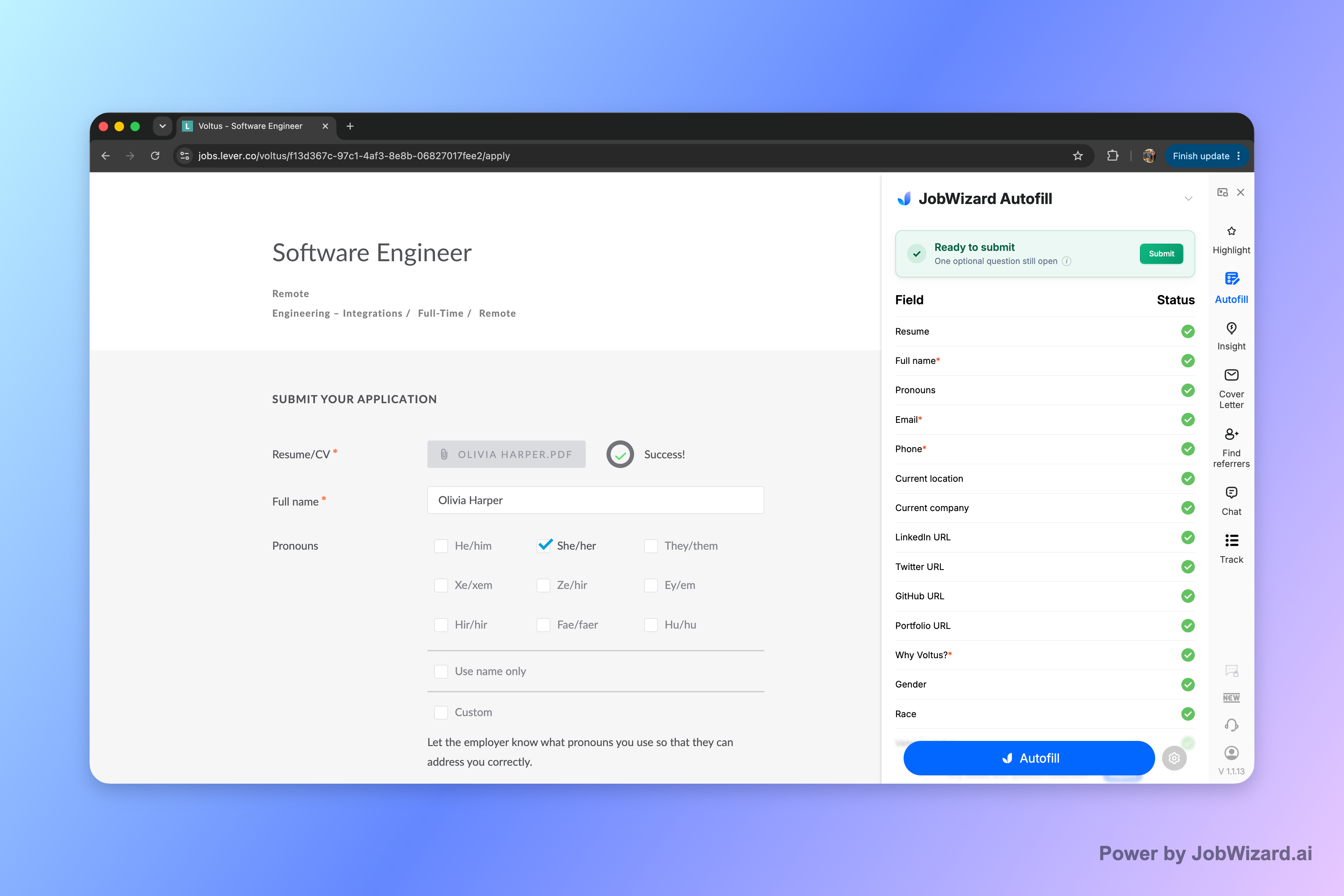
JobWizard follows that approach. It autofills fields on applications you’re already on, then you review and submit. It never submits by itself and it doesn’t apply while you’re away—so the final accountability stays with you.
How review-before-submit protects you
- Screening stays accurate: you can verify every eligibility and custom question before submitting.
- Documents stay aligned: you confirm the resume you’re sending matches the role’s requirements.
- Consistency stays human: you can check names, locations, dates, and links so the application reads like it’s truly yours.
This “autofill + review-before-submit” model is particularly helpful when forms are long and repetitive. The time savings come from filling repeated fields quickly—not from letting software decide what you meant.
Across 720,000+ applications submitted and 600,000+ autofill sessions run through JobWizard, the autofill typically handles ~18 repetitive fields per application (often 11–23), while the user reviews and submits. Approximately 65% of autofill activity is on Workday.
Why it matters in the auto-apply conversation
When people talk about aiapply price, they’re often comparing subscription costs for automation. But the hidden “price” is quality control. If the workflow encourages mistakes you won’t catch, you may spend money and time sending applications that never should have been submitted.
Review-before-submit doesn’t eliminate effort—but it focuses your effort where it’s most valuable: the parts that actually require your judgment and your accuracy.
How to evaluate aiapply price: look for quality-control, not just automation
If you’re trying to compare tools, treat aiapply price like a proxy for workflow design. Two products can cost the same and still produce very different outcomes depending on what they do automatically and what they require you to verify.
Use this checklist before you pay for “AI apply”
- Confirm the submission behavior: Does it submit for you automatically, or does it stop and let you review?
- Audit screening question handling: Can you see and correct every answer before submission?
- Check resume matching: Can you ensure the exact resume and links correspond to the role?
- Look for user responsibility: Is there a clear review step where you validate details?
What “good value” looks like
Good value isn’t just “less typing.” It’s “less typing on the boring parts,” paired with a workflow that prevents you from sending the wrong information. That’s the core reason autofill + review-before-submit is often more appropriate than true auto-submit.
Think of it this way: your time matters, but your application accuracy matters more—especially when the employer uses screening logic.
Fair comparison guidance (so you can choose confidently)
Some tools focus on automating submissions, while others focus on accelerating parts of the form-filling process. Both approaches can be attractive. The difference is whether you stay in control before the “submit” moment.
Practical takeaway: If a tool’s design reduces your ability to catch errors, that’s a risk—even if the convenience is real.
| What you’re evaluating | Why it matters | What to look for instead |
|---|---|---|
| Auto-submit vs review control | Auto-submit increases the chance of incorrect eligibility/screening answers | Autofill that stops for you to review and submit |
| Resume and document alignment | Mismatched resumes can make your experience look irrelevant | Manual confirmation of the resume/link details before submitting |
| Consistency across fields | Inconsistent dates/locations/answers can trigger extra scrutiny | Field-by-field review before the submission step |
| Employer automation detection | Patterns can trigger anti-spam or “automation suspicion” logic | Controlled pace + accurate submissions you personally verify |
Make it work for your goals: fast forms, careful answers, better submissions
Use automation where it helps, and keep your standards where it counts: the questions and content that affect whether a human considers you. That’s the difference between speed for productivity and speed that creates avoidable mistakes.
If you’re applying to roles with detailed screening questions, a “review-before-submit” workflow protects you from the most common failure modes: wrong answers, mismatched resumes, and the automation vibe that can trip filters.
A simple workflow you can copy
- Start the application: open the job’s application page and ensure you’re applying to the right role.
- Autofill the repetitive fields: let the tool fill what you’d otherwise type over and over.
- Review every screening/custom question: correct anything that could be misinterpreted.
- Confirm the resume and links: verify you’re sending the correct version for that specific posting.
- Submit yourself: your review step is the quality gate.
That’s the safer middle ground: faster execution without gambling your application accuracy.
Do this automatically with JobWizard
Skip the manual work — JobWizard's Smart Autofill handles this for you. On these platforms: JobWizard vs AIApply.
FAQ: aiapply price and what to do about auto-submit risks
Does JobWizard do auto-submit or mass-apply for me?
No. JobWizard autofills fields on applications you’re already viewing, but you review and submit yourself. It never submits by itself and it doesn’t apply while you’re away.
What are the most common reasons auto-submit bots get rejected or cause problems?
Common issues include wrong answers to screening questions, mismatched resumes (e.g., content that doesn’t match the role), and employer-side spam or automation filters. Even when an application is technically sent, inaccurate or inconsistent details can hurt your odds.
How is a “review-before-submit” workflow different from the idea behind auto-submit bots?
With review-before-submit, repetitive fields can be filled quickly, but you still verify sponsorship/salary/EEO/custom questions and confirm accuracy before submitting. That reduces the chance you send information you didn’t intend to share or that doesn’t fit the job.
How can I protect my reputation when using any tool that helps with applications?
Treat submitted info as your responsibility: double-check every screening and eligibility question, confirm the resume/portfolio links match the role, and ensure your experience statements are consistent. If a tool can’t guarantee review control, be especially cautious.
When should I stop using an auto-submit bot and submit manually instead?
Stop when you notice repeated errors (wrong role keywords, inconsistent dates, missing documents, or answers that don’t match your background), when a job’s screening questions are detailed, or when you care about the employer enough to justify extra review time.
Ready to apply faster without risking a bad auto-submit? Try JobWizard to autofill the repetitive parts, then review everything and submit yourself—so your applications stay accurate, consistent, and in your control.
Frequently Asked Questions
Autofill your next job application
JobWizard is a free Chrome extension that fills applications, tracks statuses, and optimizes your resume.