“ai to apply for jobs automatically” isn’t what you want—here’s the safer way to use AI without damaging your chances
Searching for “ai to apply for jobs automatically”? Avoid bot-submission risk. Instead, speed up form completion, review carefully, and submit yourself so screening answers and documents stay accurate.
Free Chrome extension
Autofill your next job application
JobWizard is a free Chrome extension that fills applications, tracks statuses, and optimizes your resume.
Looking for ai to apply for jobs automatically? The problem is that “automatic” often means a bot is clicking submit while you’re not reviewing the answers. When that happens, you can easily give employers the wrong information—then you’re left trying to recover after the fact.
For job seekers, the smarter approach is AI-assisted autofill + review-before-submit: let AI speed up repetitive fields while you stay responsible for every screening question, resume choice, and job-specific detail. Below, you’ll see exactly what goes wrong with auto-submission and how to keep your applications accurate without slowing yourself down.
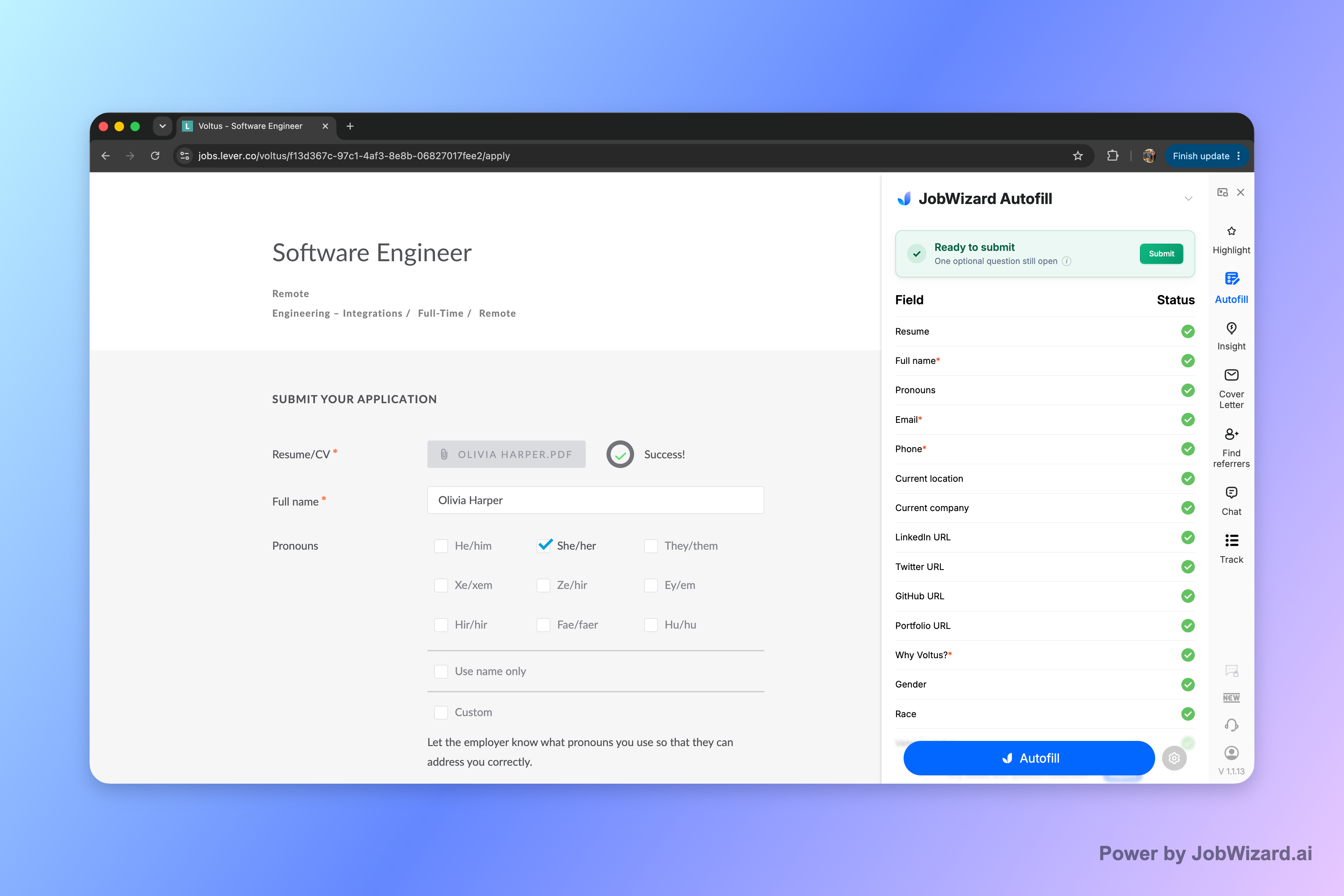
Why “ai to apply for jobs automatically” can backfire
Auto-submission tools can quietly turn your application into a mismatch. Even if the form gets filled, the most important part of hiring is the content: screening answers, eligibility details, and document alignment. If those are off, you can get rejected faster—or flagged by employer filters.
Auto-apply tools are often built for scale. That’s useful when you’re experimenting broadly, but it’s a bad fit when you care about accuracy. Hiring managers and ATS workflows are trained to interpret inconsistencies as low effort, even when you didn’t intend the mistake.
Wrong answers to screening questions
Screening questions are where “almost right” becomes “no.” Bots can misread or misinterpret prompts, especially when employers use nuanced wording (availability windows, required skills, legal eligibility, or “yes/no” variations). If the tool answers the wrong option, you can be filtered out without a human ever seeing your true fit.
- Yes/No or conditional questions answered incorrectly
- Date-based answers that don’t match your resume timeline
- Skill or experience questions that are too generic to satisfy the prompt
Mismatched resumes and job-specific details
A fast fill can still choose the wrong document. Many applicants customize resumes by role (titles, achievements, keyword emphasis, and relevant projects). Auto-apply workflows may apply a generic resume or the last-used document, which can create a mismatch with the job description.
That mismatch matters: some screening systems use document text to determine eligibility, and recruiters look for direct relevance. If the resume doesn’t support the answers you selected, it creates a contradiction.
Employer-side spam or quality filters
Volume and repetitive submissions can trigger employer systems. Even without “malice,” some companies treat suspiciously high or templated submissions as low-quality. When you’re not reviewing and tailoring, you’re more likely to submit duplicate or near-duplicate content that looks automated to filters.
That can reduce your visibility for the exact employer you want—because the system may deprioritize future applications from you or mark your submissions as low confidence.
Damaged reputation with a company you actually want
Submitting incorrectly can cost you trust. If you apply to a company you care about with answers that don’t match your background, you may never get to a recruiter conversation. Worse, if you later apply again with corrected details, your profile may still be associated with earlier low-quality signals.
This is why “ai to apply for jobs automatically” isn’t just a workflow choice—it’s a reputation choice. Employers remember patterns.
The safer alternative: autofill the application you’re on, then submit yourself
You can keep speed without surrendering control. The review-before-submit model is designed for accuracy: AI/autofill handles repetitive fields, while you stay responsible for anything that could affect fit or screening outcomes.
In practice, that means you’re not outsourcing judgment—you’re outsourcing typing. You can apply faster while still making sure the answers reflect your real experience and the role’s requirements.
What to expect from a review-before-submit workflow
Autofill should reduce friction, not replace your decisions. A good workflow fills repetitive fields quickly, then stops short of “set it and forget it.” The goal is to prevent the most common auto-submit failures: wrong screening selections, incorrect timeline details, and mismatched documents.
- You review filled content before clicking submit
- You answer any job-specific questions personally
- You confirm the resume and details that match the specific posting
Where JobWizard fits (and where it doesn’t)
JobWizard autofills repetitive application fields you’re already viewing. It’s built to speed up the form-filling part while you review and submit yourself. Importantly, it’s not an “auto-submit while you’re away” product.
That distinction matters for your search: JobWizard’s value is autofill + review-before-submit, not blind mass application.
Verified usage context: JobWizard has supported 720,000+ applications submitted and 600,000+ autofill sessions, with an average of about ~18 repetitive fields per application filled for the user to review before submitting.
Because the user is still in control at the submit step, the workflow is meant to reduce manual typing without handing over your job-specific answers.
How to choose the right “AI” for your situation (scale vs. accuracy)
Pick the model that matches your goals: volume experiments or high-intent applications. If you’re applying broadly, you may be willing to trade some accuracy. If you’re targeting a specific employer or role, accuracy is the advantage.
Here’s a practical way to decide.
When auto-apply behavior is tempting
Auto-submission is usually about volume. People reach for ai to apply for jobs automatically when they feel overwhelmed and want to “cover more ground.” That logic is understandable—job searching is exhausting.
- You’re applying to many roles where you’re not tailoring deeply
- You want quick iteration and don’t mind lower precision
- You’re treating the process like discovery
When you should prioritize review-before-submit
For competitive roles, accuracy beats throughput. If you’re applying to a company you genuinely want, a bot submission can be the difference between “knocked out by screening” and “moved to review.”
- You’ve customized your resume for that role
- The job has tricky eligibility or screening questions
- You can’t afford contradictions (dates, skills, location)
A simple decision checklist
- Do I care about this employer? If yes, review-before-submit is safer.
- Does the posting include complex screening? If yes, you need human verification.
- Have I tailored my resume for this specific role? If yes, confirm the selected document matches.
- Am I okay with employer-side filtering risk? If not, avoid “set and forget.”
What to double-check after AI/autofill—so you don’t accidentally self-sabotage
Autofill can be fast and still leave risky gaps if you don’t verify. Before submitting, scan for the details that change your candidacy.
Use this checklist every time, especially if you’re using any AI tool to populate forms.
Fast verification checklist
- Screening questions: confirm each answer matches the job requirements and your actual history.
- Resume/document selection: make sure the resume you intended is the one attached or referenced.
- Work history dates and titles: look for off-by-one errors or missing roles.
- Location/eligibility fields: confirm what the employer asks (and what you can truthfully offer).
- Custom questions: answer them directly in your own words when needed.
Small contradictions that cause big outcomes
Hiring systems detect inconsistency. A resume that claims one set of skills while screening answers select something else can reduce confidence. Even if you’re otherwise a strong fit, a mismatch can push you into a no pile.
That’s why the best workflow is AI for speed and you for judgment—especially if you’re targeting roles where you want humans to take a second look.
Do this automatically with JobWizard
Skip the manual work — JobWizard's Smart Autofill handles this for you.
FAQ about ai to apply for jobs automatically
Here are the most common questions job seekers ask before they trust an auto-apply workflow.
Is “ai to apply for jobs automatically” actually safe for my job search?
It can be risky because auto-apply tools may submit incorrect or mismatched answers while you’re away. For roles you truly want, that can hurt screening outcomes and your relationship with employers. A safer pattern is: use AI to speed up filling the application you’re viewing, then review every screening question and document detail before you click submit.
What can go wrong if a bot submits applications for you?
Common failure points include wrong responses to screening questions, using the wrong resume or work history, failing to match job-specific details (like location or eligibility), and triggering employer-side spam or quality filters. Even if the application was sent successfully, you can end up looking careless to a company you actually want.
How does JobWizard help without auto-submitting?
JobWizard autofills repetitive fields in the application you’re already on, then you review the filled content and submit yourself. That means the system speeds up the busy form-filling part, while you stay in control of sponsorship/salary/EEO/custom questions and any job-specific answers.
What should I verify before I submit after AI/autofill?
Before submitting, verify screening answers, the resume and any document selections, your work history and dates, location/eligibility details, and any custom questions tied to the job. Also confirm that required fields are complete and consistent with the role description so you don’t accidentally contradict yourself.
Is using an auto-apply tool ever worth it?
If your goal is very high-volume outreach for roles you don’t care about, you might tolerate the trade-off. But for competitive positions, most applicants are better off with a review-before-submit workflow: fill fast with AI/autofill, then apply thoughtfully so your answers, resume fit, and documentation match the employer’s screening criteria.
Apply faster with AI autofill—then submit with confidence
If you want fewer typing hours and fewer mistakes, focus on review-before-submit. Instead of searching for ai to apply for jobs automatically, use AI to speed up what’s repetitive and keep your judgment where it matters: screening questions, resume fit, and job-specific details.
Try JobWizard to autofill repetitive application fields while you review and submit yourself—so your applications stay accurate, consistent, and in your control.
Frequently Asked Questions
Autofill your next job application
JobWizard is a free Chrome extension that fills applications, tracks statuses, and optimizes your resume.