“Automate jobs” the Right Way: Why Bots Get You Rejected and How to Still Move Fast
Trying to automate jobs with submission bots can backfire—wrong screening answers, mismatched resumes, and spam-filter headaches. JobWizard helps you move faster by autofilling fields you review before you submit.

Free Chrome extension
Autofill your next job application
JobWizard is a free Chrome extension that fills applications, tracks statuses, and optimizes your resume.
Trying to automate jobs with auto-submit bots sounds efficient—until the employer reviews your application and something doesn’t match. When a tool sends responses without your judgment, the smallest mismatch can tank your chances, especially on roles with screening questions and strict eligibility checks.
Job seekers often get burned by “set it and forget it” systems. This guide explains what goes wrong when bots submit for you, then shows a better workflow: autofill the repetitive fields, review the important answers, and submit yourself.
Why “automate jobs” bots get you rejected (even when they “fill everything”)
The problem with tools built to automate jobs is that application accuracy matters more than speed. Employers typically evaluate more than your resume text—they look for consistency across your screening answers, history, and eligibility information.
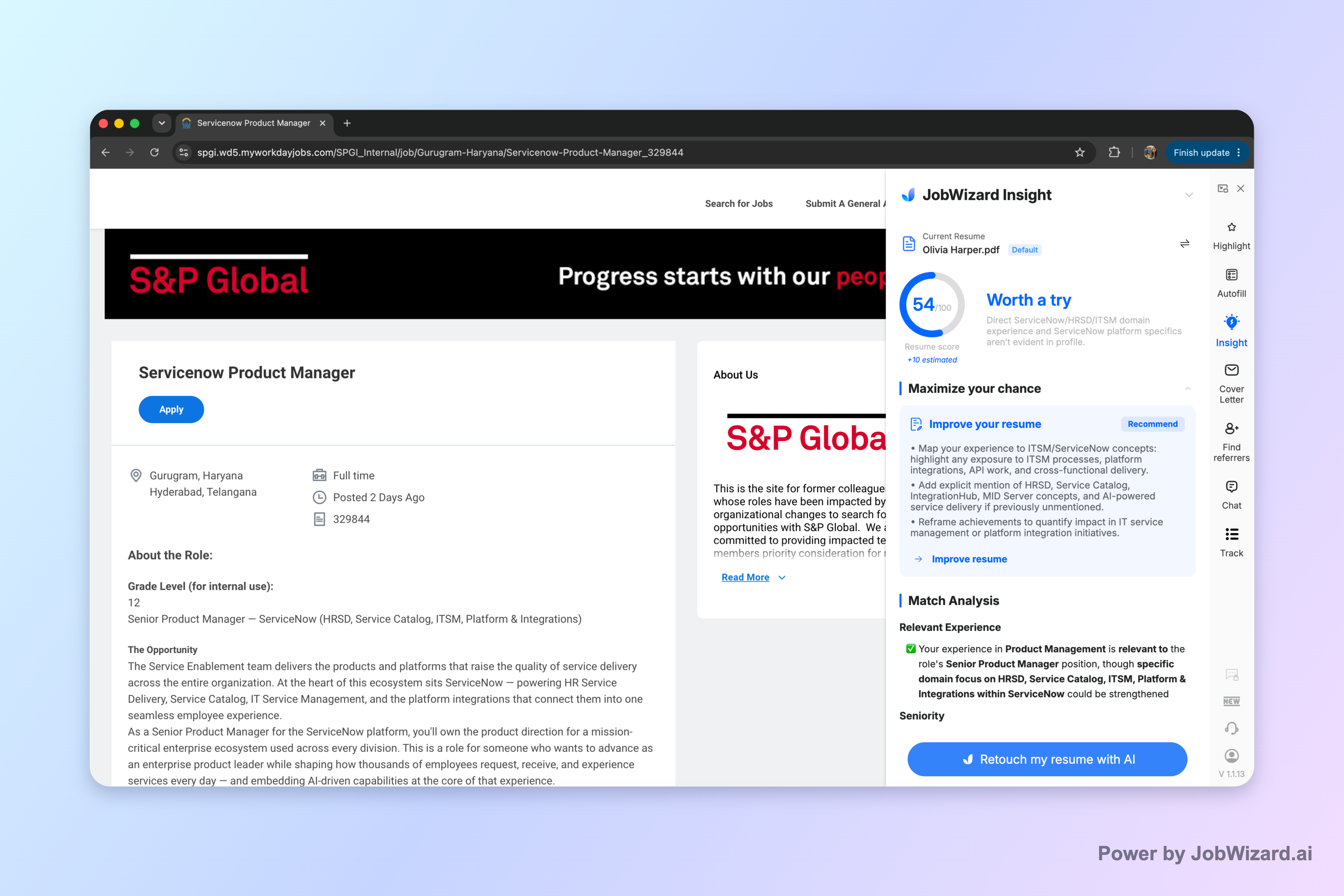
Here are the most common failure modes when a bot submits without your careful review:
- Wrong answers to screening questions: A bot may guess eligibility, years of experience, location flexibility, or legal/consent answers. One incorrect response can disqualify you.
- Resume mismatch and missing details: The tool might upload the wrong document version, omit an attachment, or fail to align resume content with what the form asks (for example, a specific job title or timeframe).
- Inconsistent data that looks automated: If your work history, dates, or phrasing doesn’t line up across fields, it can look careless or mass-generated—especially when multiple applications have similar patterns.
- Employer-side spam or quality controls: Many systems watch for repetitive submission behavior, missing required fields, or identical data at scale. Even without “bad intent,” a bot’s pattern can trigger filters.
The key point: even if an auto-submit tool “works,” it doesn’t guarantee your application is coherent and role-specific. And because screening questions often determine whether a human ever sees your resume, the cost of one mistake is high.
What a reviewed workflow changes: fill fast, then submit yourself
The safest way to keep momentum while avoiding bot-style mistakes is the “fill fast, review fully, submit yourself” workflow. Instead of sending decisions to a bot, you stay in control of the final step.
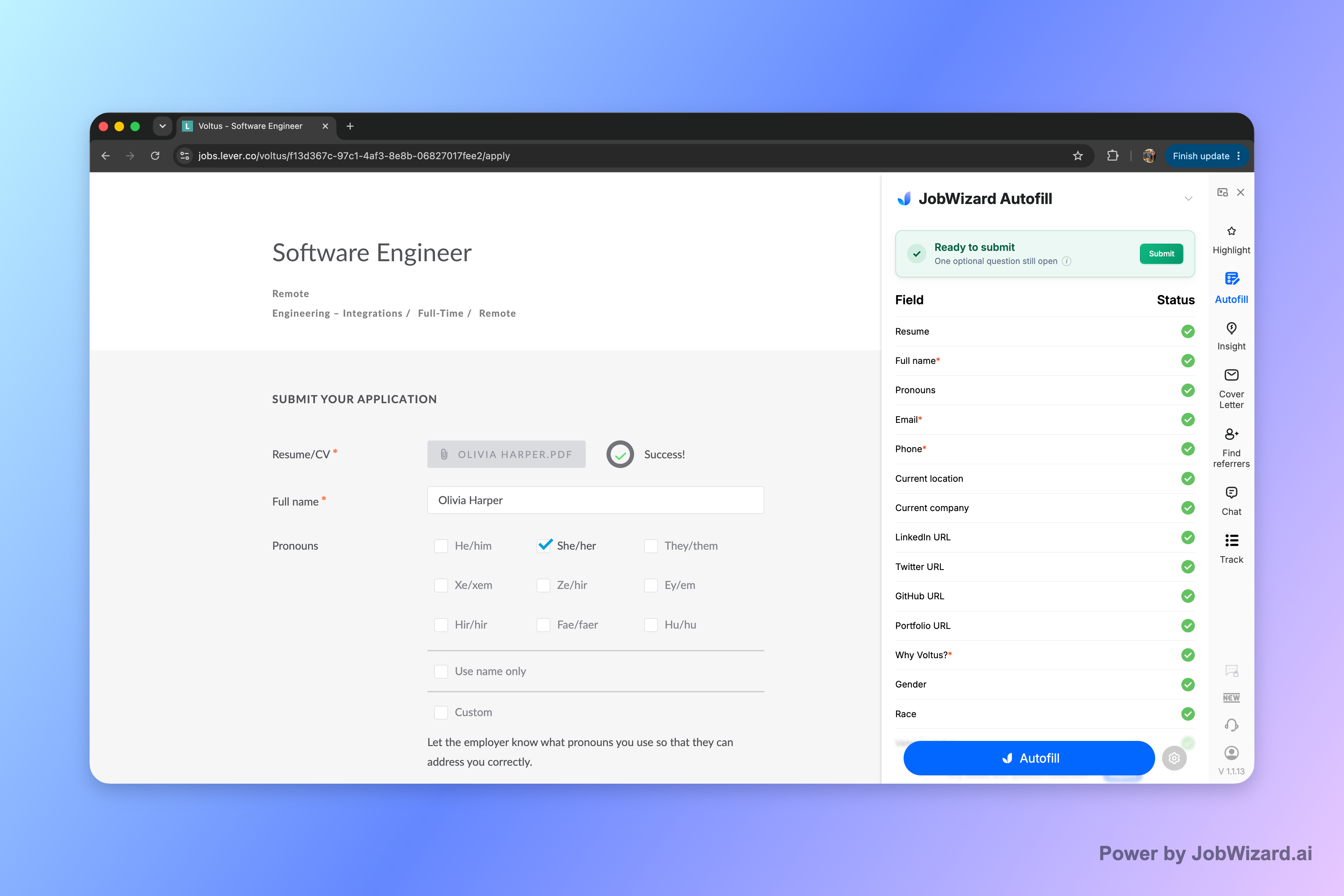
With JobWizard, the approach is different from auto-submit automation: it helps by autofilling the application fields you’re already on, and you review the content before you submit. That means you can catch anything that’s off—dates, titles, eligibility, and custom questions—before the employer receives it.
Think of the process like this:
- Open the application: Start on the employer’s form, where the required fields are visible.
- Autofill repetitive fields: Save time on the parts that repeat across applications (typical forms often include many repeated items).
- Review the decision-critical sections: Verify screening questions, any “required explanation” boxes, and anything that determines eligibility.
- Confirm the correct resume: Ensure the submitted document aligns with the role and the experience you claim in the form.
- Submit yourself: You press submit after the final check.
Across submitted applications and autofill sessions, JobWizard helps with repetitive fields while still supporting a review-before-submit process, not blind auto-submission.
Concrete examples: how bot mistakes happen in real job applications
To make the risk tangible, here are common scenarios where an automate jobs-style bot can create the exact kind of mismatch employers reject.
Example 1: Screening questions that override your resume
Imagine you’re applying for a role that asks: “Do you have X years of experience with Y?” If your resume supports it but the bot selects “No” based on a misread, you may be filtered out immediately. In this case, your review step is the difference between “you could pass” and “you never get reviewed.”
Example 2: The wrong date or title breaks consistency
Many forms ask for month/year ranges, job titles, or employment status. If a bot fills a start date incorrectly—or reuses a similar prior role title—it can look like you’re providing inaccurate information. A human recruiter may not verify every detail, but automated screening often uses strict matching.
Example 3: Resume version mismatch
Suppose you update your resume to reflect a recent project, then later you apply with a form that requires you to choose a file. If a tool selects an older version (or if it fails to align with what the form asks), your application might “say” you didn’t have that experience. Again, the issue isn’t that documents are hard—it’s that bots can’t reliably manage your intent and context.
Example 4: Custom questions that require nuance
Some employers ask open-ended questions like “Tell us about a time you…” or “Why this role?” Bots often respond with templated guesses. Even if the text is grammatically fine, it can be generic or mismatched to the specific posting. A reviewed workflow lets you quickly tailor the final answers in the moments that matter.
Trade-offs: what to keep from automation (speed) and what to avoid (auto-submit)
It’s reasonable to want to automate jobs because applications are repetitive. The trade-off is choosing where automation helps—and where it creates quality risk.
Most auto-submit tools (in general across the ecosystem) aim to reduce your manual effort. That can be useful for saving time on repetitive steps, but the risk increases when a tool sends answers without your review, especially for screening and custom questions that require accuracy.
Here’s how to think about the decision:
| Approach | Where it saves time | Where it can go wrong | Best-fit situation |
|---|---|---|---|
| Autofill + review-before-submit | Repetitive form fields while you’re on the application | You must still check decision-critical fields for correctness | When you want speed but accuracy on screening questions and eligibility |
| Auto-submit while you’re away | Manual submission steps and timing | Wrong answers, wrong documents, inconsistent data, and filter triggers | Only if you’re comfortable with reduced control over the final content sent |
JobWizard’s positioning fits the first option: autofill for speed, review for accuracy, then you submit. That structure is designed to reduce the “bot submitted the wrong thing” problem without claiming to replace your judgment.
How to move faster for “automate jobs” search intent without damaging your reputation
If your goal is to apply more consistently, your fastest path is a workflow that prevents preventable errors. In other words: build speed into the repetitive parts, and guard the submission.
Use this checklist as your last-mile quality gate:
- Verify screening fields: Eligibility, years of experience, location/work authorization, and consent/EEO selections.
- Confirm the resume: Make sure the chosen document matches the role and the experience you’re describing.
- Check custom questions: Replace generic answers with 2–4 sentences that reflect the specific posting.
- Scan for consistency: Dates, job titles, and project scope should align across the resume and the form.
- Submit yourself: Treat the final click as a verification step—because it is.
For additional guidance on job search strategy and application quality, you can also explore related posts on tightening your process and improving how you present your experience, such as how to tailor your resume for each job.
JobWizard CTA: If you want to keep applying at a steady pace, use JobWizard to autofill the repetitive application fields you’re already on—then review and submit yourself with confidence.
Do this automatically with JobWizard
Skip the manual work — JobWizard's Smart Autofill handles this for you.
FAQ: “automate jobs” and what to do instead of risky auto-submit
What’s the difference between autofill tools and “automate jobs” auto-submit bots?
Autofill tools (like JobWizard) fill repetitive application fields while you’re on the employer’s form. You review everything—especially screening, work history, and custom questions—then you click submit yourself. Auto-submit bots try to submit without your careful review, which increases the chance of wrong answers or mismatched documents going out.
What goes wrong when a bot submits for you?
Common failures include incorrect or incomplete screening-question responses, submitting the wrong resume or missing attachments, and triggering employer-side quality controls or spam filters due to inconsistent or repetitive application data. Even when the application “looks filled,” one wrong detail can cost you—especially if the role depends on specific eligibility or experience wording.
How can I still apply quickly without risking bot-style errors?
Use autofill to save time on repetitive fields, then treat the submit step as your quality gate. Review each section that requires judgment (screening questions, eligibility, compensation, EEO/consent, and any custom essay fields), verify the correct resume and work history, and only then submit yourself.
Is it safer to avoid any auto-application feature entirely?
If a tool submits while you’re away or without your review, the risk is higher because you can’t catch mistakes before submission. The safer workflow is “fill fast, review fully, submit yourself,” where you personally confirm the critical parts of the application.
Can incorrect autofilled answers hurt my chances even if I review before submitting?
Yes. Autofill can still populate fields with imperfect matches (for example, a wrong date, role title, or eligibility detail). The fix is to review line-by-line for anything that affects screening decisions, then make targeted edits before you submit.
Frequently Asked Questions
Autofill your next job application
JobWizard is a free Chrome extension that fills applications, tracks statuses, and optimizes your resume.