Jobcopilot pricing: what it costs matters less than what bots get wrong
Jobcopilot pricing is only half the decision. Learn what goes wrong with bot-based auto-apply—and why smart autofill + review (like JobWizard) can be the safer alternative.

Free Chrome extension
Autofill your next job application
JobWizard is a free Chrome extension that fills applications, tracks statuses, and optimizes your resume.
Jobcopilot pricing is easy to compare—but the real cost of auto-apply tools is what happens after the button gets pressed. Many “auto-apply” bots can mis-handle screening questions, mismatch the right resume to the right role, or generate submissions that look repetitive to employer systems. The safer workflow is simple: autofill fast, review every answer, and submit yourself.
If you’ve been searching for jobcopilot pricing, you’re probably deciding whether to pay for convenience—or whether that convenience creates risk. In this guide, I’ll break down what goes wrong with bot-based submission, how to check tool behavior without getting trapped by marketing, and why an autofill-then-review approach (like JobWizard) often produces cleaner applications.
Jobcopilot pricing won’t fix bot mistakes—here’s what goes wrong when a bot submits for you
The biggest problem with bot-style auto-apply is that pricing doesn’t change the failure modes. When a tool submits on your behalf, it has to guess or infer details you may not have explicitly provided in a machine-readable way—especially for screening questions and conditional fields.
Wrong answers to screening questions (the “sounds right” problem)
Screening questions are often the difference between “maybe” and “no.” Bots can pick incorrect options when questions require context—like role preference, eligibility timing, location constraints, or work authorization specifics. Even if the rest of your application is perfect, a single wrong selection can disqualify you.
- Default answers that don’t match your real situation
- Conditional logic that changes follow-up questions based on an earlier response
- Ambiguous fields where a human interpretation matters more than a keyword match
Mismatch between your resume and the job (wrong “fit” signals)
Auto-apply flows often assume the same resume will work for every posting. In reality, job descriptions vary: skills, seniority level, and tool experience can shift quickly. If the wrong resume ends up attached, recruiters may see an inconsistent story—even if you intended to submit a different version.
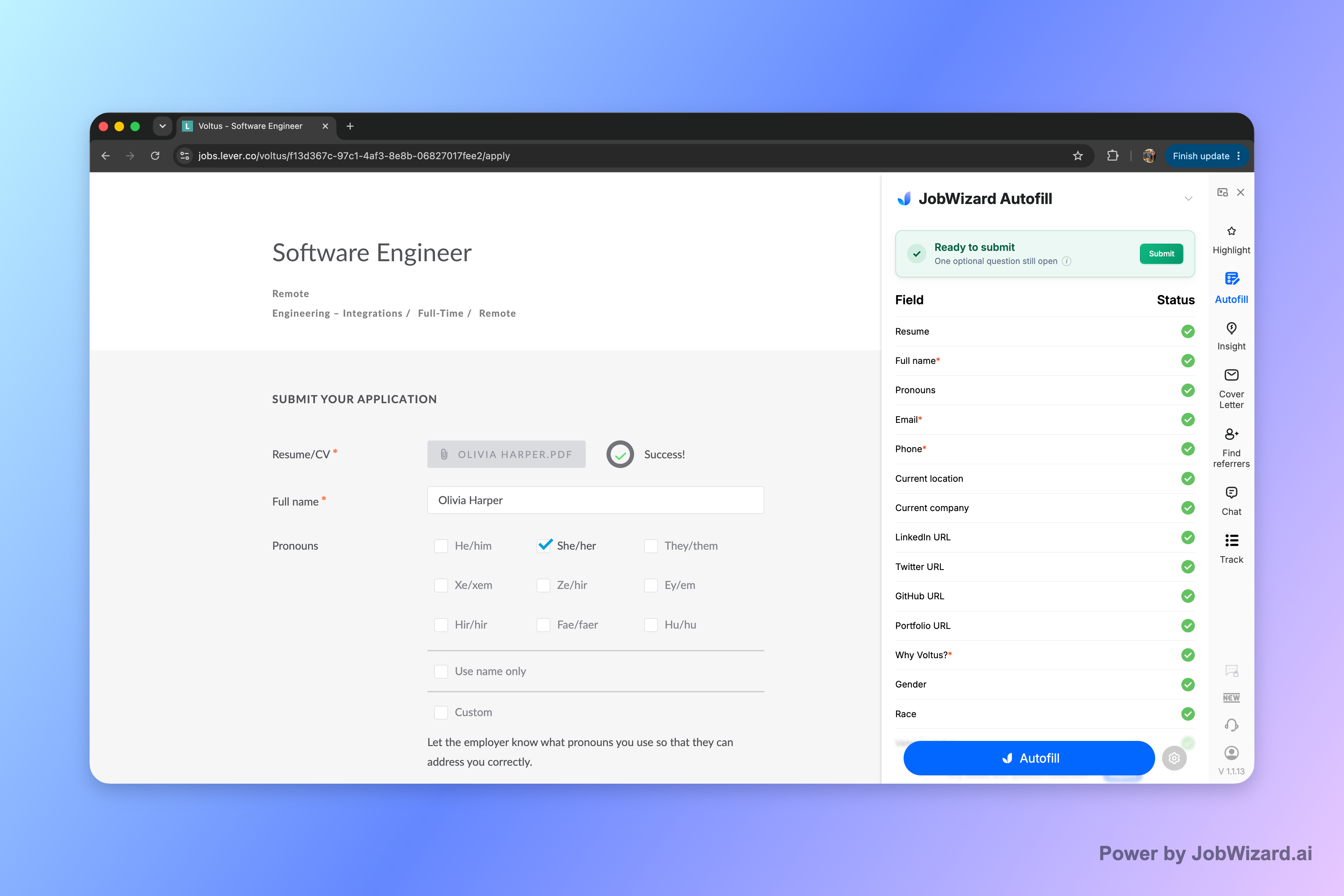
JobWizard’s approach is to help with autofill on the page you’re applying to, while keeping final control in your hands. Specifically, it uses saved profile and resume data to fill detected fields and then you review before submitting. When a required field needs attention, it can identify it so you can jump directly to the matching question.
Employer-side spam filters (you don’t want your dream employer to view you as noise)
When submissions are automated—especially at scale—employer systems can treat them as low-effort traffic. Even without “malicious intent,” repetitive patterns or inconsistencies can trigger scrutiny. The longer-term cost can be fewer replies and reduced trust with companies you genuinely want.
JobWizard’s workflow is autofill + review-before-submit, not blind auto-apply. That difference matters because it keeps your final submission aligned with your real answers.
Damaged reputation with a company you actually want
Some companies are selective about communication quality. If a bot submits an application with incorrect or mismatched details, you’re not just risking rejection—you’re potentially creating a perception problem. And since you can’t fully “un-send” a submission, the safest move is to prevent avoidable errors at the source.
How to evaluate jobcopilot pricing: compare behavior, not just cost
If you’re shopping for jobcopilot pricing, don’t stop at the number. Instead, confirm what the tool does to your application before it’s sent.
Checklist: what you should verify before paying for an auto-apply tool
- Does it ever submit without you? If the tool can submit on its own, treat that as a major risk area for screening accuracy.
- Are you reviewing every populated answer? A good workflow is: fill repetitive fields, then read and confirm before submission.
- How are required fields handled? If required fields need attention, you should be able to quickly identify and correct them.
- Does it support the platforms you use? If you frequently apply on Workday, Greenhouse, Lever, or Ashby, you’ll want reliable autofill behavior there.
JobWizard has been used heavily for the “autofill + review-before-submit” pattern: more than 720,000+ applications have been submitted through it and over 600,000+ autofill sessions have been run. Autofill typically covers around ~18 repetitive fields per application (usually 11–23), which is exactly where time is lost—while the user still reviews sponsorship/salary/EEO/custom questions before submitting.
For platform mix, about ~65% of submitted applications are on Workday, ~19% on Greenhouse, ~12% on Ashby, and ~4% on Lever—where Workday is where it saves the most time.
Where “premium” convenience can become expensive—emotionally and strategically
Buying jobcopilot pricing based on speed alone can backfire if the tool creates extra fixes or rejections. A few incorrect screening answers can waste the effort you put into tailoring your resume. The goal is to reduce the repetitive typing burden without trading away accuracy on the questions that decide outcomes.
Jobcopilot pricing vs a safer workflow: autofill fast, then submit yourself
The alternative to bot-based submission is not “no automation.” It’s controlled automation: fill what can be filled quickly, then verify the rest.
The approach that keeps you in control
JobWizard’s smart autofill works by filling detected fields on supported application pages using your saved profile and resume data. Then you review the populated fields and submit the application yourself. It also supports a human-in-the-loop correction step—if a required field still needs attention, it can identify it so you can jump to the exact question.
- Repetitive fields get filled quickly (the “copy/paste” part)
- High-impact fields stay under your review (screening answers, custom questions)
- You decide what gets submitted, so you prevent avoidable mismatches
What this means in practice (a concrete mini-scenario)
Imagine you’re applying to two roles at the same company: one is “Senior Backend” and the other is “Backend (Platform).” An auto-submit bot could reuse the same resume and guess answers for eligibility or location. If you instead use autofill + review, you can ensure the resume and screening selections match each posting’s requirements.
Even if you’re applying quickly, you’re still doing the most important step: verifying every filled response before it’s sent.
Do this automatically with JobWizard
Skip the manual work — JobWizard's Smart Autofill handles this for you. On these platforms: JobWizard vs JobCopilot.
FAQ: jobcopilot pricing and the auto-apply trade-off
Is jobcopilot pricing the main thing to compare before you use an auto-apply tool?
No—price can change, but the failure modes stay the same. Focus on whether the tool autofills fields for you and then lets you review before submission, or whether it can submit on its own.
What are the most common ways bots get screening questions wrong?
Bots often choose default or mismatched answers for screening questions (for example, employment dates, eligibility, location, or work authorization) because they can’t fully interpret your context the way you can.
How do employer-side spam filters and reputation issues come into play?
If a tool triggers unusually repetitive or inconsistent submissions, it can look like low-effort spam. That can lead to delays, fewer callbacks, or internal review—especially at companies you actually want to impress.
What should I do instead of letting a bot submit automatically?
Use an autofill-then-review workflow: fill repetitive fields quickly, then read every populated answer and submit yourself once everything is correct.
How is JobWizard different from true auto-submit bot behavior?
JobWizard autofills application fields on the page you’re on, then you review and submit. It never submits by itself, never mass-applies, and won’t apply while you’re away.
Want the autofill-then-review workflow for your next application? Start with How to Autofill Job Applications (Step-by-Step with JobWizard), then check JobCopilot Review What to Check Before Paying for Auto-Apply (Do the Right Kind of Autofill) and compare with aiapply.co pricing: What to know before you use an auto-apply bot as well as LazyApply Pricing: What You Really Pay For When a Bot Applies for You. Try JobWizard to fill the repetitive fields in seconds, review every answer, and submit yourself.
Frequently Asked Questions
Autofill your next job application
JobWizard is a free Chrome extension that fills applications, tracks statuses, and optimizes your resume.