Web Strategist Resume Keywords That Get Past ATS (and Win Interviews)
Learn how to find and use web strategist resume keywords—starting with your target job description—so your resume reflects the responsibilities and qualifications hiring managers look for.

Free Chrome extension
See your resume's match score for any job
JobWizard compares your resume to each job description and shows the exact keywords to add — free.
Web strategist resume keywords start with the job description, not guesswork
If you’re searching for web strategist resume keywords that help your resume feel “relevant,” your best starting point is the job description itself—because that’s where the hiring team’s responsibilities, qualifications, and wording live.
Think of keywords as the bridge between what you’ve done and what the role is asking for. Your goal isn’t to stuff buzzwords; it’s to use the same language where it’s genuinely true. To do that, you need a repeatable process for extracting requirements from the JD and then editing your resume so it reflects your actual experience.
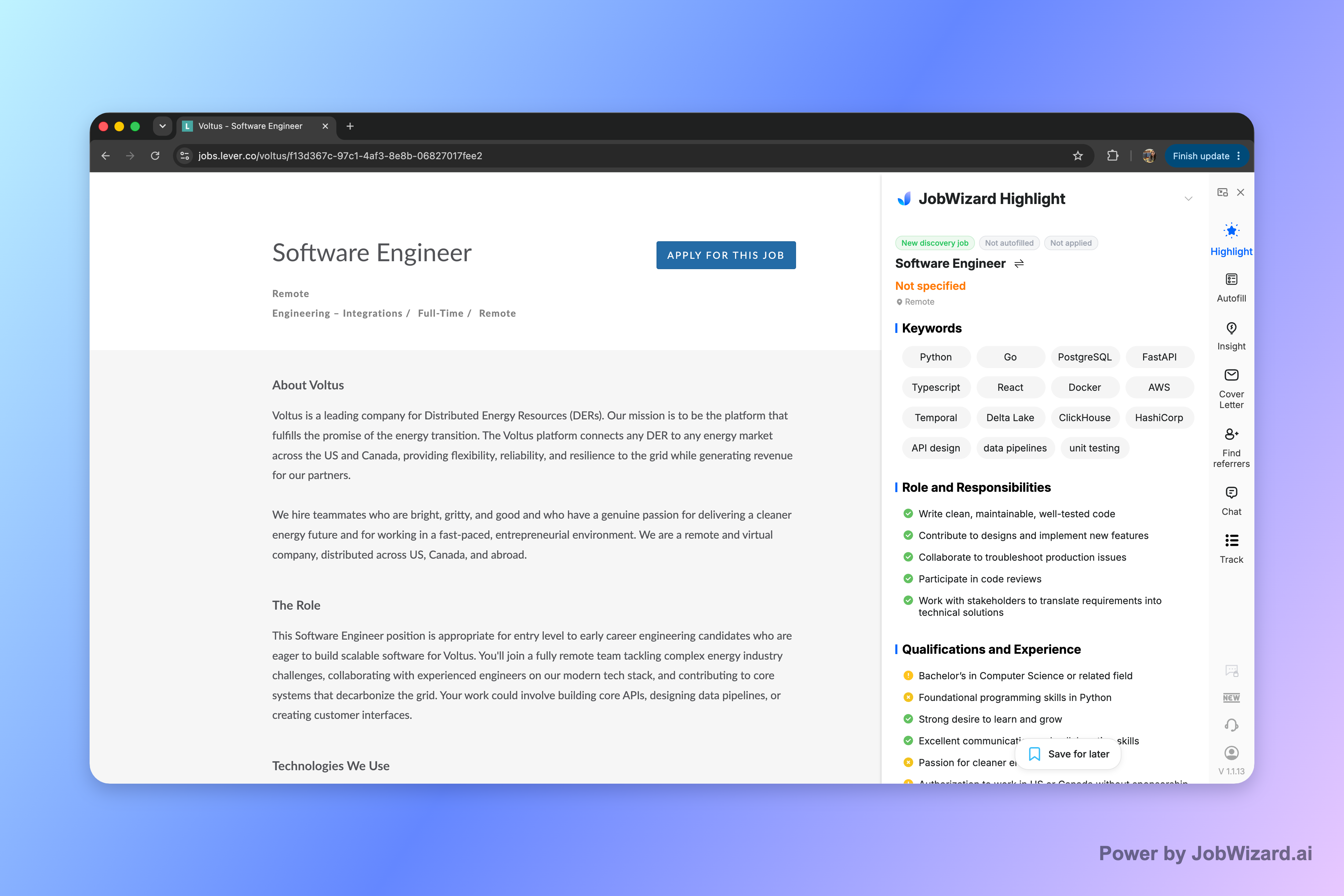
JobWizard can organize a long job description into keywords, role responsibilities, and qualifications so you can review requirements more systematically—so you’re not hunting manually across a wall of text.
Turn a web strategist job description into a keyword checklist (then map it to your experience)
The fastest way to find web strategist resume keywords is to convert the JD into categories you can actually audit: keywords, responsibilities, and qualifications.
Follow this workflow the next time you apply:
- Extract the responsibilities the role expects day-to-day (for example, performance, experimentation, site optimization, or conversion work).
- Extract the qualifications (years of experience, specific methodologies, stakeholder collaboration, or required tools).
- Extract the keyword phrases as written (including titles, competencies, and commonly repeated requirements).
- Map each item to your proof by adding a truthful bullet or a skills mention that matches your real work.
- Keep “sponsorship”/policy/custom questions human—don’t let automated wording replace your review. You should always verify accuracy before you submit.
Here’s what this looks like in practice for a typical web strategy role.
| JD requirement area | What to extract (examples of keyword types) | Where it goes on your resume | What “good” looks like |
|---|---|---|---|
| Responsibilities | Conversion rate improvement, testing/experimentation, UX/content alignment, analytics-informed optimization | Experience bullets (start with action + outcome) | You describe work you’ve done using JD-aligned phrasing. |
| Qualifications | Experience level, tool familiarity, cross-functional collaboration, reporting cadence, experimentation rigor | Summary + Skills + selected experience bullets | You include only what you can support confidently. |
| Keyword phrases | “web strategy,” “site optimization,” “measurement,” “conversion,” platform names, or internal process names | Skills section and/or resume bullets | You match phrasing when it’s accurate, not because it’s trending. |
Pro tip: if the JD uses a specific term (like “content-to-conversion alignment” or a named analytics platform), you can incorporate it as long as your experience supports that language. If you’ve done similar work but under different wording, translate carefully—accuracy first, then clarity.
Use an insight workflow to spot expression gaps and revise efficiently
Once you’ve extracted the role’s requirements, the next step is to check where your resume wording doesn’t reflect what the web strategist job description is asking for—this is where “tailoring” becomes practical.
JobWizard Insight compares your selected resume with the current job description and presents an overall assessment, improvement suggestions, and a match score. It can also turn JD-based diagnosis into an editable resume revision draft.
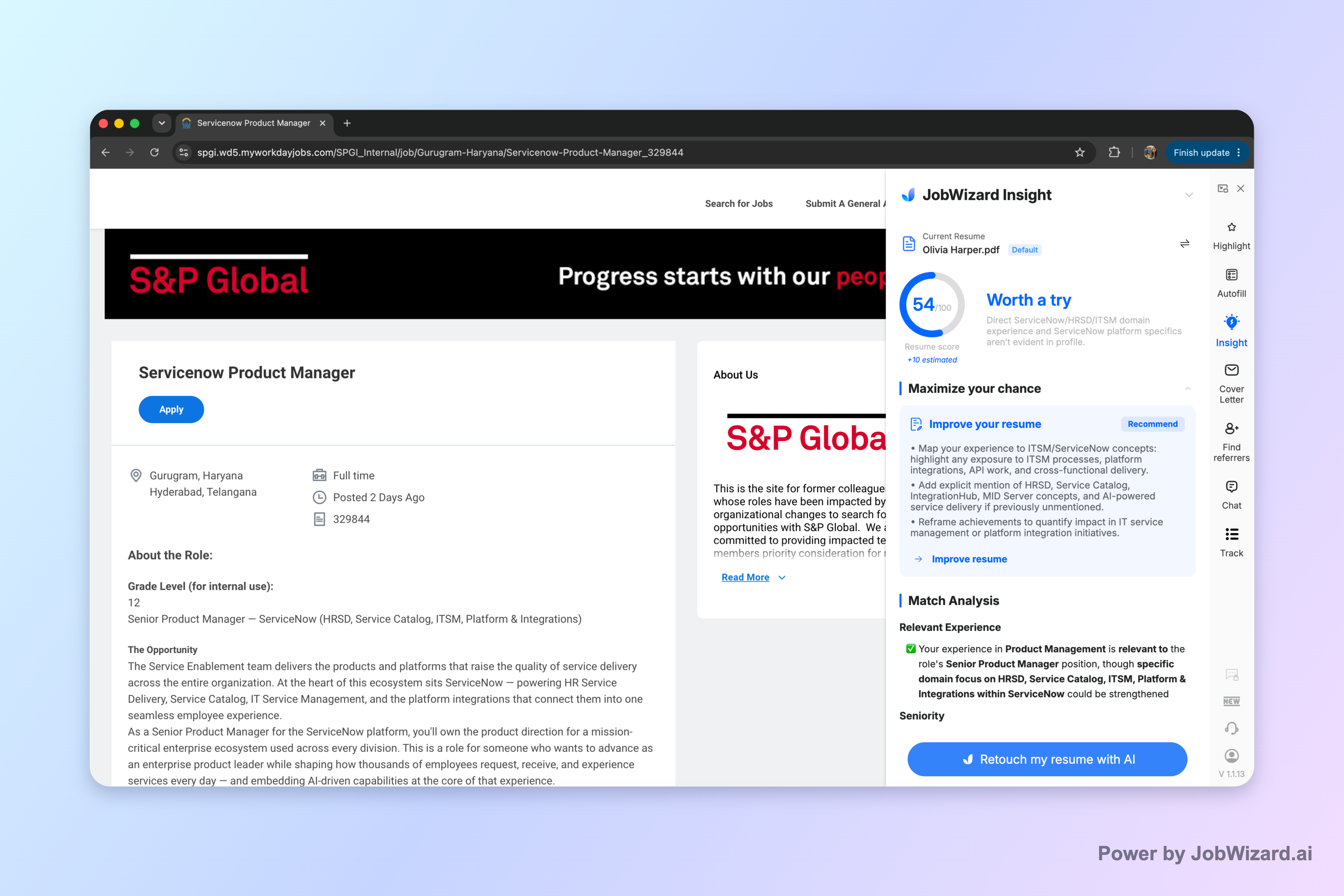
Insight helps you identify resume expression gaps—so you can revise the exact sections that need alignment, rather than rewriting your entire resume from scratch.
What to do with the match score (and what not to do)
A match score is useful for prioritizing revisions, but it’s not a hiring probability. It doesn’t guarantee ATS passage or an interview, and you must verify every suggested resume change and keep only accurate experience.
So use it like this:
- Prioritize the biggest gaps first (the sections the diagnosis suggests are most out of sync).
- Verify every change before you adopt it—don’t “borrow” skills you don’t have.
- Translate, then refine: if you did the work differently, rewrite it to match the JD’s phrasing without misrepresenting your role.
- Keep your proof intact: metrics, project scope, and stakeholders should reflect your real background.
Where web strategist keyword alignment usually hides
Most resumes look fine at a high level but miss keywords in the “middle,” like:
- Skills section granularity (listing capabilities like analytics, experimentation, and optimization in a way that mirrors the JD’s wording)
- Experience bullet structure (starting bullets with action verbs and tying them to the web strategy responsibilities from the JD)
- Summary wording (including a short, accurate positioning statement that reflects the role’s qualifications)
As you revise, aim for alignment that reads like you—just with the job description’s requirements reflected clearly.
Build a web strategist keyword bank you can reuse across applications
A keyword bank helps you tailor faster while staying accurate—because you reuse proven phrasing patterns instead of reinventing each resume from scratch.
Start by creating a list of keyword categories that show up across web strategist postings. Then keep them grouped so you can quickly update your resume for each new JD.
| Keyword bank category | What to capture (examples) | How to apply it to your resume | Common mistake to avoid |
|---|---|---|---|
| Measurement & analytics | Measurement, reporting, performance insights, analytics-informed optimization | Add to Skills and include one bullet that shows how you used insights to make decisions | Listing tools without connecting them to responsibilities |
| Experimentation & improvement | Testing, experimentation, iterative optimization | Use experience bullets that mirror experimentation responsibilities from the JD | Including experimentation language with no supporting project context |
| UX/content conversion | Conversion, user experience, content-to-conversion alignment | Reference collaboration with content/design/UX stakeholders in relevant bullets | Overstating ownership if you only influenced recommendations |
| Cross-functional delivery | Stakeholder collaboration, prioritization, roadmap input | Pinpoint how you partnered with marketing/product/engineering | Writing generic “collaborated with teams” statements |
| Tech/tool familiarity | Platforms and named tools mentioned in the JD | Only list tools you used; weave them into bullets when possible | “Keyword dumping” a tool list with no usage proof |
When building your bank, treat each entry like a template you must verify. If a keyword appears in the JD, you can mirror it—but only after you confirm it matches your real experience.
Tailor your resume for ATS and humans with a repeatable checklist
Good web strategist resume keywords strategy means your resume is legible to humans and structured for ATS-style matching.
Use this final checklist before you submit:
- Mirror the JD’s keyword categories (responsibilities, qualifications, keyword phrases) in the right sections of your resume.
- Make bullets evidence-based so each keyword maps to something you actually did.
- Keep terminology consistent (use the same names for tools/methods when accurate).
- Confirm you didn’t add anything untrue—tailoring should improve clarity, not rewrite your history.
- Review before any application submission and ensure custom questions, EEO/salary/sponsorship-type fields are answered correctly.
If you want to sharpen your ATS thinking further, use these related guides to compare approaches across roles:
- How to Optimize Resume for ATS: A Practical 2026 Checklist (general ATS structure and targeting steps).
- Property Management Resume Keywords That Beat ATS: Match JD Terms to Real Experience (useful for understanding how to map job description phrasing to your experience).
- Mechanical Engineer Resume Keywords: JD-Driven ATS Terms (Plus a Match Score Workflow) (for learning how “match” logic can guide edits).
- Business Intelligence Resume Keywords That Beat ATS: JD-Matched Phrases for Real Work (helps with keyword selection discipline).
Real-world use (so you can trust the workflow): JobWizard has supported 720,000+ applications submitted and 600,000+ autofill sessions. On average, autofill fills ~18 repetitive fields per application (typically 11–23). Across those submitted applications, ~65% are on Workday, ~19% Greenhouse, ~12% Ashby, and ~4% Lever—Workday is where it saves the most time. Autofill + review-before-submit means repetitive fields are filled quickly while user-verified sponsorship/salary/EEO/custom questions stay under your control.
Keywords win faster when your application process is efficient and your edits are deliberate: autofill can help with repetitive fields, but your keyword alignment still comes from tailoring your resume to the specific job description.
Do this automatically with JobWizard
Skip the manual work — JobWizard's Match Score handles this for you.
FAQ: Web strategist resume keywords (quick answers)
What are web strategist resume keywords, and where do I find them?
Web strategist resume keywords are the specific skills, tools, responsibilities, and qualifications that appear in a job description for a web strategist role. Use the job description to extract the responsibilities, qualifications, and keyword phrases—then mirror them (where accurate) in your experience and skills sections.
Should I add every keyword from the job description to my resume?
No—only add keywords when they accurately match your real experience. A good workflow is to use the job description to identify expression gaps, then revise wording only where it’s truthful (and keep any must-have details you can support during interviews).
Does an ATS “match score” guarantee I’ll get an interview?
No. A match score is an overall assessment and improvement suggestions, but it’s not a hiring probability and doesn’t guarantee ATS passage or an interview. You still need to verify every suggested change and keep only accurate experience.
How do I tailor my web strategist resume without rewriting everything?
Use a two-step approach: (1) pull the role’s key requirements from the job description (responsibilities + qualifications + keyword phrases) and (2) compare your current resume to identify the biggest expression gaps. Then revise those sections into an editable draft, keeping your factual experience intact.
Ready to tailor smarter for your next web strategist application? Open the target job description, extract its responsibilities and qualifications, then use JobWizard Insight to compare your resume against it and revise the biggest keyword gaps before you submit.
Frequently Asked Questions
See your resume's match score for any job
JobWizard compares your resume to each job description and shows the exact keywords to add — free.