Convert Resume into Keywords That Win ATS Screening: A Step-by-Step Workflow
Learn how to convert resume into keywords your target job description is actually looking for. Use a practical JD-to-resume workflow and verify every change before you apply.
Free Chrome extension
See your resume's match score for any job
JobWizard compares your resume to each job description and shows the exact keywords to add — free.
Convert resume into keywords by mapping each job requirement to a truthful resume bullet—not by guessing
If you want to convert resume into keywords that actually fit a specific job post, start with a simple rule: every keyword you add must be supported by something you can point to in your experience. Otherwise, you’ll end up with “keyword stuffing” that doesn’t help you qualify for the role.
In practice, this means translating a job description’s requirements into resume language you can defend. You’re not trying to trick an ATS—you’re trying to make your resume easier to match against the role’s expectations.
Here’s the workflow to follow: identify what the job is asking for, convert those requirements into keyword-aligned resume phrasing, and then review-before-you-apply so your final version stays accurate.
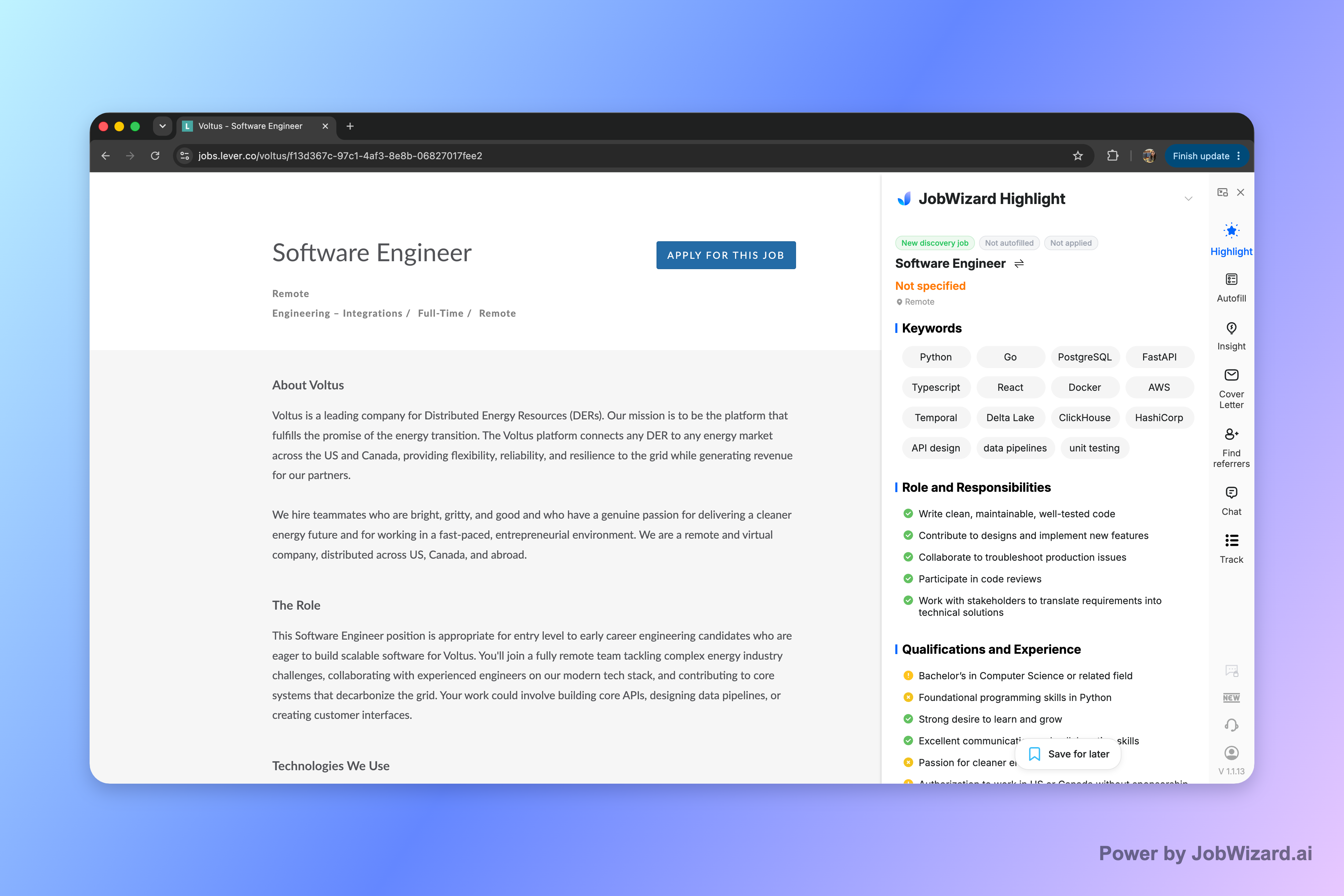
Start by organizing the job description. JobWizard’s JD Highlights can turn a long job posting into a structured view of the role’s key requirements so you can review responsibilities and qualifications more systematically.
Turn the job description into a keyword list you can translate (JD Highlights + categories)
The fastest way to convert resume into keywords is to build your keyword list from the job description itself, then translate it into your resume categories. When you don’t do this, you’ll pull keywords from random sources and miss what that employer actually cares about.
Use a simple categorization method based on what the posting provides:
- Responsibilities: actions you’ll perform (e.g., “analyze,” “own,” “build,” “partner,” “improve”)
- Qualifications: proof you have done related work (e.g., experience level, skills, tools, certifications)
- Job requirements / requirements language: the exact wording they use for what “good” looks like
As you convert the job description into categories, copy the key phrases that signal requirements—not just generic buzzwords. Look for recurring structures such as:
- Tool or platform mentions (e.g., systems, frameworks, reporting tools)
- Skill clusters (e.g., stakeholder management, data analysis, testing, incident response)
- Experience scope (e.g., “end-to-end,” “enterprise,” “cross-functional,” “production”)
Then, build a mapping table for yourself (even if you don’t use a tool). The goal is to create a clean “keyword → evidence” link.
| Keyword/Requirement Phrase | Where it appears in the JD | Your Evidence (bullet/task) | How you’ll phrase it |
|---|---|---|---|
| “Build and maintain dashboards” | Responsibilities | Created weekly reporting dashboards in X | “Built dashboards in X to track Y metrics” |
| “SQL for analysis” | Qualifications | Wrote SQL queries to segment customers | “Used SQL to analyze customer behavior and trends” |
| “Work cross-functionally” | Requirements language | Partnered with Product and Sales | “Partnered with Product and Sales to…” |
This mapping step is what makes convert resume into keywords meaningful: you’re not copying words blindly—you’re linking wording to accurate work.
Convert your resume content into keyword-aligned bullets using a “responsibility-to-proof” rewrite
Once you have keyword targets from the job posting, the actual conversion is a rewrite exercise: take each relevant resume bullet, adjust the phrasing to match the requirement language, and ensure the meaning stays true.
Think “responsibility-to-proof.” If the job expects an action, your resume should show that action plus a believable context and outcome you can stand behind. You can do this without making up metrics—focus on what you actually did and the tools/processes you used.
A practical rewrite formula (use it for 80% of bullets)
For each target keyword, rewrite one bullet using this order:
- Action: mirror the job’s responsibility verb (analyze, build, design, lead, automate)
- Method/tool: include the specific skill/tools the JD calls out
- Scope: add the relevant scope terms (cross-functional, end-to-end, production, enterprise)
- Result you can defend: state what improved or what was delivered, in honest terms
Example: converting a resume bullet for keyword alignment.
- Job requirement phrase: “Analyze customer behavior using SQL”
- Your original bullet: “Used SQL to pull customer data and help the team.”
- Keyword-aligned rewrite: “Analyzed customer behavior using SQL by pulling and segmenting datasets to support product decisions.”
Notice what changed: the meaning is the same, but the phrasing now mirrors the responsibility and the keyword expectation (“analyze,” “customer behavior,” “SQL”). That’s the core of convert resume into keywords—alignment, not fabrication.
Where to place converted keywords (so they’re actually visible)
ATS matching depends on visibility, but humans do too. After you convert keywords, place them where they make sense and read cleanly:
- Experience bullets: best place for responsibilities, tools, workflows, and scope terms
- Skills section: best place for tool names and skill categories (only what you can support)
- Projects: useful for keyword conversion when your experience is indirect or early-career
- Certifications: strong evidence for qualification keywords
If you add a keyword only in the Skills section but never reflect it in bullets, your resume may look inconsistent. Aim for consistency: keywords should show up in the story you’re telling.
Use match insights to find “expression gaps” when converting resume into keywords
Sometimes you already have the experience—but your resume describes it differently than the job description. That’s where “expression gaps” matter when you convert resume into keywords.
JobWizard’s Insight / Match Score can compare the selected resume with the current job description and present a match score, an overall assessment, and improvement suggestions. It can also diagnose resume expression gaps and turn them into an editable resume revision draft.
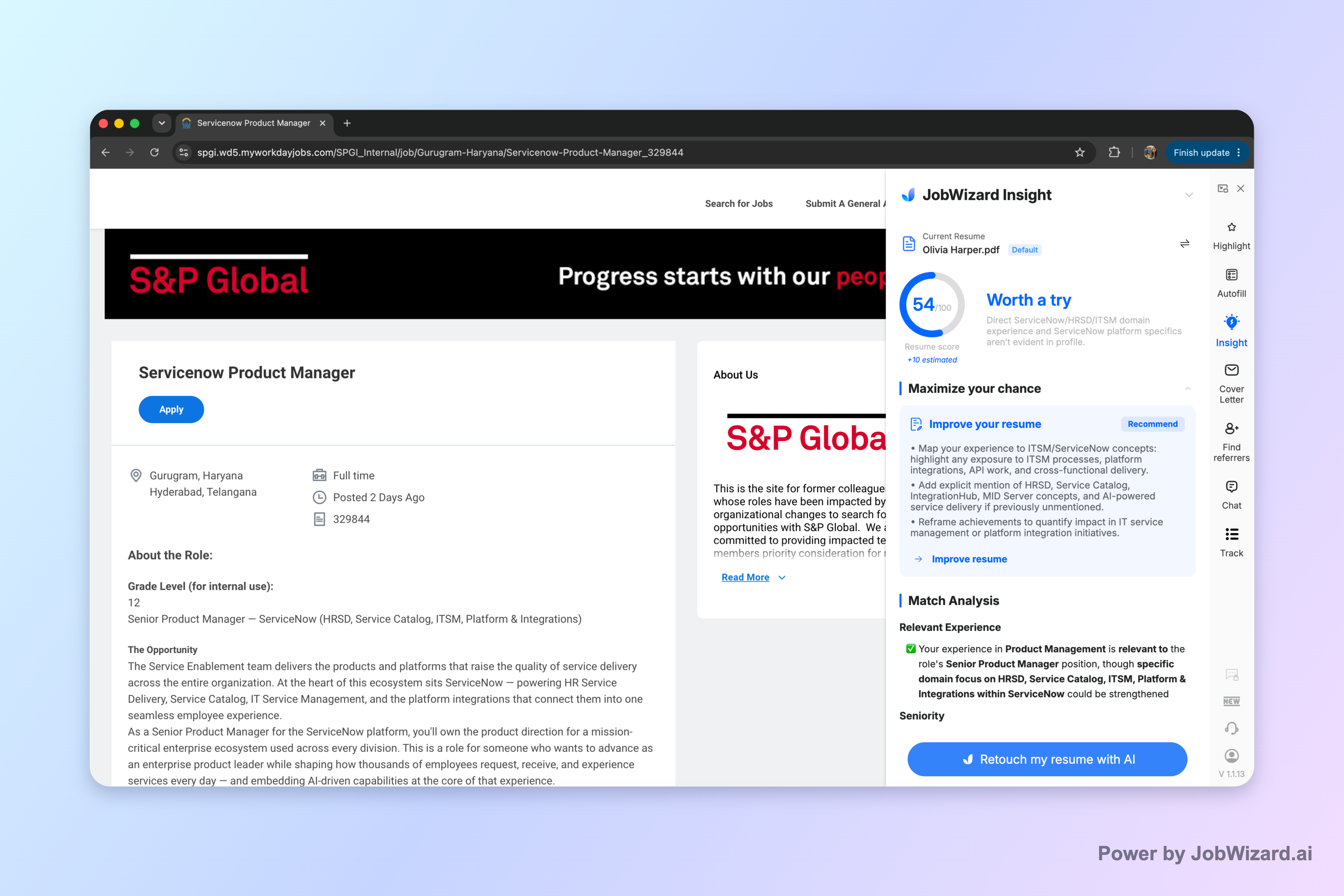
When you see the gaps, use them as a rewrite checklist. The key is that you still verify every suggested resume change and keep only accurate experience—no blind acceptance.
How to use match insights without losing accuracy
When you apply keyword conversion suggestions, follow a “review-before-submit” mindset:
- Check meaning: does the suggested change still describe your real work?
- Check scope: did your responsibility match the JD’s scope (team size, system ownership, project phase)?
- Check tools and labels: do you genuinely use the tools/technologies named?
- Check chronology and role: does it fit the time period and your job title?
This is also why you should treat keyword conversion as alignment work for your target role—not as a guarantee. The goal is to help your resume reflect what the posting requests.
Limitations to keep in mind: Insight’s score is not a hiring probability and does not guarantee ATS passage or an interview. You must verify every suggested resume change and keep only accurate experience.
ATS-friendly keyword conversion checklist (so you can apply with confidence)
Before you submit, run a quick verification pass to ensure your converted keywords are truthful and well-placed. This is the difference between “sounds right” and “matches the job description.”
Use this checklist every time you convert resume into keywords for a new role:
- Coverage: each major qualification from the job description has at least one relevant reference in your resume (bullet, skills, project, or certification)
- Consistency: keywords appear in the experience story (not only the Skills section)
- Truth check: every tool/skill/experience claim matches your real background
- Specificity: you included the job’s terminology where it reflects your actual responsibilities
- Readability: bullets still sound like you—no unnatural keyword strings
If you want a simple way to start, convert just 6–10 of the most important requirements first (from responsibilities and qualifications). Then refine additional bullets once your core match is aligned.
For the final step, apply with your reviewed resume. If you’re using tools that help organize job requirements and compare your resume to the JD, remember: they assist with analysis and draft suggestions—you are still responsible for accuracy.
Do this automatically with JobWizard
Skip the manual work — JobWizard's Match Score handles this for you.
FAQ: Convert resume into keywords
How do I convert my resume into keywords without stuffing?
Convert resume into keywords by mapping each keyword to a specific, accurate part of your experience (job duties, tools, metrics, or certifications). If you can’t back a keyword with your real experience, leave it out—and verify every edit before submitting.
What’s the best way to turn a job description into keywords for my resume?
Use the JD Highlights approach: break the job description into requirements categories (responsibilities and qualifications) so you can review the requirements more systematically. Then translate those requirements into resume language that reflects your actual work.
What is an “expression gap” when converting resume into keywords?
An expression gap is when your experience is relevant, but it’s described differently than the job description. Insight compares your resume to the job description, shows a match score and improvement suggestions, and can generate an editable revision draft—then you review and keep only changes that are accurate.
Will using keyword conversion tools guarantee I pass ATS or get interviews?
No. Converting resume into keywords can help align wording to a specific job posting, but it doesn’t predict an ATS decision or guarantee hiring outcomes. You should verify every suggested change and submit yourself.
How can I verify that the keywords I added are still truthful?
After you convert resume into keywords, cross-check each added keyword against your original resume bullets and facts (titles, dates, tools, certifications, and scope). If any change stretches the truth, remove or rewrite it to accurately describe what you did.
Ready to convert resume into keywords for your next application? Open the target role and review its responsibilities, qualifications, and keywords—then use JD Highlights and Insight to turn job requirements into an editable, keyword-aligned resume draft you can verify before you submit.
Frequently Asked Questions
See your resume's match score for any job
JobWizard compares your resume to each job description and shows the exact keywords to add — free.