ATS Resume Optimization Tips That Actually Improve Your Match Score
Use these ats resume optimization tips to align your resume with the job description, close expression gaps, and improve your match score—without risking accuracy.
Free Chrome extension
See your resume's match score for any job
JobWizard compares your resume to each job description and shows the exact keywords to add — free.
If you’re wondering why your resume isn’t getting interviews, the issue is often ats resume optimization tips—not a “bad resume.” ATS systems and recruiters heavily rely on how well your document matches the language and requirements in each job description.
This guide shows you a practical workflow: what to optimize, what to ignore, and how to use a match-style comparison responsibly so your updates are accurate—not made-up. You’ll also see where your resume might have expression gaps, and how to turn them into a clean, editable revision.
Start with a job-description comparison (not guesses) to guide your ATS resume optimization tips
The fastest way to improve outcomes is to build your edits from the job description you’re applying to, line by line. Instead of relying on vague “keyword stuffing” advice, compare your current resume against the specific requirements for that role.
With JobWizard Insight, you can compare the selected resume with the current job description and get an overall assessment plus improvement suggestions. The JD-based diagnosis can identify resume expression gaps and turn them into an editable resume revision draft—so you know exactly what might be missing and why.
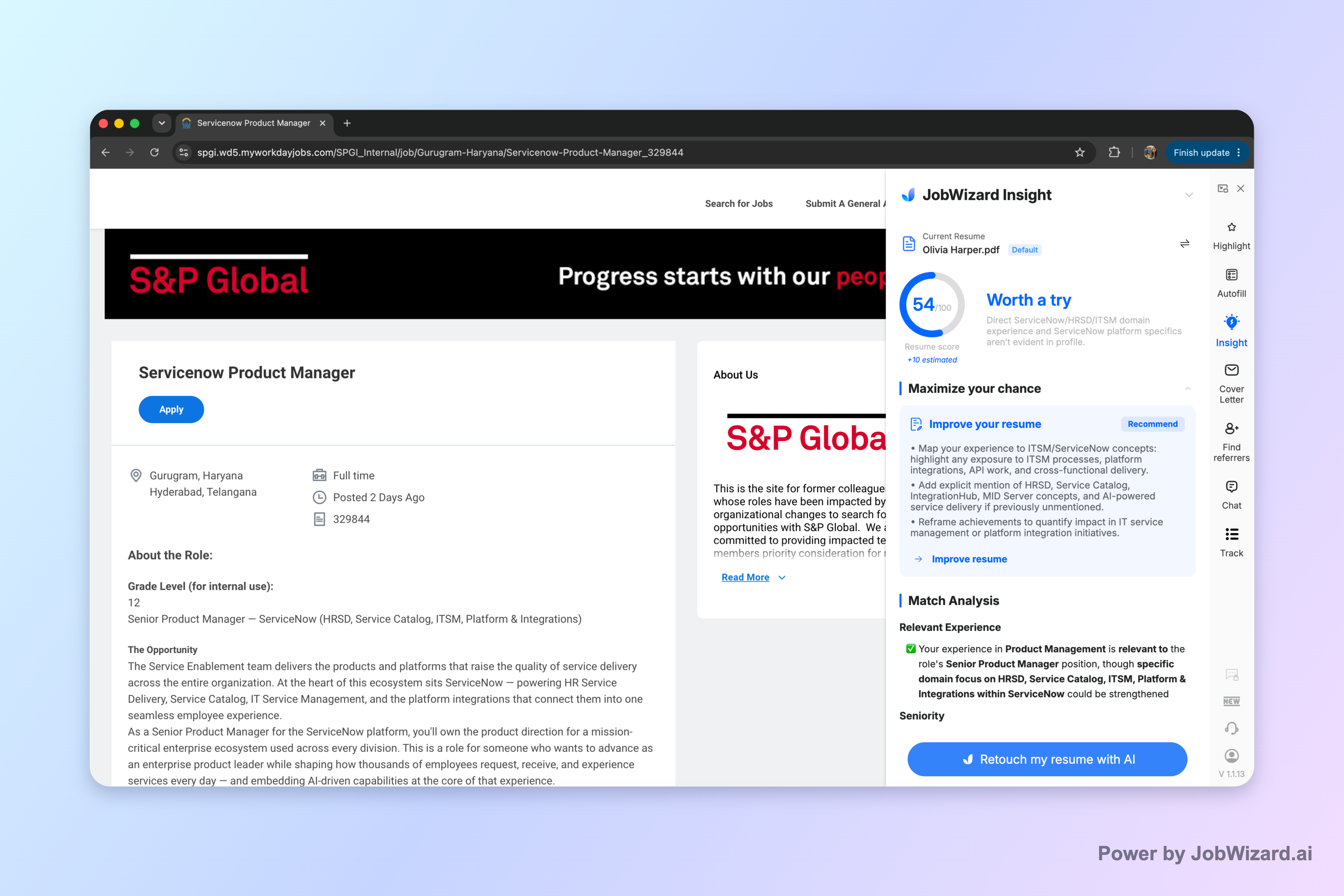
Key reminder: the match score is not a hiring probability and it doesn’t guarantee ATS passage or an interview. You still need to verify every suggested resume change and keep only accurate experience.
To make this comparison actionable, focus on categories that commonly drive “skills gap” concerns:
- Skills and tools: Are the same (or clearly equivalent) competencies shown where you talk about accomplishments?
- Responsibilities: Do your bullet points describe the work the role actually names?
- Qualifications: Do you reflect education, certifications, or experience requirements as stated?
- Formatting targets: Is your resume structured so the relevant details are easy to parse and scan?
If you want a deeper baseline on formatting and structure, start with the pillar guide: How to Optimize Resume for ATS: A Practical 2026 Checklist.
Optimize your resume sections so the right information lands where ATS looks
“ATS-friendly” isn’t one trick—it’s about making sure each resume section is legible, complete, and mapped to the job description. These ats resume optimization tips work best when you treat your resume like structured data, not a creative poster.
Here’s a section-by-section approach that keeps your resume readable for systems and for humans.
Professional summary (or opener)
Your summary should reflect the job’s reality, not generic branding. Use it to mirror the role’s focus (domain, seniority, key skills) so the rest of the resume “proves” it.
- Do: match core keywords from the job description where you genuinely qualify.
- Don’t: list everything you’ve ever used; keep it role-relevant and specific.
Skills section (make it scannable and accurate)
Use a skills section to reflect the categories the employer expects, especially tools/technologies and role competencies. This is one of the easiest places to correct expression gaps.
- Do: group related skills (e.g., “Analytics Tools,” “HR Systems,” “Design Tools”) if the job description signals those groupings.
- Don’t: pad with unrelated terms just to chase an ATS keyword.
Experience bullets (turn responsibilities into evidence)
Experience is where you win. Your bullets should describe what you did, the scope, and results—using wording that aligns with the job description’s responsibilities.
When you update bullets from an Insight-style diagnosis, keep the draft editable and verify it against your real experience. If a suggestion doesn’t match your history, replace it with an accurate version—even if the language isn’t identical to the job post.
- Find the job’s repeated responsibilities: Use them as headings or anchors for your bullet themes.
- Rewrite bullets for clarity: Make sure each bullet contains a skill + action + context.
- Map the proof: Add measurable or specific outcomes where you can accurately do so.
- Cross-check accuracy: Verify every change before submitting.
Education, certifications, and projects
Include credentials exactly when they matter for qualification. If the job description lists certifications or certain education categories, mirror them clearly so they’re easy to locate.
If your target roles are UX, HR, or marketing, these keyword-focused guides can help you align the wording without losing accuracy:
- ATS Resume Keywords for UX Designer Roles: Expert Tips
- ATS Resume Keywords for HR Generalist Roles: Best Tips
- Marketing Resume Keywords: How to Match ATS and Get More Interviews (JobWizard Tips)
Use match-score guidance to close “expression gaps,” then review before submitting
When your resume doesn’t align, it’s often because the job description uses phrasing that you didn’t reflect—even if you did the work. This is exactly what match-score style analysis is designed to surface: resume expression gaps.
JobWizard Insight compares your selected resume with the job description and presents a match score, an overall assessment, and improvement suggestions. The JD-based diagnosis can identify gaps and produce an editable resume revision draft that you can review and refine.
What it is: JD-based comparison + a score + improvement suggestions + an editable draft.What it isn’t: not a hiring probability and not a guarantee of ATS passage or an interview.
Here’s the responsible way to use this workflow so you don’t accidentally harm your credibility:
- Keep it truth-based: Use suggestions as a starting point; verify each updated bullet against your actual experience.
- Don’t chase the score: Aim for accurate coverage of requirements, not a number.
- Leave custom items for you: Sponsorship/salary/EEO/custom questions (where applicable) should be reviewed by you—this process is about fast repetitive-field filling and review-before-submit, not blind submission.
In practice, “ATS resume optimization tips” that work are the ones you can apply with confidence: add missing requirements you truly have, and rewrite unclear wording so ATS and recruiters interpret your experience correctly.
Prioritize ATS + recruiter readability with keyword coverage that stays natural
Keywords help, but the real goal is coverage—your resume should communicate that you meet the job description’s requirements in a way that’s easy to interpret. The best ats resume optimization tips balance keyword inclusion with natural, role-specific phrasing.
Use these strategies to avoid common keyword pitfalls:
| Opportunity | What to look for in the job description | How to optimize your resume |
|---|---|---|
| Skills alignment | Specific tools, competencies, or methods repeated in requirements | Add role-relevant skills to your skills section and include them in experience bullets where they apply |
| Responsibility matching | Action verbs + outcomes (e.g., “manage,” “build,” “analyze,” “deliver”) | Rewrite bullets to mirror responsibilities you’ve actually performed, using clear action + context |
| Qualifications clarity | Education/certifications and “must-have” experience | Make credentials easy to find and express them exactly where relevant |
| Expression gaps | Requirements that appear but aren’t reflected in your current wording | Update only accurate sections using an editable draft, then verify before submitting |
Because Workday is where JobWizard saves the most time, many users run into similar requirement patterns across that platform. Across submitted applications, about 65% are on Workday, and JobWizard autofills about 18 repetitive fields per application on average (typically 11–23). But even with fast repetitive-field filling, you should still review and submit yourself—especially for custom questions.
To make sure your keyword strategy matches your target role, use the role-specific keyword articles above, and then return to the checklist: How to Optimize Resume for ATS: A Practical 2026 Checklist.
Apply the optimized version strategically: tailor per job, verify changes, then submit
The final step is where many candidates lose momentum: they optimize once, then submit broadly. Strong ats resume optimization tips are job-specific enough to reflect the actual job description requirements, without rewriting your entire life each time.
Use this streamlined tailoring loop:
- Select the exact job description: Copy key requirements into your planning and comparison.
- Run a resume-vs-JD comparison: Use the match-style output to spot expression gaps.
- Draft edits, then verify: Keep only accurate experience and confirm every suggested change.
- Update your “proof” bullets: Make sure skills show up in experience—summary alone won’t carry the application.
- Review submission items you control: Sponsorship/salary/EEO/custom responses must be accurate and reviewed by you.
If you want an even more targeted starting point for your resume type, pick one role angle and work from there:
- UX role keyword alignment for design-focused requirements
- HR generalist keyword best tips for HR systems and responsibilities
- Marketing resume keyword matching when campaigns and analytics terms matter
Ready to make your resume match the job description you’re actually applying to? Compare your resume against the posting, review the identified gaps, and turn the suggestions into an editable revision you can verify—then submit with confidence using JobWizard.
Do this automatically with JobWizard
Skip the manual work — JobWizard's Match Score handles this for you.
FAQ: Ats resume optimization tips for common resume problems
What does an ATS “match score” mean, and does it guarantee an interview?
A match score is an Insight-style comparison between your selected resume and the job description. It’s an overall assessment and includes suggestions for improvement, but it’s not a hiring probability and it doesn’t guarantee ATS passage or an interview.
How do I use ats resume optimization tips to tailor my resume without changing the truth?
Use the job description to identify wording or skills you might not have expressed clearly, then update only what you can verify from your real experience. Any AI- or diagnosis-based draft should be reviewed by you, and you should keep only accurate details before submitting.
Which job-description sections should I target for ats resume optimization tips?
Prioritize the core requirements from the job description: skills and tools, responsibilities (especially those you’ve done), education/certifications, and any recurring phrases in the qualifications. Then make sure your resume uses clear, editable wording that matches those requirements where it’s truly applicable.
Do ats resume optimization tips focus only on keywords?
Keywords matter, but they’re only part of the job-description alignment. Effective ats resume optimization tips also improve clarity and coverage—so your responsibilities and skills are expressed in a way that reflects the role’s requirements, not just a scattered keyword list.
Should I apply immediately after seeing a match score?
Don’t treat the score as a green light by itself. Compare your resume to the specific job description, review the identified gaps, verify every suggested change for accuracy, and then submit when the updates genuinely reflect your experience.
Frequently Asked Questions
See your resume's match score for any job
JobWizard compares your resume to each job description and shows the exact keywords to add — free.